/pic3187811.jpg)
Kingmaker simulates the Wars of the Roses, the period of sporadic Civil War in England between 1450 and 1490. Ruled by a weak and mentally unstable king, Henry VI, demoralized by the defeat in France at the end of the Hundred Years War, and encouraged by the ambitions of Richard, Duke of York, and his sons; the country's noble families used their large private armies in attempts to gain control of the throne.
The game is based on the premise that the powerful Noble families used the Lancastrian and Yorkist princes as pawns in a greater struggle to gain control of England. The nobles in a player's faction use their military and political powers to gain control of royal heirs in an effort to crown one and put him or her on the throne. Of course everyone is out to capture and control the last heir alive, so once acquired, an heir needs to be protected.
Kingmaker has been published by several companies, starting with Philmar under their Ariel imprint in 1974, by Avalon Hill in 1976, by Gibsons Games in 1983, and by TM Games in 1988/9. In 2023, Gibsons Games published a new edition, which has its own entry under Kingmaker (2023).

Kingmaker (1974) - Part 3 - How to Win
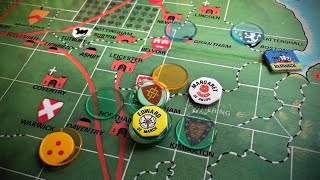
- Rich strategic depth
- Engaging negotiation aspect
- Dynamic player interaction through alliances and parliament
- Historical theme well-integrated
- Complex rules that can be hard to grasp initially
- The rule about town control not being tied to a specific noble can be confusing
- The Wars of the Roses
- Medieval England
Mechanics (from transcript analysis)
- Alliance — Players can form alliances where their nobles can stack and move together.
- Area Control — Players control regions and towns on the map, with control of towns being a significant factor.
- Combat — Battles are resolved using odds tables and card draws, with potential for noble casualties.
- Coronation — A key mechanic where a player can claim the throne under specific conditions.
- Deck building (implied) — Crown cards are drawn and can be used to influence battles or gain advantages.
- Hand Management — Players manage cards like Crown cards and Writ cards.
- Movement — Nobles and forces move across the map, with movement rules influenced by terrain and ships.
- Negotiation — Players are encouraged to make deals and alliances.
- Parliament — A mechanism for distributing offices and titles, and exchanging cards among players.
- Set Collection (implied) — Collecting bishops or other requirements for coronations.
- siege — The game includes rules for conducting sieges of towns and castles.
Video topics + discussion points
Quotes (from this video)
- so there's swings and roundabouts as is always the case in King maker
- all these things are tradables that you can use as leverage to make other players do what you want and and work together
- The Spoils of War are good
- you can't have a parliament where they're the only player seated they need Nobles from another faction and this is where they use their ripped cards
- so we could potentially have some orange Nobles stacked with some blue Nobles as an alliance
References (from this video)
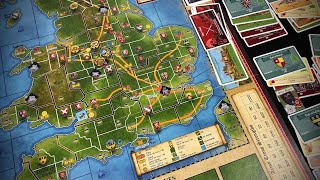
- The Chancellor cards are much better in this reimagining of Kingmaker, being simple and straightforward.
- The game is still pretty good and provides the necessary text information, making it easy to figure out swaps from the pictures.
- There are a few little printing errors and things aren't quite set up as they should be in some of the diagrams.
- Some of the imagery might be a little outdated, with square royal pieces that don't look quite like they do now, suggesting it was from an older iteration.
Mechanics (from transcript analysis)
- Combat — Combat occurs during the combat phase. In the first round, attacking other factions' Nobles is not allowed, giving players a chance to reposition without fear of being attacked. Stacking Nobles combines their forces for attacking and defending.
- Control Markers — Control markers are placed on the map to show which fortifications block roads and which ports are controlled. These markers help players track control of roads and ports, which impacts travel and movement.
- Event deck — The event deck ticks through towards being able to take a Prestige victory. Event cards can reshape things on the board, such as storms at sea, requiring ships to head to the nearest port, or peasant revolts that call Nobles to different places and offices. Plagues attack certain towns and cities, and remembering which plague cards have come out is important for knowing which towns are safe to use.
- Home Castles — Nobles have one home castle, but some, like Cromwell, have two. This affects where Nobles begin on the map and influences setup decisions for allocating crown cards.
- Movement — There are three types of movement: Regional, Road, and Sea. Each move can only be one of these types. Regional movement allows movement within an area or to adjacent areas in the same region, with restrictions on entering neutral or enemy fortifications. Road movement allows travel along roads, blocked by enemy fortifications, unless permission is granted. Sea movement allows ships to move up to five spaces, and is never blocked.
- Parliament and Coronation Phases — Parliament and Coronation phases have specific conditions attached and do not happen every turn. Parliament involves assigning cards from the Chancery, and Coronation involves crowning a royal piece.
- siege — Besieged locations always block movement through roads. To initiate a siege, players must have enough troops to attack a location.
- Stacking Nobles — Nobles can stack together, combining their troops to form a larger army. This does not change movement rules but affects their combined strength in defense and attack.
- Start Player — The start player is determined by whoever holds the most senior Archbishop or Bishop card, following a specific order of rank.
- Titles and Offices — Titles and offices are assigned to Nobles, and some of these grant control of cities or towns, providing extra cards or troops. Not all controlled towns are pinpointed on the mini-map, and some title cards are cosmetic.
Video topics + discussion points
Quotes (from this video)
- if you control a royal piece then you can eliminate them voluntarily from the game
- so this is how you get down to having a single crowned King with no heirs you eliminate all the other roll pieces by taking control in them and yeah eliminate them
- you can't combine them all right so you can't move a bit by Road a bit by sea a bit by land
- if you control rows important points in roads you can actually get around the whole of this map pretty quickly
- ship movement at Sea is never blocked
- you can get to those that's they're just one region away in fact
- little pieces don't fight back enemy Nobles do
References (from this video)

- Very long playtime
Mechanics (from transcript analysis)
Video topics + discussion points
Quotes (from this video)
- I remember playing the the original one and I remember standing at the table playing with Don and JB no Jamie wasn't there it was uh Chris and a couple other guys and I remember the cover of the game but I do not remember playing the game you know it's like it left no impression on me whatsoever
- I mean it hit the table a couple times for me and then like then it did hit the table forever so it was one of those things where you know just give it up you know let somebody else you know
- but but highrise was one of those games that everybody said no it's just too expensive to publish now I have no idea what happened with his high-rise campaign or or how he did it but when he only raised like 52 grand for it and then like and then he did his high-rise Ultra plastic Edition and he raised like a little over 100 Grand like for the life of me I I think like basically he didn't my me personally with with covet and everything else it was like one of those things where I think it was just way too expensive I mean you can't make a big old plastic fancy thing for 100 grand
- It's like it's like the the the the the the best answer in most situations if you are stopped by a police officer um and asked hey uh where are you going your best answer is I don't answer questions that is just yeah and just yeah yeah and that's I mean and yeah they're they're gonna be annoyed with you and they're gonna but you know you're just better off not saying anything and and just go the fifth
- I think it's a good thing for the hobby I think it really is I think it's just gonna some of those people just uh suck it suck it uh go go work at UH Burger Time and and try to uh the same pre-insured me okay go to the work houses
- I just don't understand it neither do I if you if you can't find a game for fifty dollars that's available right now and you will go back some 300 no no backer no backer history no prior history game I just don't get it why would you do that
- I don't think it's a perfect solution would you want to get bigger anymore I don't think so I mean I really like it the way it is I feel like it's it's unwieldy
- I think it's a lot of potential here too people really seem to enjoy I don't think the coffee ones are that funny if I mean me personally
- Yeah the problem is those those rooms go into the block or don't go back into the block price so they go in for stupid price so you don't get a good deal
- I mean it's just it's crazy hard like what yeah you know we we ship out we don't really let stuff sit in orders for more than a day maybe a day at most and it still like takes a couple days takes two three days three or four days yeah
- it is rules dense but it is nowhere near as rules and sense as uh as as magic Rome was
- I'm going to hate doing the video I'm going to absolutely hate doing the video because it is going to be it is going to be uh uh it's going to be annoying to try to get all the rules correct
- magic realm was one of his all-time favorite games when he was a kid
- bo Jackson bo knows baby
- I just don't understand how you make money on honestly selling games it's really tough
- people don't want to buy games that exist already they want to buy games that don't exist for some reason I don't get it
- I mean it is like it is like there are pages and pages and pages of games that are just like who is this who is publishing this what is this you know
- the flea market spoken Lobster steak
- it's like the the ideal game library was a database of mine oh sorry a database of more than 700 short board game reviews in French and broken English
References (from this video)

- second edition is a great game
- host likes the new edition
Mechanics (from transcript analysis)
Video topics + discussion points
Quotes (from this video)
- Go look up Europa. You're talking almost $400, $500 a game.
- my first edition Blood Bowl is rare.
- My Warhammer is worth a ton.
- First edition of Space Hulk is worth a lot.
- It's It's literally tasteless [ __ ]
- Tastes like the color white. If white paste had a flavor, like white diarrhea [ __ ]
- I will cut you out of my life without even thinking without even thinking if that's what you want to do
- You either figure it out and see that these people aren't here for you. You're just entertainment for them. Or I'll just take you from this world.
- You get it out of your system or I'm not gonna let you kill your mother, I'm gonna kill you.
- I think the most important thing is is that you never give up on your family, on your children, on your grandchildren, and you give everything that you got.
- All I want written on my damn gravestone is I wish I was up there reading this.
- If in all these years I helped somebody, you want to know something? That's worth more than all the subscriptions, all the views, and all the [ __ ] YouTube YouTuber influencer [ __ ] that you can have.
References (from this video)
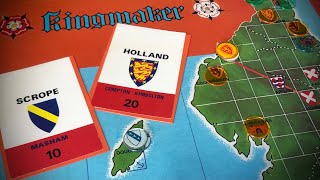
- The event deck changes the game dynamics and keeps it unpredictable.
- Crown cards add surprise and strategic depth.
- Movement rules allow for strategic positioning and maneuvering.
- The potential for plotting and intrigue is high.
- The game speeds up with new mechanics like zonal movement (in newer versions).
- Some rules regarding offices and titles are complex or were unclear in certain printings.
- The randomness of events can be a factor.
- Controlling power and succession in a kingdom
- Medieval England
Mechanics (from transcript analysis)
- Assigning Offices — Offices can only be assigned to titled Nobles, and a titled Noble can only hold one office.
- Battles — Occur when two enemy units are in the field in the same square at the end of the turn, or when a player chooses to attack a fortification or another unit.
- Coronation — The process of crowning a new king, which involves players positioning themselves and having the necessary religious titles (Bishops, Archbishops).
- Crown cards — Played face-down and kept in hand, these cards can be played at any time to add elements like Nobles, offices, titles, mercenaries, or ships.
- event cards — Dual-use cards that are played face-up for events and face-down (bottom left) for resolving battles. They introduce unpredictable elements like plagues, storms, and revolts.
- Movement — Nobles and ships can move up to five spaces. Movement can occur on land, sea, or along roads. Castles and towns controlled by other players can block road movement.
- Parliament — Can be called using Parliament/Writ cards, allowing players to summon other Nobles, potentially pulling them out of strong defensive positions.
- siege — Attacking a fortification requires a force equal to or greater than the Garrison plus any troops protected by the fortification. Sieges are generally successful unless delayed by specific event cards.
Video topics + discussion points
Quotes (from this video)
- pulling Nobles pulling ships from place to place involuntarily during the event phase is what keeps the game Dynamic and keeps the game unpredictable
- The event deck really changes up the game
- This is key all right be ready to pounce when these events happen because it may pull a noble into a vulnerable position where he can be attacked by an enemy
- Siege is always successful we've got enough troops to complete the siege
- Field battles are tough I must say
- no titled Noble can hold more than one office
References (from this video)
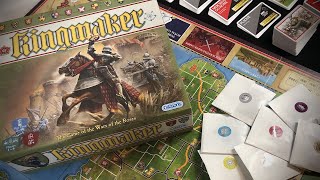
- Updated map with clearer regions and grid references.
- New solo variant available.
- Consolidated rules and components from previous editions.
- Improved usability and playability.
- New victory condition (Prestige Victory).
- Distinct mechanics for Kingmaker II vs. Classic vs. Extended.
- Colored tokens per Noble for clarity.
- Double-sided Noble tokens to indicate fortified vs. field locations.
- Pre-built factions available for quicker setup.
- Solo variant is not covered in this video.
- Some players may not find the included paper baggies and stickers satisfactory.
- Kingmaker II plays 2-5 players, not 1-6.
- Some components (battle board, specific tokens) are for extended classic only.
- Wars of the Roses
- Medieval England
- Kingmaker (1974)
- Game of Thrones
Mechanics (from transcript analysis)
- Area Control — Players aim to control locations on the map, which are represented by Nobles with units, and these locations block roads.
- Combat — Siege attacks are used to take control of fortified locations defended by garrisons.
- Deck Building — Players draw cards from the event deck each turn, and the composition of this deck, including the placement of the Prestige Victory tile, affects game pacing.
- Dice Rolling — Dice are mentioned as components used in the game.
- Hand Management — Players manage a faction of cards, including Nobles, Titles, Offices, Towns, Mercenaries, and Ships, to gain influence and troops.
- Negotiation — Players can form alliances and make private agreements.
- Set Collection — Players collect specific types of cards like Offices and Titles to assign to Nobles and gain benefits.
- Variable player powers — Factions are represented by unique sets of cards and Nobles, influencing their starting capabilities and strategies.
- Victory Points — Prestige points are tracked and contribute to one of the victory conditions.
Video topics + discussion points
Quotes (from this video)
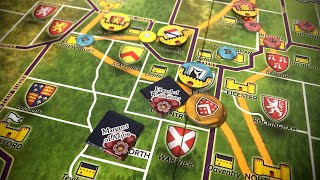
- This is King Maker the game of the wars for the Roses designed by Andrew Mcneel and published by Gibsons.
- Gibsons have brought this game up to date with this 2023 release redeveloped by Alan Paul.
- This is King maker II for the new game the reimagined king maker and King maker classic.
- Usability and playability have driven a lot of the changes cosmetic changes that we see in this new release of King maker.
- In King maker second adds a second Victory condition this was what classic was all about this but now we have a new Victory.
- The game is on a bit of a timer there is a Prestige Victory tile and you're going to insert this into the event deck.
- We're playing a faction in the time of the War of the Roses.
- In the old game you kind of just had to know and it wasn't always easy I mean if we're here in Cal you have to say I'm in the fortification or I'm in the field outside the fortif ification but now there's no ambiguity you're in the fortification you're outside in the field you just flip the token to show whether you're in or outside the fortification.
- There's no writ cards in this event deck these are for King maker classic only.
References (from this video)
- Rich negotiation depth and dynamic politics between factions
- Integrated siege, battle, and event systems that create tension and strategic choice
- Clear feedback on consequences of actions (executed/noble casualties, offices, prestige)
- Alliances offer cooperative pathways and shared victory conditions
- Complex rules can be hard to learn for new players
- Luck elements from event and plague cards can swing outcomes
- Game length can be lengthy, especially with multiple players
- Noble power politics, conquest, and diplomacy
- Medieval England during a dynastic power struggle
- Historical intrigue with negotiation and shifting control
Mechanics (from transcript analysis)
- Battle in the open — Nobles fight in the field against each other with troops; outcomes depend on troop strength and card effects.
- Besieged locations — Locations under siege are locked for movement and card augmentation while the siege resolves; special tokens track siege status.
- Crown cards — Cards that can be added to Nobles to boost troop counts during attacks or affect resolution and outcomes; limited by location and siege state.
- Noble capture and transfer — Captured Nobles can be ransom’d or executed; offices and titles become vacant and can be reassigned later.
- Parliament and crowning — Post-combat phase where offices are distributed and crowns may be awarded to the most senior Royal Piece; impacts prestige.
- Rally to the cause — Card-based compensation mechanic: for every two cards discarded via combat losses, players draw crowns; provides a reduction-and-draw mechanism to recover from losses.
- Siege resolution — Attackers must match or exceed the defenders' troop count in fortified towns; resolution involves adding Crown cards and potential luck via event cards.
Video topics + discussion points
Quotes (from this video)
- you must have as many troops in your attacking Army as the Defenders as many or more so if I had less than 200 troops here I couldn't attack I just couldn't do it
- this location has an inherent Garrison of 200
- Wheeling and dealing to be had during those times
- remember this is a bit of a negotiation game
- for every two cards discarded this way we draw one card from the crown deck
- it's part of the game it's a big part of the game