/pic7857343.png)
Game Info
Year
2023
Players
2-4
Age
8+
Collection
Ratings
Mechanic profile
Not enough video data yet
Vibe profile
Not enough video data yet
Description
In Knarr, you are the leader of a band of Vikings that you send to new destinations. Manage the recruitment of your crew, and choose the best territories to explore. Depending on the destinations reached (for trading or influence) and the Vikings who accompany you, you can increase your reputation to gain even more wealth. Each turn, you:
Place a new member in your Viking crew, activate the effects of all of them with the same icon, and get another one from those available under the matching color on the central board, or
Explore new destinations, with the opportunity to trade with those places and get more gains or reputation.
Featured Videos
Review
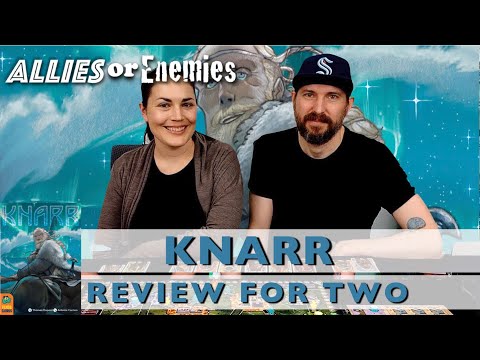
Knarr - Board Game Review
Playthrough

Knarr | Solo Playthrough
Ask a Rules Question
All mentions
Browse transcript mentions, sentiments, pros/cons, mechanics, topics, quotes, and references.
Total mentions: 10
This page: 10
Sentiment:
pos 7 ·
mix 0 ·
neu 0 ·
neg 1
Showing 1–10 of 10
Video n7_esmKbsLM
Allies or Enemies Review at 0:00 sentiment: positive
video_pk 88232 · mention_pk 323871
Click to watch at 0:00 · YouTube ↗
Overall sentiment (raw)
positive
Pros
- Fast, streamlined card-game feel with deep and varied strategies
- Color-blind friendly iconography and color-coding
- High replayability due to variable land cards and Viking cards
- Strong two-player experience with quick playtime
- High-quality art and thematic cohesion
Cons
- Initial ship-color tokens can be hard to distinguish
- Limited direct interaction beyond the race for cards
- Artifact cards can be a learning curve for first-timers
Thematic elements
- set collection, engine-building, rapid race to 40 points
- Viking age, exploration and settlement
- explanatory and evaluative
Comparison games
- Sea Salt & Paper
- Ela
Mechanics (from transcript analysis)
- artifact cards — Optional artifact cards add variability; typically one card can be included to modify the setup.
- Card Crafting — Optional artifact cards add variability; typically one card can be included to modify the setup.
- Card placement into color columns — Play a card to add it to a color column; gain benefits from all cards in that column and then draw a new card from the market based on the color of the card just played.
- Double-sided ships — Ships are double-sided, adding variation to strategy depending on which side is used.
- Engine Building — Build an engine by stacking Vikings to access roads and bonuses; dismantle to spend Vikings for land cards and rewards.
- Engine-building with Vikings and lands — Build an engine by stacking Vikings to access roads and bonuses; dismantle to spend Vikings for land cards and rewards.
- Land cards and engines — Spend previously played cards to gain land cards; place above your ship and gain immediate benefits and points.
- Recruits as wild cards — Recruits can be used as wild cards to help pay for lands.
- Reputation and scoring flow — Reputation contributes to points at the start of each turn; victory points accumulate toward the end condition (40 points).
Video topics + discussion points
No key topics recorded for this video.
Quotes (from this video)
- this game's very color blindness friendly
- it's a quick card game
- incredibly replayable
- the race element is plenty of interaction
- the iconography is incredibly clear
- it's just such a simple game to explain
References (from this video)
No references stored for this video.
Video v0SsPk875Ns
Tabletop Minions Discussion at 1:48:48
video_pk 87585 · mention_pk 229199
Click to watch at 1:48:48 · YouTube ↗
Pros
none
Cons
- No physical printed version is available.
- Saddle stitching machines are difficult to maintain and prone to breakdowns, leading the company to stop offering it.
Thematic elements
none
Comparison games
none
Mechanics (from transcript analysis)
- Equipment add-ons — Includes new equipment and guns for 'Space Station Zero'.
- Faction/Philosophy add-ons — Includes add-ons like a new philosophy (faction) for 'Rain and Hell'.
- Micro-game — Includes a micro-game within its content.
- PDF format — The game is primarily available as a PDF, with options for screen-readable format or spreads for self-printing.
- Perfect Bound binding — Perfect bound is the standard method where the book is squared off and glued, with no staples. This is how the printing company normally works.
- Saddle Stitch binding — Saddle Stitch binding is used for smaller booklets like this 28-page notebook, where pages are folded and stapled, similar to a comic book.
- Scenario add-ons — Includes two new scenarios for 'Rain and Hell'.
Video topics + discussion points
No key topics recorded for this video.
Quotes (from this video)
- Friends don't let friends Buy HP printers
- Wizards of the Coast would really rather that you just buy Magic by the case directly from them it seems
- They've been making a lot of really bad decisions in my opinion and if they go to business I will laugh and point
- I just don't understand why they don't want to do that
- I mean the machines that do the saddle stitching are a real pain to maintain they have a tendency to break down a lot
- The print books like the vast majority of people are buying the printed versions as opposed to just PDF only
- I don't know what the fourth dimension is
- I don't really pay attention to that stuff too much
- Most new Morheim players I talk to seem happy to download the PDFs for free from broheim these days and when I mention paper Printing and hard copies they think I'm crazy
- One odd thing about cyber punk red starter doesn't come with with gonks which I feel is like an essential mechanic
- Monac is a great game and the minis for the main monsters are beautiful and fun as heck to pain
- I attended a one-day charity Horus heresy event yesterday called Pride of the Legion a good day for a great cause but now I'm horse and this can be and need at least a day to recover
- If you want some great plastic modern soldiers look at the April issue of War Games Illustrated with the free sprew of warlord games special ops Troopers
- what's your favorite Warhammer mini does that mean which one that I own the most of because it's probably then going to be I don't know what they call them anymore they used to call them nurgle chaos Lord but nowadays he's that guy
- I think I have like six or seven of them it's great for kid bashing
- Does snarl not have a physical book to buy it doesn't
- the machines that do the saddle stitching are a real pain to maintain they have a tendency to break down a lot so some years ago they got rid of Saddle Stitch
- The newest Kill Team box set, 'Germination', is discussed.
- It's been a minute since I've liked both sets of models in a kill Team box.
- Kill team germination is coming this week can't wait
References (from this video)
No references stored for this video.
Video IJBDW-UBdUw
Tabletop Minions Discussion at 1:25:37 sentiment: positive
video_pk 87524 · mention_pk 228926
Click to watch at 1:25:37 · YouTube ↗
Overall sentiment (raw)
positive
Pros
- PDF only format that can be printed as a small booklet
Cons
none
Thematic elements
Comparison games
none
Mechanics (from transcript analysis)
Mechanics unknown.
Video topics + discussion points
No key topics recorded for this video.
Quotes (from this video)
- The people who bought it really enjoyed it were like oh this is very cool and I like this and I'm very proud of the book as well because I think it's a cool rule set and I also think that the layout on it went very well took a long time but I really enjoyed the way that it came out
- Majestic 13 did not sell all that well
- Death Wizards has been out for a month and a couple of days and it has sold more copies than Majestic 13 has which came out 13 months ago
- it's an indie game made by enemy spotted studios
- so the games are shorter
- it is a very highly tactical game
- players must rely on their widths precise positioning and equipment to win forget about special rules rules in Army building in blackout it's all about raw tactics
- we're kind of out cuz you talked about our our our game in your video recently and we are out of product now
- kill team 3.0 better be good the whole obstruction line of sight has God awful
- I would like them to change kill team drastically and make a third version and see how that works out I would kind of like them to go back to the old ways but I know I'm the only one who thinks that
- Kingdom Death is a great example of a boutique game versus any that I've named so far
- quar such a fantastic game love their minis
- Fallout is the wild west of ips for me something I really can't bring myself to care about
- it's the bombs dropped in 2077 which means that we like got to where we are now here in 2024 and then decided you know what's cool the 1950s let's go back to that and make thing and I'm like why did this happen
- it's alternate history kind of Fallout is yes it's the future you know the bombs dropped in 2077 but the reason we got to that point was because the transistor was never invented so it that's that that's why things are different is because it's alternate history which never had clicked with me the entire time I've been playing those damn games
- I am definitely interested in Fallout tactics
- it was it was too board gamey for me frankly like that was the problem
- I'm liking death Wizards a lot I'm currently working on building up some minis so I can play it nice
References (from this video)
No references stored for this video.
Video ZmYY4eORME0
Before You Play Discussion at 29:47 sentiment: positive
video_pk 87507 · mention_pk 228819
Click to watch at 29:47 · YouTube ↗
Overall sentiment (raw)
positive
Pros
- Plays very quickly.
- Addictive gameplay loop.
- Always getting something on your turn.
- Positive feedback mechanism.
- Enjoyed more playing the physical copy.
- Competitive element is stronger in physical play.
- Good for conventions as it's easy to teach and plays fast.
Cons
- Ends faster than desired, leaving players wanting more.
- Online play (BGA) is less enjoyable due to automation and lack of player interaction.
- Longevity may be limited after a few plays.
Thematic elements
- Vikings leveling up reputation, gathering crew, and going on expeditions.
- Viking era.
- Crew members have distinct colors and associated rewards.
Comparison games
- Splendor
Mechanics (from transcript analysis)
- Race game — The objective is to be the first to reach a certain point total (40 points).
- Resource Management — Gaining and using resources to activate abilities or trade.
- Set Collection — Collecting crew members of specific colors and completing expedition requirements.
- Tableau Building — Players build a tableau of crew members, with each column only containing crew of the same color.
Video topics + discussion points
No key topics recorded for this video.
Quotes (from this video)
- if our videos seem to be uh very close together within the next couple of weeks just know that we had one of our hard drives fail in the past week and some of the videos that we wanted to release weren't able to be released
- unfortunately uh game Brewer which is a publisher in Belgium uh is shutting down
- so if you'd like to help celebrate with us then uh do something fun I guess with your with your cat or a dog there you go if you have one at home or just treat yourself
- it's now private it is now a private video we don't do unboxings
- we're just basically showing you uh images of what the first setup looks like so it doesn't really spoil anything
References (from this video)
No references stored for this video.
Video UobDmnFkzOw
Chairman of the Board Top List at 0:30 sentiment: negative
video_pk 87451 · mention_pk 228576
Click to watch at 0:30 · YouTube ↗
Overall sentiment (raw)
negative
Pros
none
Cons
- Tension is eradicated
- Token management not tense
- Subpar compared to No Thanks
Thematic elements
Comparison games
- No Thanks
Mechanics (from transcript analysis)
- Card Drafting — Take a card from the center or place one of your tokens on it in order to pass it on to the next player.
- Card Overlay — Higher value cards can be covered up with a lower value card and therefore nullify the scoring of these two beneath it.
- pyramid building — Each of the cards kind of represents a piece of a pyramid where you are essentially trying to build a pyramid of cards and only the pinnacles of those pyramids will score you points.
- Set Collection — Trying to get as few points as possible.
Video topics + discussion points
No key topics recorded for this video.
Quotes (from this video)
- Unfortunately, the tension is completely eradicated from the game when comparing it to a game like no thanks.
- I love it visually I think the artwork is really nice it has this kind of like uh Golden Age Disney fil vibe to it with these nice um gilded cards.
- Ultimately it boiled down to that card crafting system being a bit of a gimmick I think rather than an actual unique mechanism.
- This feels like this was the intended game and Cascadera was built after it rather than the other way around.
- For me if you played cascadero and not cascadeo I'd definitely recommend looking at cascadeo.
References (from this video)
No references stored for this video.
Video EVlt0BQd9M8
Tabletop Minions Discussion at 19:29 sentiment: positive
video_pk 86862 · mention_pk 226270
Click to watch at 19:29 · YouTube ↗
Overall sentiment (raw)
positive
Pros
- Simplified stats for goblins make it a more accessible party game.
- Available as a PDF.
- Features additional content like a micro-game and add-ons.
- Included a section called 'Rain in Hell: The Broken Door' with three new scenarios.
Cons
- Printing can be difficult and appear off-kilter due to the number of pages and binding.
Thematic elements
- Goblins
Comparison games
- Rain in Hell
Mechanics (from transcript analysis)
- PDF Availability — The game is available as a PDF, allowing players to print it themselves.
- Simplified Stats — Goblin models have similar stats regardless of their armament, making the game easier to learn and play.
Video topics + discussion points
No key topics recorded for this video.
Quotes (from this video)
- The idea behind 3D printing is that I can go onto my minifactory and find a really weird specific interesting to me type of model that probably wouldn't sell well out in the real world if it was made in plastic
- We're not constantly line goes up up because not only do we have no shareholders we have to make happy we also don't have to do this this isn't our day job
- it's the more Choice um I don't really think it's actually about saving money
- the point of the game is to try and crawl to the highest spot so there's a lot of rules for pushing people off of things and falling off of things and stuff like that and climbing and things like that
- but they were a lot of fun to paint and they were very interesting and whatnot
References (from this video)
No references stored for this video.
Video 8SA6Lup7ktY
Board Gaymes James Top 10 List at 10:07 sentiment: positive
video_pk 84726 · mention_pk 215722
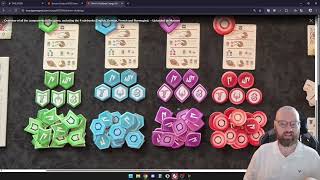
Click to watch at 10:07 · YouTube ↗
Overall sentiment (raw)
positive
Pros
- Distinct 3D components and bold visuals
- Dynamic movement with stacking mechanics
Cons
none
Thematic elements
- Demon tokens and aura-based scoring
- Towering eggs and demon-token hunt on a moving board
Comparison games
none
Mechanics (from transcript analysis)
- 3D eggs stacking — Egg pieces stack and influence gameplay.
- Polyomino — Catch tokens using polyomino shapes.
- Polyomino-based demon capture — Catch tokens using polyomino shapes.
- Tetromino-like tile movement — Tiles move in tetromino-inspired patterns to affect the board.
Video topics + discussion points
No key topics recorded for this video.
Quotes (from this video)
- This is my sensory candy for spiel.
- it's basically an area majority game, it sounds like, based off of this, just really, really pretty board.
- This is a re-implementation of Qin.
- I love a good tile layer and the tile layer, you're building out this city and these canals, and you can sail your boats around it.
- Turns, catch three demon tokens using a polyomino.
References (from this video)
No references stored for this video.
Video Qs9zPU7CzBA
Jamie, Tabletoptiktok Review at 0:08 sentiment: positive
video_pk 61517 · mention_pk 154166
Click to watch at 0:08 · YouTube ↗
Overall sentiment (raw)
positive
Pros
- Outstanding table presence and high production quality; components look and feel premium
- Thinky, puzzle-driven design that rewards careful planning and sequencing
- Clear on-table organization that aids setup and cleanup, reducing friction during play
- Supportive community through a fan-made solo variant, indicating good accessibility and replayability
- Three-round structure provides a satisfying arc and a clear path to scoring
Cons
- Rulebook clarity could be improved; a per-player quick reference or aid for purchasing pieces would help new players
- Center board and associated components require a relatively large play area, which can be a constraint for smaller tables
- The game trends toward a multiplayer solitaire experience, which may dissuade players seeking heavier direct interaction
- Some mappings (color-to-component purchases) can be a bit fiddly and may benefit from an in-game quick reference to avoid confusion
Thematic elements
- abstract mosaic/tiles and modular assembly with an emphasis on geometry, color matching, and layered construction. The core thematic concept centers on constructing a decorative floor and revealing patterns through deliberate placement and sequencing.
- Inara is presented in the video as a spatial, tile-based floor-building puzzle set within a cafe-like aesthetic. The gameplay centers on constructing a layered floor by collecting and assembling distinct components—frames, centers, cores, and tables—on a shared play area. The setting is conveyed more as an elegant spatial puzzle than a narrative shooter, emphasizing the tactility and visual grandeur of the components as the player progressively builds toward a scoring objective.
- non-narrative, puzzle-focused progression where storytelling is minimized in favor of exploration of spatial strategy, sequencing, and tactile satisfaction of building a larger composite.
Comparison games
none
Mechanics (from transcript analysis)
- color-set collection — Players play cards of the same color to claim different structural elements (frame, center, core, table). The number of matches and the order in which they are played determines which component is claimed and what scoring bonuses are earned.
- Hand Management — At the start of rounds, players receive a hand of cards (colors corresponding to frame components). Players must decide how to allocate colors to different building objectives while managing cards for future turns.
- Hand management and drafting — At the start of rounds, players receive a hand of cards (colors corresponding to frame components). Players must decide how to allocate colors to different building objectives while managing cards for future turns.
- limited interaction / multiplayer solitaire — Although players share the center board, the core experience is puzzle-driven with limited direct interaction, focusing on personal optimization and sequencing rather than direct conflict.
- multi-stage component construction — Components are acquired in ascending hierarchical stages (frame → center → core → table). Completing each stage unlocks new scoring opportunities and advances you toward end-game points.
- Player Board | Main Board — The central board and associated components occupy significant table space. Players must coordinate table layout and cleanup to optimize playability and minimize clutter.
- round-based progression with variable pacing — The game unfolds over three rounds. After each round, players perform minor end-of-round scoring, and at the end of round three, the final scoring occurs to determine the winner.
- Set Collection — Players play cards of the same color to claim different structural elements (frame, center, core, table). The number of matches and the order in which they are played determines which component is claimed and what scoring bonuses are earned.
- table-space management — The central board and associated components occupy significant table space. Players must coordinate table layout and cleanup to optimize playability and minimize clutter.
Video topics + discussion points
No key topics recorded for this video.
Quotes (from this video)
- this is a really fun thinky puzzly game and its table presence is so beautiful
- I like this game a lot because it's that puzzly thinky thing that I like it has beautiful table presents
- so this game looks really cool and obviously the more complete you build each one the more points you're going to get at the end of the game
- this game hits all of the sweet spots amazing production quality great thinky game
- it's a multiplayer solitaire in a lot of ways you're not having a lot of player interaction for me that's not a negative thing
- The back of the rule book shows you how to buy the pieces with the types of cards and I wish this was a player Aid available for every player that is the only drawback I can find to this game
- I absolutely endore inaria and would love to know if you have played it what do you think of it give me a like and a follow and I'll keep bringing you more board games game content thanks bye
References (from this video)
No references stored for this video.
Video Sfu-5hiEazU
Crimsonboardgames Playthrough at 1:10
video_pk 61652 · mention_pk 154289
Click to watch at 1:10 · YouTube ↗
Pros
none
Cons
none
Thematic elements
- Array
- Array
- recruitment, exploration, trade, and reputation-building within a small, modular Viking setup
- Array
- Viking-era rebels exploring, recruiting a Viking tribe, and trading across locations on a shared board
- Array
- Array
- Array
- positive
Comparison games
none
Mechanics (from transcript analysis)
Mechanics unknown.
Video topics + discussion points
No key topics recorded for this video.
Quotes (from this video)
- it's a wonderful game designed by Thomas Dupont
- it's a beautiful game and it plays quite fast
- it's a game that for me will probably be a staple for like holidays, vacations to take with me because it's such a small box game
- it's a small box game
- the setup is very easy
- Knar it is a lovely game
- it will definitely be a go-to for me or just to take with me
- that is how you play knar it is a lovely game
- absolutely lovely game
References (from this video)
No references stored for this video.
Video JkwJVRxri_Q
Our Family Plays Games Discussion at 13:34 sentiment: positive
video_pk 5830 · mention_pk 93830
Click to watch at 13:34 · YouTube ↗
Overall sentiment (raw)
positive
Pros
none
Cons
none
Thematic elements
Comparison games
none
Mechanics (from transcript analysis)
Mechanics unknown.
Video topics + discussion points
No key topics recorded for this video.
Quotes (from this video)
- the games are Made in India yes It's Made in India
- this is Halloween for sure
- I cannot wait till this one comes really enjoyed it
- the house that you put up is huge
References (from this video)
No references stored for this video.
Transcript Navigation
Showing 1–10 of 10