











L.L.A.M.A. Deep Dive
What the Community Thinks About L.L.A.M.A.
L.L.A.M.A. has earned recognition as a remarkably elegant card game that demonstrates Reiner Knizia's gift for distilling complex decision-making into simple rules. The game's recent reprint as Dump the Skunk marks a turning point in its reach. Board Game Animal's Justin notes that the new theme "makes the flow of the game a little bit better and a little bit easier to teach for some reason that I can't particularly put my finger on." More significantly, the reprint has landed L.L.A.M.A. in mainstream retail spaces like Target and Barnes & Noble, a rarity for hobby games of this caliber. Justin emphasizes the accessibility achievement: "A game by Knizia is now everywhere and getting a whole new audience to people who won't find it too intimidating and maybe it could be the first of a new journey for them." The broader hobby community views L.L.A.M.A. as a step above mass-market alternatives like Uno, offering meaningful decision-making without the intimidation factor that keeps new players away from deeper games.
Core Mechanics That Define L.L.A.M.A.
Play Equal or One Higher
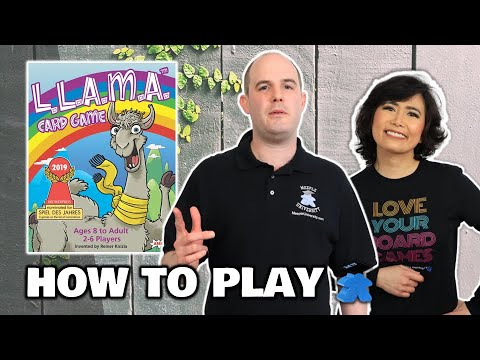
The foundation of L.L.A.M.A. is its climbing mechanic: on each turn, a player must play a card that either matches the value of the top discard card or is exactly one higher. What makes this elegant is the sequence of values. Cards run from 1 through 6, plus Llama cards. The sequence wraps: Llama beats 6, while 1 beats Llama, creating a circular ladder. Meeple University's Terence and Sarah explain the core action clearly: "Take a card from your hand which either matches the current card on the discard pile or is one higher than the card on the discard pile and play it on top." This single rule generates all the game's tension. Players face constant decisions about when they have the card they need, and more importantly, when they do not and must instead draw or quit.
The Quit or Draw Decision
Every turn presents a genuine dilemma. If you can't play a legal card, you have two options: draw from the deck and hope for a playable card, or quit and lock in your current hand's penalty. Meeple University identifies this as the heart of the game: "Knowing when to keep going and when to quit is a key part of winning L.L.A.M.A." The push-your-luck tension builds as the round progresses. Early in a round, quitting with six cards is painful. But as the deck depletes and your hand shrinks, the calculus shifts. Do you risk drawing when only two cards remain? One draw could empty your hand and reset your score counter, or it could saddle you with a high-value card and force you out. This binary choice, repeated dozens of times across a game, creates memorable moments and genuine player agency despite the game's lightness.
The L.L.A.M.A. Experience
Push-Your-Luck Tension in a Compact Format
L.L.A.M.A. delivers the pulse-quickening anxiety of push-your-luck mechanics in a 20-minute package. Each decision to draw or quit carries real weight: it determines not just your immediate situation but your final score. The game avoids analysis paralysis because each turn is quick; the tension comes from the cumulative effect of many small choices. The emotional arc of a round mirrors a tighter version of Blackjack or Dice Throne: escalating stakes, visible opponents making similar agonizing choices, and a sudden end when someone either empties their hand or everyone bails out. Players experience genuine excitement at narrow escapes and real frustration at near-misses, all within a timeframe suitable for a family gathering or casual game night.
Accessible Social Gameplay for Families
The game operates as a social equalizer. The core loop is simple enough that eight-year-olds grasp it within minutes, yet the decision tree remains interesting enough to engage experienced gamers. Board Game Animal notes the reskin's role in accessibility: the original Llama design and its reprint as Dump the Skunk both serve the same function, but the newer theme appears to lower the teaching barrier. The game supports 2 to 6 players without significant rules bloat, and playtime stays around 20 minutes whether you play with three or six. This makes L.L.A.M.A. a reliable social choice: fast enough to fit into an evening, light enough not to demand concentration at family gatherings, yet engaging enough to hold players' attention. The scoring system (where points are penalties and the player with the fewest points wins) adds a subtle strategic layer without overwhelming new players who are still learning the core quit-versus-draw decision.
What Makes L.L.A.M.A. Stand Out
Elegant Mechanical Simplicity from a Master Designer
Reiner Knizia's reputation rests on games that hide their cleverness. L.L.A.M.A. exemplifies this gift. The ruleset fits on a single page, yet the game delivers asymmetric hand states, genuine decision-making, and emergent variety from one core mechanic. Most games that attempt to be simple end up being trivial; L.L.A.M.A. achieves simplicity through ruthless editing. There is no deck manipulation, no hidden information (apart from the deck's remaining contents), no secondary scoring tracks. Every action (play, draw, quit) connects directly to the central tension. Board Game Animal positions L.L.A.M.A. as a "riff on Uno" that offers "more involved" gameplay: the comparison reveals the design philosophy. Where Uno relies on color and number matching with random special cards, L.L.A.M.A. forces players to think ahead about their hand's shape, the likely state of the deck, and opponent behavior. It is chess to Uno's checkers in scope, yet it maintains the accessibility that makes Uno ubiquitous.
Mass-Market Availability and Gateway Appeal
The presence of a Knizia game in mainstream retail stores signals a shift in how hobby games reach new players. Justin's observation that Dump the Skunk (the new printing) is "now everywhere" at Target and Barnes & Noble matters because it removes the gatekeeping of specialty shops. New players discover the game through mass-market channels rather than through hobby communities or recommendations from experienced hobbyists. This democratization of access serves hobbyists as well: having a widely available game that is both light and well-designed creates a shared reference point. L.L.A.M.A. becomes the game you hand to someone who has only played Uno or Phase 10, a natural next step that neither intimidates nor bores. The reprint's improved theme and presentation also lower the psychological barrier to teaching. Tim Chuon's description of the Gen Con experience (the game was popular and available) underscores its growing prominence in gaming culture. For new players, L.L.A.M.A. offers a tangible proof that hobby games can be both simple and worthwhile; for established players, it functions as a reliable social filler that doesn't require emotional labor to teach.
Potential Drawbacks
Limited Strategic Depth for Dedicated Hobbyists
L.L.A.M.A. is not a strategy game in the traditional sense. The core decision (quit or draw) is binary and often forced by the cards in hand and the state of the deck. Players seeking deeper decision trees, economies, or engine-building mechanics will find L.L.A.M.A. too light. The game's outcome is influenced significantly by draw luck; a player who draws high cards early faces constant difficulty, while lucky draws can make an aggressive strategy pay off dramatically. Experienced Euro-game players may find the luck element frustrating and the decision space too narrow. A 50-play veteran of L.L.A.M.A. is not discovering new strategies or experiencing significant depth variation; the game is designed as a repeated social experience rather than a puzzle to be solved. This is not a flaw in the game's design, but rather its intended scope. Recognizing L.L.A.M.A. as a filler or social game rather than a main event prevents disappointment.
Reprint of an Existing Design, Not a Novel System
Dump the Skunk is a rebranding of Reiner Knizia's Llama, published years earlier. While Justin praises the reskin for improving teachability, the underlying system is not new. The game is not a rediscovery of a lost gem so much as a re-release with better market positioning. For collectors or players seeking novelty, the game may feel familiar or derivative. The reskin, while elegant, does not introduce new mechanics or strategic layers; it simply makes the existing game more palatable to mainstream audiences. Some players may reasonably prefer deeper or more recent designs. Additionally, the existence of the older Llama printing means players who own a copy already have the complete game experience; the reprint offers no mechanical advantage or expansion, only better art and distribution. This is appropriate for a mass-market strategy, but it means L.L.A.M.A. occupies a narrow niche: a casual game that is not attempting to innovate or compete with heavier offerings.
If You Enjoy L.L.A.M.A.
L.L.A.M.A. has circulated under more than one name. Board Game Animal's Justin flags a 2025 mass-market reprint called Dump the Skunk as essentially the same Reiner Knizia design, repackaged for shelves at Target and Barnes & Noble. Justin frames the original as Knizia's own riff on Uno: a card-shedding, push-your-luck game built for exactly the audience that already knows how to play Uno and wants something with a touch more decision-making without losing the quick, social pace. For players drawn to L.L.A.M.A.'s accessible push-your-luck tension, the most natural next step is simply other light Knizia card games, since Knizia's name recurring across a store's card-game shelf is itself a reliable signal of a similar design sensibility: quick rules, real tension, and sessions that rarely overstay their welcome. The key is recognizing that L.L.A.M.A. works best as a bridge game: not a destination for serious players, but a warm-up, social filler, or gateway into hobby gaming for newcomers.
What Reviewers Are Saying
"The theme actually makes the flow of the game a little bit better and a little bit easier to teach for some reason that I can't particularly put my finger on."
— Board Game Animal
"A game by Knizia is now everywhere and getting a whole new audience to people who won't find it too intimidating and maybe it could be the first of a new journey for them."
— Board Game Animal
"Knowing when to keep going and when to quit is a key part of winning L.L.A.M.A."
— Meeple University