/pic2073938.jpg)








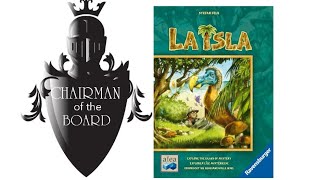

La Isla Deep Dive
What the Community Thinks About La Isla
La Isla holds a unique position in Stefan Feld's expansive catalog: a lighter design that does not sacrifice depth for accessibility. Getting Games praise how its simultaneous card system keeps everyone engaged and downtime low, while Chairman of the Board frame it as one of Feld's gentler games and a strong on-ramp to engine building. What initially looks like a middling area-control title transforms into something far more compelling in motion, a game that proves elegance and engagement can coexist in a compact playtime, published by Ravensburger and alea.
Core Mechanics That Define La Isla
Simultaneous Multi-Use Cards
Every turn pivots on a deceptively simple moment: you draw three cards, and each must be assigned to one of three functions. One half provides an ongoing power, one corner offers a colored cube resource, and another shows an animal you can advance. This forces constant negotiation between immediate needs and future payoff. Getting Games highlight how this streamlined approach eliminates the analysis paralysis that can plague Feld designs while keeping decisions genuinely interesting. Because all players reveal at once, nobody waits on anyone else agonizing over a choice.
Compound Scoring and Animal Progression
La Isla's endgame clock is communal: all players collectively advance the value of five animal species on shared tracks. These tracks begin at little value and climb as players boost them throughout the game, and once their combined total reaches a threshold the game ends. You then score the animals you captured by surrounding their habitats, plus bonuses for complete sets and the final value of each animal. This creates a push-pull tension, since boosting your most-collected animal risks inflating its value for opponents who also hold those pieces.
The La Isla Experience
Breezy Pacing With Crunchy Decisions
Despite its light ruleset, La Isla delivers satisfying decisions without dragging, completing in roughly forty-five to fifty minutes regardless of player count. Getting Games stress that simultaneous actions keep everyone thinking every turn, so the game feels like something that should run much longer compressed into a tight package. It fits at the start or end of a game night without demanding heavy mental bandwidth, yet still rewards tactical and strategic play.
Limited Engine Building With Forced Iteration
Your player board holds only a few permanent powers at once, and you add a new one every turn, covering and losing an older one when you run out of room. Chairman of the Board love this constraint, since just as your engine begins to synergize you must sacrifice one of its parts. This prevents the game from becoming a solved optimization puzzle and instead keeps players adapting, wrestling each round with which good thing they are willing to give up to make room for the next.
What Makes La Isla Stand Out
Simultaneous Action and Minimal Downtime
Nearly everything in La Isla happens at the same time, with only the explorer-placement step following turn order. Getting Games call out how satisfying it is to make interesting decisions without worrying about others being bored on your turn. This design choice solves one of Feld's recurring problems, delivering the crunchy appeal of multi-use cards and tactical placement without the social tax of lengthy turns.
Elegant Interaction Through Shared Scoring
Instead of direct territorial fighting, La Isla uses indirect interaction through its communal animal tracks. Advancing an animal bumps its value for everyone, so your decisions help and hinder in equal measure without feeling like kingmaking. The game also rewards overlapping placements, with cards that grant bonuses when you place explorers where opponents already have pieces, encouraging tactical crowding rather than separation.
Potential Drawbacks
Randomness Can Create Runaway Leaders
The game layers randomness: the board assembly, the scattering of animal tokens, each player's starting specialization, and the card draws are all random. Getting Games note that clustering of favorable animals can reward whoever started with the matching specialization, and a run of poorly synergized hands can leave you taking weaker turns while an opponent's draws align perfectly. The short playtime softens this, but the luck factor caps the game's depth.
Component Clarity and Teaching Materials
The game ships with minimal player aids, so teaching involves passing a single reference sheet around to decode the many small icons. Getting Games also found certain cube colors hard to distinguish, both on the components and between the cards and the board. This resolves after half a game, but it adds friction to that critical first play, and the thin boards and scoreboard are places where production could have been stronger.
If You Enjoy La Isla
La Isla sits at the intersection of set collection and engine building. If you enjoy Stefan Feld's lighter designs, The Castles of Tuscany offers a similarly brisk, decision-rich experience. Splendor shares the push toward efficient set collection under a tightening clock. For the simultaneous card-allocation feel, Karuba delivers parallel decision-making with no downtime, while San Juan captures the tension of cards that must serve multiple competing uses.
What Reviewers Are Saying
"This one takes probably the juiciest part of your turn and makes it simultaneous. You get three cards, and each card has three different locations on them, and you are going to do one of each location."
— Getting Games
"This game feels streamlined largely due to almost everything happening simultaneously. You have this satisfying experience where you're making interesting decisions, and you're not worrying about everyone staring at you, bored because it's not their turn."
— Getting Games
"I love that you've got this limited engine where you can only ever have three powers at once, and eventually you're going to have to start sacrificing powers that are good. As soon as you get something good going, it's going to be taken away from you. I love that hard decision, which one am I forced to cover up. It's a really nice introductory game for feeding the engine-building element into a gamer's repertoire."
— Chairman of the Board