


Legends of the Arena Deep Dive
What the Community Thinks About Legends of the Arena
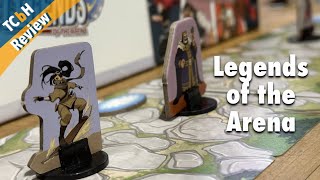
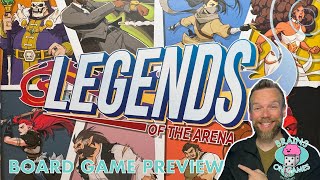
Reviewers judge Legends of the Arena, the 2026 fighting game from Toth Games, almost entirely through the lens of Super Smash Bros. The Cardboard Herald argues that few tabletop fighting games wear their inspiration as openly, and it credits this title with capturing the tempo and precision of its digital source even inside a turn-based structure. The One Stop Co-op Shop reaches a similar view after playing two matches, describing a brawler in the vein of Smash Brothers in which characters try to knock each other off the arena. Brains On Games, hosted by Dr. Brian McDonald, approaches the game as a light, accessible battler and is the most enthusiastic about its approachability. BoardGameCo covered it only in passing during a Gen Con hall tour, calling it a Smash Bros inspired board game, so its coverage adds little beyond confirming the comparison.
The shared consensus is that Legends of the Arena rewards players who enjoy aggression, close calls, and reading opponents. Reviewers agree that it is intense and that its appeal depends heavily on the group. They diverge on how much the chaos should count against it. The Cardboard Herald reports that a household partner who usually enjoys heavy conflict games disliked the syncopated, aggressive pace, while a friend who also grew up on Smash Bros. loved it. Brains On Games found the same split in its own game night, where a teenager who knew the Nintendo fighters asked to play again right away.
Core Mechanics That Define Legends of the Arena
Simultaneous Card Programming
Each round, a player draws one of the character's special cards and then places three cards face down in a sequence, playing them in order from top to bottom. Basic cards always return to the hand after they are used, while special cards go to a discard pile and are unavailable until the player chooses to reshuffle them. Brains On Games explains that everyone reveals their stacks at the same time, but each card resolves in turn, so a player cannot see an opponent's later actions until they happen. The One Stop Co-op Shop describes the speed value in the upper corner of each card as the key to ordering. Higher values act first, and an initiative token breaks ties. Because the targets are not chosen in advance, each attack hits the closest valid foe, with ties broken by the slowest card and then by the least fatigue. Toth Games publishes the system as the centerpiece of the design, and reviewers consistently treat the guessing it creates as the heart of play.
Fatigue and Push Damage
Instead of tracking hit points, each fighter advances a fatigue token whenever an attack gets past its opponent's block, regardless of how much damage goes through. Unblocked damage then determines how many push tokens the target receives, counted from the position of the fatigue token. The Cardboard Herald summarizes the effect as the more hits a fighter takes, the squishier they become, so even a low damage hit can eventually send them flying. Brains On Games notes that a fighter at high fatigue can be knocked off the edge by a single point of damage, and that the knocked-out fighter returns to the center with fresh fatigue. This mirrors the damage percentages of Super Smash Bros., and reviewers see it as the mechanism that connects the game to its source.
The Legends of the Arena Experience
Frantic, Always-Involved Chaos
The most common description of the feel is frantic. Brains On Games says that players stay engaged even while others resolve their cards, because every hit changes someone's fatigue and position. The Cardboard Herald describes the result as a beguiling, sometimes frustrating dance of near hits, disrupted plans, and close calls. At higher player counts, the reviewers note that the board fills with targets, so more actions find a valid target and the chaos becomes more rewarding than frustrating.
Mind Games With Opponents
The second feeling is a tense, psychological back-and-forth. Brains On Games frames each turn as a question of whether an opponent will block first or attack, and whether a player should block in return. The One Stop Co-op Shop repeatedly stresses that facing matters, since a fighter who turns the wrong way can be pushed off the edge while unable to respond. The Cardboard Herald calls the resulting play a balance between frustration and elation, especially between two evenly matched players who keep anticipating and foiling each other.
What Makes Legends of the Arena Stand Out
Distinct Characters With Real Asymmetry
Reviewers consistently praise the characters. The Cardboard Herald highlights varied weight classes and flavorful personalities, from Meatman and Beefy Viking Babe to the werewolf Zatty and Maul Ninja, and says the moves bring them to life. Brains On Games finds that the asymmetry is strong enough that each character feels different to play. It singles out Ticket, a time cop who replays the round's cards in reverse, as the high complexity option. The One Stop Co-op Shop shows how Alicia's rush-down style differs from the defensive Fitz, and how Lucius transforms between human and wolf forms with different attacks in each.
A Compact Package With Smart Bot Opponents
The Cardboard Herald values the small box, which it sees as matching the game's quick pick-up, easy-to-teach nature and fitting in a backpack. The One Stop Co-op Shop praises the solo mode expansion, which lets a single player fill out a match against bots. Each bot character has special cards with priority lists on the back, and the bot flips the top card to choose a conditional group of actions based on its current situation. The reviewer calls this system clever, and it lets solo play feel like a real opponent instead of a random one.
Potential Drawbacks
Aggression May Not Suit Every Table
The most consistent concern is that the game is aggressive by design. The Cardboard Herald warns that anyone who prefers low-stakes, low-pressure games will likely have a bad time, and the reviewer's partner found the syncopated dance of the system off-putting. Brains On Games notes that frustration is possible when a carefully planned sequence fails, and that a three-player free-for-all can feel chaotic. Reviewers suggest that the chaos is easier to enjoy with more players because more targets are in range.
Limited Special Abilities and Repetition
Brains On Games points out that each character has only a limited set of special abilities, so playing the same fighter again and again may begin to feel repetitive. The reviewer hopes future expansions add options, and notes that deck construction could eventually add variety. The One Stop Co-op Shop also observes that some matchups are lopsided, arguing that Lucius is a poor fit against the zombie-summoning Lord Grim, and that 2v2 play is needed to balance such weaknesses. The Cardboard Herald adds that the game is more focused than party-oriented, which means it lacks the playful atmosphere of a Smash Bros. session with items and dynamic stages.
If You Enjoy Legends of the Arena
Reviewers converge on a single comparison across every review: Super Smash Bros. Players who enjoy that game's knockout tempo, the spacing of attacks, and the satisfaction of pushing a rival off the edge will recognize those ideas in Legends of the Arena, which translates them into a simultaneous card programming system. No other tabletop titles came up as comparisons in the available coverage, which underscores how directly this design is read as a tribute to one specific source rather than part of a wider genre of fighting board games.
What Reviewers Are Saying
"It wasn't until Legends of the Arena that I found something that actually kind of captured the tempo and frenetic precision that those games are best known for, even in this turn-based structure."
— The Cardboard Herald
"The characters feel different. There's that little bit of asymmetry, and it's enough asymmetry that it feels different depending on what character you're playing."
— Brains On Games
"They have these special cards that have each of the priority for the bot on the back. You flip the topmost one, and it gives you conditional groups of cards for them to play in order. Really clever."
— One Stop Co-op Shop