




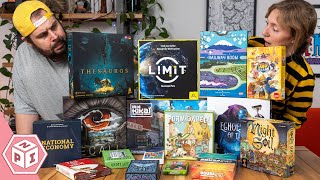
Limit Deep Dive
What the Community Thinks About Limit
Limit arrived at the 2025 Essen convention as an anticipated title generating considerable pre-release buzz, though information remains sparse. The game captures the attention of reviewers precisely because it represents a departure for publisher Ludonaute. Board Stupid anticipates it could be a "sleep ahead," a sleeper hit in the making. The Broken Meeple expresses genuine enthusiasm despite limited availability of details, describing the concept as "really really cool" and noting genuine intrigue about how the design will ultimately execute. This anticipation carries bittersweet weight: Ludonaute has announced the company is winding down, making Limit one of the publisher's final releases. Reviewers acknowledge the significance of engaging with what may be the last game Ludonaute produces, adding poignancy to their interest regardless of how the game ultimately plays.
Core Mechanics That Define Limit
Resource Management
Resource management sits at the heart of Limit's design philosophy. As competing nations across seven generations, players must acquire, convert, and spend limited resources to fuel every meaningful action. Board Stupid describes the mechanic directly: players face constant trade-offs. The social phase forces players to "pay the price" for the political decisions their predecessors made, consuming resources in response to consequences. Players must ration their resources across competing priorities, with the value of each resource shifting based on board state and proximity to crisis events. Ludonaute's economy game creates scarcity as the defining constraint.
Engine Building
Limit incorporates engine-building elements in its tableau-construction approach. The Broken Meeple identifies a "Terraforming Mars type of feel" where players invest early decisions into permanent structures and cards that compound value over time. Players build gradually across seven generations, with early political choices and resource allocations feeding into late-game payoffs. The civilization players construct, nations managed across time, represents the engine that grows more powerful through deliberate, long-term planning.
The Limit Experience
The Weight of Generational Stewardship
Limit's defining emotional experience emerges from its seven-generation structure. Players do not simply play a nation in isolation; they inherit the consequences of prior generations' choices and create cascading effects for generations to come. The social phase explicitly crystallizes this: decisions made in the political phase must be paid for later, forcing players to contend with the full weight of their governance. Board Stupid captures this: "you pay the price for your bad decision making done by the parents." The game simulates historical consequence in a board game context, where poor choices compound across time.
Crisis as Shared Pressure
The international phase introduces crises (war, famine, energy shortages, ecological collapse) that transcend individual nations. These are not obstacles each player solves independently but collective pressure points where preparation and strategic positioning matter desperately. Board Stupid emphasizes this tension: "Have you prepared well for the next war, famine problem, energy crisis?" Players must balance pursuing national interest while monitoring the global scale, knowing that unpreparedness across generations creates vulnerability when crises strike.
What Makes Limit Stand Out
The Seven-Generation Timeline
Few board games embrace the scope of seven generations spanning from the 1800s to approximately 2060. This structural choice is ambitious: it allows the game to simulate historical and near-future challenges while creating natural asymmetry between early and late game. Each generation brings different crisis types and pressures. The Broken Meeple and other reviewers note the game is "heavier from recollection than a typical Luda," a weight justified by the civilizational arc it attempts to capture.
Geopolitical and Sociological Simulation Depth
Limit sets itself apart by embracing theme at a depth uncommon for Ludonaute. Board Stupid explicitly compares it to geopolitical simulation games, citing the "revolution" that followed titles like "World Order." The game features GDP, happiness, financial power, and military goals as distinct scoring vectors. It is not merely about economic optimization; it simulates the interlocking systems of nations navigating ecological, financial, and military crises simultaneously. The Broken Meeple emphasizes: "It's really like outside the box for them. You know, it's really outside the box for them." This thematic ambition, to simulate sustainable governance across centuries while managing global crisis, distinguishes Limit from both typical Ludonaute releases and most contemporary euros.
Potential Drawbacks
Heavy Complexity Limiting Accessibility
Limit's weight represents both appeal and barrier. Board Stupid and Meeple University both identify it as "medium heavy to heavy," substantially heavier than Ludonaute's typical catalog. The 60-150 minute playtime and multiple interlocking phases (political, social, international) require players comfortable with cognitive load and systems thinking. For casual players or those seeking lighter fare, the complexity may prove prohibitive. The Broken Meeple notes the sparse availability of information suggests "there's not a lot of people talking about it," which could mean limited visibility and review coverage once it ships.
Limited Pre-Release Information and No Established Community
Because Limit remains unreleased at the time these reviews were recorded, reviewers work from limited information. The Broken Meeple expresses honest uncertainty: "It could be bad. It could be rubbish. We don't know." No established player community yet exists to confirm whether the design succeeds at its ambitions. The game's departure from Ludonaute's established identity as a publisher creates additional uncertainty; this is unfamiliar territory for the company. Additionally, Ludonaute's closure adds context that may affect availability and community building post-release.
If You Enjoy Limit
If Limit resonates with you, Terraforming Mars offers kindred pleasures. Both games center on long-term strategic decision-making across generations with ecological themes woven throughout. Both require players to balance resource scarcity against competing long-term goals. Both reward planning that accounts for cascading consequences. While Terraforming Mars focuses on terraforming a single planet rather than governing competing nations, the tableau-building approach and engine-building progression that reviewers identify in Limit operate similarly. Players drawn to geopolitical simulation and centuries-spanning strategy will find familiar strategic depth in Terraforming Mars.
What Reviewers Are Saying
This is a weighing kind of nice heavy euro. Nice medium heavy medium heavy euro but this is a looks like an economy game. The idea is that you are competing nations trying to create a sustainable country a sustainable nation over a period of seven generations all the way up to sort of 2060. Yes starting from the 1800s into like the near future.
— Board Stupid
You are it's a competitive you play as a nation facing the challenges of our world you make crucial political decisions manage resources global crisis and it's all about you know in a sense saving the planet you know food consumption and all this stuff but as a theme that is something very different for Ludenor you know it's really like outside the box for them.
— Luke Hector, The Broken Meeple
That will be the final game from Ludenort Games that I ever review because they're no longer operating. So, yeah, that's going to be a sad swan song, especially if I don't like the game.
— Luke Hector, The Broken Meeple