



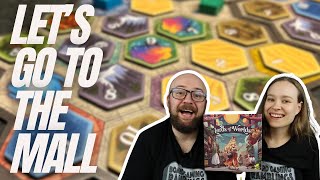



Lords of Worlds Deep Dive
What the Community Thinks About Lords of Worlds
Lords of Worlds arrives as a welcome addition to the world of light strategy games, crafted by the renowned design duo Vulcan Kramer and Michael Keysling. The community response has been consistently positive, with reviewers praising the game's elegant simplicity and surprising strategic depth. Across multiple gaming channels, Lords of Worlds is positioned as a solid filler game that punches above its weight in terms of player engagement and decision-making opportunities, making it an ideal choice for players seeking quick, satisfying gaming sessions without excessive complexity.
Core Mechanics That Define Lords of Worlds
Tile Placement on Your Personal Planet
At its heart, Lords of Worlds centers on a tile placement mechanic where players construct their own worlds by acquiring and positioning hexagonal terrain tiles. Each player starts with an empty personal board and gradually fills it by purchasing tiles from a central marketplace. The placement itself carries strategic weight because tiles placed on empty spaces contribute to adjacency-based scoring, creating a puzzle-like experience where positioning matters as much as acquisition. Players earn points by forming connected groups of identical terrain types, encouraging thoughtful spatial planning throughout the game. This personal board approach keeps everyone engaged simultaneously, as each player pursues their own strategic path without directly blocking others, creating a cooperative-feeling atmosphere despite the competitive framework.
The Card Market System
The standout mechanic that reviewers consistently highlight is the card market, published by Mojito Studios as a centerpiece of Lords of Worlds. Players use numbered cards (representing resources or purchasing power) to navigate a marketplace and claim tiles. The elegant refill system keeps the market dynamic: whenever a tile is purchased, a new one is revealed from the deck, creating a constantly shifting landscape of opportunities. This mechanic forces meaningful decisions about timing and sequencing. Do you take a mediocre tile now to refresh the market for yourself, potentially setting up opponents? Or do you wait and risk someone else claiming your target tile first? The tension emerges not from confrontation but from the calculation of consequence, making every action resonate through the shared market space.
The Lords of Worlds Experience
Light Complexity with Surprising Engagement
Lords of Worlds delivers a deceptive experience. On first glance, the rules are straightforward: move your shopping basket around a hexagonal grid, spend cards to acquire tiles, and place them on your board for points. Reviewers consistently note that despite these simple mechanics, the game generates genuine moments of tension and decision-making that feel disproportionate to its lightweight ruleset. Players find themselves calculating multiple move sequences in advance, hoping opponents don't disrupt their carefully laid plans. This accessibility combined with hidden depth makes the game appealing across experience levels, whether teaching newcomers or providing veterans with a quick evening option that doesn't demand intense concentration yet still rewards smart play.
Flexible Gameplay for Your Table
The game's two variants cater to different play preferences and groups. The basic version uses face-down tiles, emphasizing luck and discovery for family gaming or casual play. The strategic variant, however, reveals all tiles face-up, transforming Lords of Worlds into a thinky puzzle game where planning and interaction increase significantly. Reviewers universally recommend the strategic variant to players seeking real decisions, while acknowledging the basic version's charm for younger players or those prioritizing accessibility. This flexibility allows Lords of Worlds to work across table compositions, a rare quality in modern designs. The game plays well across player counts (2 to 4), with reviewers noting that the fewer players in strategic mode, the tighter the tactical puzzle becomes.
What Makes Lords of Worlds Stand Out
Elegant Market Dynamics
Reviewers repeatedly single out the market refill rule as the game's heartbeat. Rather than a static display, the market evolves with every purchase, creating a rhythmic tension between taking what you need now and hoping better options emerge for your next turn. This system prevents the game from feeling solvable or predetermined; each session plays differently because the cascade of revealed tiles follows no predictable pattern. The market also encourages players to engage with tiles outside their primary strategy, since sometimes the best move involves disrupting the market's flow or snapping up an unexpected gem. This interconnectedness between the marketplace and individual players' boards creates a sense of shared stakes without aggressive take-that mechanics.
Quick Play Sessions with Meaningful Choices
In an era of increasingly complex games, Lords of Worlds delivers a 40 to 60 minute experience that respects player time while maintaining strategic weight. Each turn is swift, but the cumulative effect of many small decisions creates a puzzle that develops over the course of play. Reviewers appreciate this as a genuine quality rather than a limitation. The game succeeds as a complete experience in a short window, making it ideal for gaming cafes, conventions, or evenings when time is scarce. The scalability ensures that player count doesn't significantly lengthen play time, so groups can enjoy it regardless of table size without sacrificing engagement or strategic texture.
Potential Drawbacks
Limited Thematic Depth
Lords of Worlds wears its abstract heritage proudly, using terrain tiles and planetary construction as window dressing rather than true immersion. The designers and reviewers alike acknowledge that the theme functions primarily as flavor, similar to how other abstract games use colorful components to make mathematical puzzles more engaging. Players seeking deep thematic resonance or narrative progression will find the theme inconsequential. The game operates as a spatial puzzle wrapped in planetary aesthetics, which suits players who enjoy the puzzle itself but may disappoint those wanting the theme to inform or enhance the mechanical experience.
Light Weight May Disappoint Serious Strategy Gamers
While the strategic variant adds considerable interplay compared to the basic game, Lords of Worlds operates in the light-to-medium complexity range. Players accustomed to heavier Eurogames or seeking extensive engine-building and system interactions may find the scope limited. The game does not offer the tactical depth of titles with multiple resource tracks, complex production chains, or layered decision trees. Reviewers note this as a design choice rather than a flaw, but it matters for table matching. Lords of Worlds is not designed to be your heavy evening game; it is designed to be an elegant, satisfying quick filler or an introduction to strategic tile placement. For heavy strategists, it serves best as a refresher between deeper games rather than a main event.
If You Enjoy Lords of Worlds
Players who love Lords of Worlds should explore other Kramer and Keysling designs, including their classic titles Alyattes and Expeditions Around the World, which share the same elegant design philosophy and spatial puzzle focus. The community also recommends games with strong market mechanics and tile drafting, such as Splendor for market variety or Alhambra for comparable tile-placement satisfaction. For those drawn to the quick-play experience with surprising depth, exploring recent releases in the filler category with interactive elements, such as games using similar market replenishment systems, rewards discovery. The key is seeking games that respect player time while delivering meaningful decisions, rather than pursuing title lists ranked by complexity alone.
What Reviewers Are Saying
"My favorite thing about the game is the market refill rule."
— Board Gaming Ramblings
"That card market is so good. And I highly, highly, highly advise that you play the strategic variants in the back of the rule book."
— The Dice Tower
"It was a really fun, engaging game, a very clever game where you're trying to put out these pieces out on your world, combo things together, put things next to other things."
— TheGameBoyGeek