





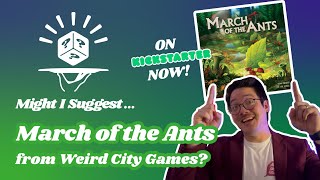
March of the Ants: Evolved Edition Deep Dive
What the Community Thinks About March of the Ants: Evolved Edition
Reviewers tend to present the Evolved Edition as a tightened, better-looking version of a 4X game that already had admirers. Commentators welcomed the new artwork and graphic design, and they described the revised mechanics as clearer and more streamlined without losing the original's identity. The overall tone is warm, with the most enthusiasm reserved for how the game handles length. Several reviewers were surprised that a 4X title with this much going on could be played in around ninety minutes.
Criticism is light. The most common complaint centers on the combat system, which one channel found a little confusing and somewhat bottlenecking when it arrived in play. That reviewer still expected the rulebook to improve understanding over time, so the friction reads as a learning hurdle rather than a flaw in the design.
Core Mechanics That Define March of the Ants: Evolved Edition
Resource Management: Food, Larvae, and Scarcity
Almost every decision costs something. Exploring, marching, and forging all require food, while playing a card requires paying the ants or larvae printed in its top corner. Reviewers emphasized that this scarcity keeps the colony's economy tight. Food also has to feed the ants at the end of each round or the colony loses points, so players must plan ahead rather than simply spending whatever they have. Several commentators described the end-of-round choice between food and larvae as a meaningful decision that often shapes the next round.
Area Control: Contesting Hexes and the Great Tunnel
Territory is the other pillar. Ants occupy collection sites, and the player whose ant sits in a hex's control site claims that hex. Reviewers saw this as a presence game in which majorities matter more than sheer numbers. Hexes adjacent to the Great Tunnel score points at the end of each round, which pushes players to contest the center of the map early. Commentators noted that battles only break out where rival colonies share a hex and at least one ant sits on the outskirts, so the conflict stays focused on specific spaces.
The March of the Ants: Evolved Edition Experience
A Brisk Pace With Real Strategic Weight
Pacing is the quality reviewers mention most often. Long 4X sessions can stretch past several hours, but this edition tends to finish in about ninety minutes. One channel said the intuitive gameplay and easy-to-learn mechanics let a first game with three players move quickly without draining the strategy. The decision space still feels deep, yet limited enough that players can work out a good plan before the analysis paralysis that slows many 4X games sets in. Reviewers described the game as a 4X experience that respects the table's time.
Tension From the Rest Race
The rest action creates a shared clock. A player who rests is effectively passing for the rest of the worker phase, and each return of play to that player forces another rest tile to be claimed. Reviewers described this as a timer on everyone else, since every other player must keep an eye on the remaining tiles and adjust their plans. One channel called grabbing early rest tiles and forcing opponents to change their plans "so satisfyingly cruel," and said it became one of the favorite parts of the game. The pressure keeps the table attentive even in quieter moments.
What Makes March of the Ants: Evolved Edition Stand Out
Evolving the Ant Species
Evolution cards are built into the player's ant body, which is divided into head, thorax, and abdomen. Commentators explained that only the top card in each segment grants its unique ability, but the number of cards in a segment adds an ongoing bonus. Heads strengthen combat, thoraxes add reactions at the end of the worker phase, and abdomens increase how many ants a food can feed. Completing a full body of all three evolution types grants points, which gives players a reason to shape their species deliberately. Reviewers liked that the thematic idea of growing a colony translates directly into these choices.
Great Tunnel Battles and Refreshed Rest Tiles
Commentators highlighted the new Great Tunnel battles and the reworked rest tiles as the most meaningful additions in this edition. The Great Tunnel resolves its own battle with spoils for the leading finishers, and the great defender tile gives a particular player an edge there. Grant's GameRex pointed to the resting cards and tunnel battles as the headline changes, while also noting the new wooden ant pieces and updated layout. For returning players, these additions give the old structure fresh tension without changing the core flow.
Potential Drawbacks
Combat Can Feel Opaque at First
The battle system draws the most criticism. Battles depend on majorities in a hex, with bonuses from evolutions and played cards, and casualties are resolved in several steps. One channel said that the combat system felt a little confusing and became a bottleneck for the flow of the game once it came into play. The reviewer expected that a clearer rulebook would make it easier to follow over time, so the concern is about onboarding rather than the core design.
Layered Rules and Optional Complexity
Reviewers noted that March of the Ants has a lot happening at once, combining worker placement, tile exploration, area control, and evolution. Kovray's walkthrough showed the depth of the rules, including centipede battles and an epic variant that adds a round. The ancient species boards, which change each player's board, were described as adding considerable complexity, extra unpredictability, and large power swings. That layering rewards players who learn the base game well, but it may feel heavy for groups who want a simpler session.
If You Enjoy March of the Ants: Evolved Edition
The game suits players who love the scope of a 4X game but rarely have an evening to spare for a long session. Reviewers framed it as a way to get a big-picture strategy experience in about ninety minutes, which makes it appealing to busy adults who still want meaningful decisions. One channel described it as a shrunken 4X game that keeps its intuitive decisions while trimming the length.
The theme is another draw. Players who enjoy bugs, nature, or colony-building will find the ant colony framing engaging, and the new artwork gives the game a fresh look that reviewers found appealing. Players who want to grow with a game may also enjoy the ancient species boards and epic variant once the base game feels familiar, since reviewers presented those options as a clear path toward more complexity and unpredictability.
What Reviewers Are Saying
I loved how Snappy it was many times when you're taking on a 4X game you're expecting to be there for the Long Haul
— Might I Suggest a Game
And this is one that plays pretty quickly, which I like.
— Grant Lyon
it honestly has a kind of a 4X sort of vibe
— Getting Games