
In Masons, players represent architects, who together establish cities on the landscape of the game board. When a city is completed, all players score points for "guild cards" they play, with the right timing in playing the right card making all the difference.
Each turn, a player first establishes a new wall somewhere on the board. Each wall will be enclosed by two towers, and will have one house placed on each side of it. It's possible for a wall to need only one, or zero, new towers by putting it next to existing towers. It's possible for only one house to be placed, if the wall is placed along the outside of the game board.
After placing the wall, the player rolls three dice to determine the color of one of the towers (the color of a possible second tower may be freely chosen), and that of the two houses (if only one house is placed, then the player may choose which of the dice to pick for the color of the house).
Finally, if the newly placed wall causes a piece of land to be fully enclosed, a new city has been established. If the new city borders one or more existing cities, it may be combined with one of those cities. Two houses of the same color inside the city are upgraded to a palace. A scoring round is now triggered, during which all players get to play one or two "guild cards", and then draw one new card. Each guild card will score a feature of either the just completed city, or outside it. Possible features are the number of houses & palaces or towers of a specified color, the number of fields of the city, the number of houses inside a "district" on the board, the number of palaces inside a city, the different number of colors inside a city, or the total number of completed cities. At the end of a scoring round, whichever player is in last place may discard as many guild cards as desired, and draw new ones to replace them.
The game ends when all pieces of a certain type have been played, and the winner is whoever has the most points.
Images



Mechanics (from transcript analysis)
Video topics + discussion points
Quotes (from this video)
- Duck & Cover is a fantastic filler family game.
- Pentago is one of the best abstract games of all time.
- What is this in the middle of all the board games on BoardGameGeek?
- This game truly is mid.
References (from this video)
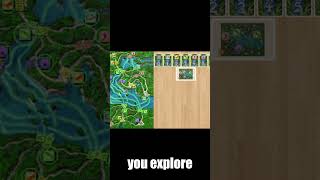
- Blends hand management, set collection, and exploration into a thematically coherent package.
- Outpost construction and resource management offer strategic depth under budget constraints.
- Jungle exploration setting provides a vivid thematic backdrop.
- Transcript offers limited detail on rules, balance, player count, and component quality.
- Ambiguity around the mention of 'network connection' as a mechanic due to the brevity of the transcript.
- Exploration, species collection, outpost establishment under budget constraints
- Amazonus Jungle in a perilous exploration scenario
- procedural exploration with strategic resource management
Mechanics (from transcript analysis)
- competition_victory_condition — Victory is pursued through accumulating fame while competing against rival players.
- exploration — Core emphasis on exploring the jungle setting to discover opportunities, hazards, and strategic options.
- Hand Management — Players manage a hand of action or resource cards to perform actions and respond to evolving game conditions.
- hand_management — Players manage a hand of action or resource cards to perform actions and respond to evolving game conditions.
- outpost_construction — Players can establish outposts to gain advantages, access additional actions, or secure resources.
- Resource Management — Funds or resources must be allocated and spent carefully to support outposts, missions, and exploration efforts.
- resource_management — Funds or resources must be allocated and spent carefully to support outposts, missions, and exploration efforts.
- secret_objectives — Hidden missions provide additional goals and scoring opportunities, adding strategic tension.
- Set Collection — Players collect specific items or species to complete sets, unlocking bonuses and scoring opportunities.
- set_collection — Players collect specific items or species to complete sets, unlocking bonuses and scoring opportunities.
Video topics + discussion points
Quotes (from this video)
- Notable information in transcript is minimal; no explicit direct quotes about gameplay were provided.
References (from this video)
- teaches categorization and critical thinking
- can be challenging for very young players
- characteristics and matching
- home/kitchen-like environment
- educational, characteristics-based puzzle
Mechanics (from transcript analysis)
- card management — reasoning to map abstract traits to familiar contexts
- characteristic matching — fit a card's characteristic into a real-world example to discard it
- Matching — fit a card's characteristic into a real-world example to discard it
Video topics + discussion points
Quotes (from this video)
- On your turn you will roll this giant dice and the color you roll is the color of the fruit you put into the basket.
- But if on your turn you roll the raven it moves closer to your garden.
- This is your first competitive game because you will play as one of these worms that will try to get to the finish line.
- Biggest lesson this game teaches you is losing alone.
- In this game, you will learn a new skill called dexterity.
- The toy factor. It looks like a toy even though it trains your dexterity and other skills.
- In this corruptive game, you're trying to stop the fox before it gets into its cave.
- The farther you move, the more treasures you will get.