


Match Madness Deep Dive
What the Community Thinks About Match Madness
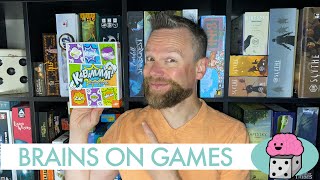
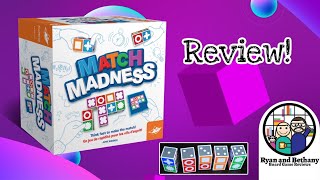
Reviewers describe Match Madness from FoxMind as a fast, tactile pattern matching game that works well for families and mixed-age groups. Ryan and Bethany Board Game Reviews opened their coverage by describing the game as built around giant three-dimensional blocks, with players racing to form the shapes shown on a card. Their household found it fun right away, and they came away describing it as a game with no stress or animosity between winners and losers. Brains On Games, hosted by Dr. Brian McDonald, placed Match Madness alongside Kabam as a rapid visual matching game and recommended it for children aged seven and up. Both channels agreed that the title fits the experience, since the puzzles can feel chaotic when a placement fails and the whole table has to rebuild.
Core Mechanics That Define Match Madness
Simultaneous Actions
Every player works on the same target card at the same moment, so the table is noisy and concurrent rather than turn based. Ryan and Bethany called it a real-time game in which a whole family could engage at once, with a fairly equal chance of scoring for each person. Brains On Games made the same point, describing a race where everyone builds the configuration simultaneously and the first player to finish claims the card. Because the rhythm is set by whoever finishes first, a player who hesitates over one placement can lose a card without ever getting a turn to act.
Memory
Brains On Games identified a visual memory layer that separates Match Madness from pure reaction speed games. Every player works from the same numbered set of blocks, so the symbol pairs on each block never change between games. Over repeated play, a player can start to recall which pairs sit on which block and reach for the right piece without searching the whole table. Dr. McDonald admitted that after several sessions the set still had not been fully memorized, which suggests the memory payoff grows with familiarity rather than arriving immediately.
The Match Madness Experience
Controlled Chaos
Ryan and Bethany described the game as "absolutely madness" once play begins. Players flip the blocks, believe they have the shape, and then discover that one piece does not fit, which forces a reshuffle of the surrounding blocks. The reviewers treated that frustration as part of the appeal, and they felt the title "Match Madness" was an accurate description of how the table sounds and looks mid-round.
Low-Stress Family Fun
Ryan and Bethany emphasized that the game is less about winning and more about shared enjoyment. They noted that scoring rules can be loosened, that some groups simply play until the children lose interest, and that the family enjoyed a game where everyone could compete on roughly equal footing. The result, in their telling, is a relaxed session that suits younger players as well as adults who want a quick game with the kids.
What Makes Match Madness Stand Out
Durable Three-Dimensional Blocks
Reviewers repeatedly singled out the components. Ryan and Bethany said the pieces are large and sturdy, which matters when children push and shuffle them during a round. Brains On Games highlighted that each block carries two symbols on each of its sides, adding up to eight different symbols spread across the whole piece, which creates the three-dimensional challenge that sets the game apart from flat matching titles. Meeple Mountain, reporting from Gen Con, likened the spatial rotation required to solving a Rubik's Cube, because players must turn several blocks to reveal the target arrangement.
Flexible Scoring and Difficulty Tiers
The cards are numbered one through five by difficulty, and the rules use that numbering to break ties, starting from the hardest cards. Ryan and Bethany also praised an optional catch-up approach in which every completed card is worth one point regardless of difficulty. They argued that this keeps a close score tight, so that a trailing player who completes an easy card does not feel left behind after a rival finishes a tougher one. Brains On Games noted that the more complicated variations assign higher point values to harder puzzles, giving experienced groups additional strategic choices.
Potential Drawbacks
Rebuilding Frustration
The same three-dimensional design that delights reviewers can also frustrate players. Ryan and Bethany described how a single misplaced block can make an apparently complete shape wrong, requiring the group to switch the pieces around and begin again. Brains On Games observed that with eight symbols packed onto a single block, the target can be hard to spot quickly, especially on the higher difficulty cards.
Speed Favors Quick Reactions
Because the game is a race, it rewards fast hands and quick visual scanning. Brains On Games framed the title as a test of reaction time, and Dr. McDonald admitted that a son's speed left the reviewer well behind during their match. Ryan and Bethany also warned that the harder cards can be very challenging, particularly for players who are new to the rotations. Groups with a mix of skill levels may need to use the easier cards or the catch-up scoring to keep the session balanced.
If You Enjoy Match Madness
Brains On Games reviewed Kabam in the same episode as Match Madness, and the two titles share a similar design philosophy. Kabam is a superhero-themed matching game for two to six players, aged seven and up, in which players shout phrases such as "wham" and "zing" while racing to match symbols on double-sided cards. McDonald described both games as rapid visual processing exercises, although Match Madness adds a stronger memory component and three-dimensional blocks. Players who enjoy the speed and shared chaos of Match Madness will likely find Kabam a comparable choice for a group that wants a lighter theme and a larger player count.
What Reviewers Are Saying
"I think that the title is very accurate it is match madness it's just like absolutely madness when you're playing trying to flip everything over thinking you got it and then also that piece doesn't really work out."
— Ryan and Bethany Board Game Reviews
"This is another visual processing speed game you are quickly matching the symbols on each of these cubes what's maybe a little bit different from kabam is that there is more of a visual memory aspect to it."
— Brains On Games
"It's blocks that you need to match a certain pattern and what's good about the blocks is they are in 3d so in 3d you sense of doing a Rubik's Cube."
— Meeple Mountain