








Mazing Deep Dive
What the Community Thinks About Mazing
Reviewers who have played Mazing, the solo and cooperative abstract puzzle from In Patience Games, mostly agree that it is a quick and clever game that rewards patient planning. Sir Thecos called it a pleasant surprise and placed it within a publisher streak that Sir Thecos described as consistently good. Tabletop Tokki praised it as an appealing solo abstract that also plays cooperatively at two players, a mode the reviewer enjoyed before switching to solo play.
The disagreements tend to follow personal taste for abstract games. Rahdo Runs Through called Mazing the deepest game they and their wife, Jen, had played in years, a cooperative chess-like puzzle with brilliant design. The couple still found it hard going, and the reviewer put that down to their own limits rather than the game, since neither of them is especially fond of chess or abstract strategy. Sir Thecos, who admitted to not being the greatest at abstract games, ended up liking it much more than expected. In the September unboxing from Tabletop Tokki, the host had only read the rules and said they had never really played a cooperative abstract before, so that video works as a first impression rather than a verdict.
Core Mechanics That Define Mazing
Piece Movement Printed on the Pieces
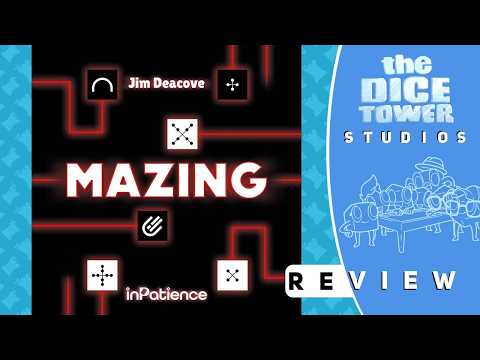
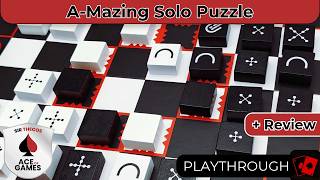
Each piece in Mazing moves in its own way, and the game makes that system readable at a glance. Messengers slide any number of unobstructed squares diagonally, and each one stays on the color of squares it started on. Walls move an exact number of spaces in one direction and cannot jump over other pieces. Bridges hop in a straight line over one or more adjacent pieces, but they cannot land on a blank space. Meteors move once to any empty square and then lock in place. Sir Thecos pointed out that the movement symbols sit directly on the tiles, so after a game or two the rulebook is rarely needed. Tabletop Tokki's unboxing credits the design to Jim Deco and the publisher to In Patience Games.
Traps That Lock Pieces for the Rest of the Game
The second pillar is the trap system. Each red-bordered trap square flips any piece that ends its movement on it, and the flipped piece cannot move again. The solo playthrough from Tabletop Tokki leaned on this constantly, locking pieces deliberately so that the remaining route stayed open for the messengers. Sir Thecos called the trap squares the thing to respect most, noting that a board packed with walls near the traps can leave a route almost unusable. Rahdo Runs Through framed each choice as a long-term question: is it acceptable to move a piece out of the way knowing it will become a permanent wall? Both reviewers treat the traps as the main source of tension, because every move permanently changes what the other pieces can do.
The Mazing Experience
Tactical Puzzling That Stays Approachable
Sir Thecos described the game as strategic in its goal and tactical in practice. You know the destination, but you advance one piece at a time, reacting to the board and rarely feeling stuck because most pieces still have a useful move. Sir Thecos said the game does not feel dry in the way some puzzle games do, where you feel you must think five moves ahead at all times. The reviewer usually plays in 15 to 20 minutes, and both reviewers treated the quick setup and short play time as a large part of the appeal. The Tabletop Tokki solo run has the same feel, with the reviewer wanting to puzzle the solution out quickly and then move on.
Cooperative Tension in Every Move
The cooperative structure adds a particular kind of pressure. Rahdo Runs Through described how every move reshapes the board for both colors, so a move that opens a route for one messenger can equally affect a teammate. That shared exposure creates a close, communal focus, but it can also sting when one choice blocks a path a partner was building. The solo finish in the Tabletop Tokki playthrough came down to a series of close calls as the last messengers squeezed through the remaining openings, which captures the same sense of tight, shared planning from the solo side.
What Makes Mazing Stand Out
A New Puzzle Every Game
Tabletop Tokki praised the randomized setup as the feature that keeps the game fresh. The pieces are shuffled and laid out in columns stretching from each messenger toward the center, so the board that results changes every time. The reviewer described how the variability challenges the player to allocate different areas of the board in different ways. A more challenging reverse side with extra traps, along with a timed variant, adds further replay options. Sir Thecos likewise described the randomized setup as giving a new puzzle every time you play.
Components That Carry the Design
Sir Thecos praised the chunky wooden pieces as far more satisfying to handle than cardboard tokens, and called the black, white, and red visual design clean and striking. Sir Thecos also described the rulebook as short, clear, and easy to follow, covering setup, gameplay, the end of the game, a double page on piece movement, and the solo rules and variants. Tabletop Tokki singled out the wood screen printed pieces and said the minimalistic design includes just enough flavor to suit the game. Both reviewers see the restrained presentation as a good match for the abstract puzzle at the center of the game.
Potential Drawbacks
A Folding Board That Does Not Lie Flat
Sir Thecos described the board quality as good but noted that its folding construction does not lie perfectly flat, which the reviewer said is normal for this style of board. Sir Thecos suggested a cloth mat or something similar might have made the game easier to handle and could have allowed a slightly smaller box, but called it a nitpick, and found the board fine overall.
End-Game Rules When One Color Finishes First
Sir Thecos was not fully sure how the end game should work in solo play. Because you alternate between colors, once both messengers of one color reach their goal you must keep playing that color until the other messengers arrive. In practice that can mean shuffling a finished color back and forth while waiting. Sir Thecos noted that careful planning avoids most of this and did not consider it a deal breaker, but it remains the rule the reviewer was still thinking about after finishing the game.
If You Enjoy Mazing
Players who enjoy Mazing's piece-based puzzling will find similar satisfaction in Chess, the reference point that both Sir Thecos and Rahdo Runs Through used when describing its feel. Sir Thecos noted that Mazing is much easier to learn than chess while keeping a chess-like sense of planning, which makes it a gentler introduction to the same style of thinking. Players who enjoy the way each Mazing piece carries its own movement pattern will find a similar appeal in Shogi, which Tabletop Tokki named as a likely comparison after looking at the pieces and board.
What Reviewers Are Saying
"But it's also very tactical because you can take it step by step, react to the current board state, and slowly work your way toward the solution. And that works better than I expected."
— Sir Thecos
"The variability of having the tiles go out randomly each game really makes for a unique setup and challenges your brain to think in different ways as far as how you allocate certain areas of the board."
— Tabletop Tokki
"This has got to be the deepest game Jen and I played, not only this month, but in years. I mean, it's not chess."
— Rahdo Runs Through