


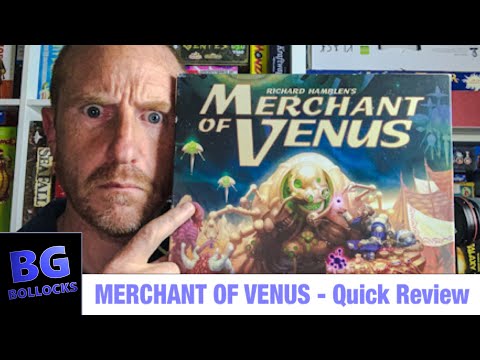











Merchant of Venus Deep Dive
What the Community Thinks About Merchant of Venus
Merchant of Venus is a 1988 space trading game that still has a devoted following. Reviewers covering it tend to return to the same qualities: a loose, pick up and deliver structure, a galaxy map that rewards exploration, and an offbeat tone that many players find hard to find elsewhere. The Dice Tower's top-10 segment, hosted by Tom Vasel, describes it as a game that keeps its place near the top of Vasel's personal list because nothing else quite matches its feel.
Much of the conversation also turns on which edition people own. The original Avalon Hill release is remembered fondly but is harder to find, while the later reprints from Stronghold Games and Fantasy Flight are the copies most players meet today. The result is a community that talks about the game as a shared reference point, with each edition carrying its own history.
Core Mechanics That Define Merchant of Venus
Pick Up and Deliver Trading
The central loop is straightforward. Players fly around the galaxy, buy goods in one system, carry them to another, and sell for profit until they have earned enough to reach the goal. The target can be adjusted for shorter or longer sessions. Vasel summarizes the structure in exactly those terms, and the trade routes players build over a session are where the game's planning really shows.
The opening phase is about discovery. Players do not yet know where every buyer and seller lives, so early purchases can sit in the hold while the map fills in. Vasel notes that this exploration runs until roughly a third of the way through the game, when the cultures have been found and routes start to form. After that point, players can plan loops in which one good sells to a market that supplies the next.
Movement by Dice and Ship Upgrades
Movement is governed by dice, and that randomness gives the game its tension. A player sets a heading, rolls, and then learns whether the ship makes it to the destination. Upgrades change the experience. A yellow drive lets the ship skip the yellow dots on the board, a larger hull carries more cargo, and wormholes and floating technology add shortcuts and surprises. Vasel points out that players can reroll or skip dots to improve their chances, so the dice are an obstacle to manage rather than a verdict.
The Merchant of Venus Experience
A Quirky Sense of Humor
The tone is one of the most cited reasons people return. Vasel describes the game as having a weird, quirky sense of humor and a pointed edge that sets it apart from other space games. That personality shows in the flavor text, the odd cultures players encounter, and the way the setting never takes itself too seriously. The humor makes the trading feel like a story rather than a spreadsheet.
Tension in Every Turn
The game rarely feels settled. Vasel explains that players often do not know whether they will reach a destination until the dice have been rolled, and that this uncertainty is part of the charm. Ships can get stuck in clouds for a turn or two, which slows a plan but rarely ends it. That loose, risk-tolerant feel is a large part of why players describe the game with such affection.
What Makes Merchant of Venus Stand Out
A Classic and a Standard Edition in One Box
The second edition, as shown in the Box of Delights unboxing, contains both the classic game and an updated standard version. The classic components sit in their own box, the classic ship cards are kept separate from the standard set, and the standard ship cards use dials to track stats. The double-sided board carries an indicator that shows which side is in use. Players who know the original can set it aside and still get a clean introduction to the revised rules.
A Solo Mode With Challenges
The solo game plays very differently from the multiplayer version. Instead of open-ended trading, the solo game sets a series of challenges, and completing them drives the session. Missions place tokens on the map, and some destinations require a shield check. The walkthrough explains that a player must roll a die and get a number under the ship's shield value to pass, which makes the odds visible and the decisions tense. For players who enjoy solitaire trade games, this mode adds a different style of play to the same board.
Potential Drawbacks
A Slow Start
The exploration phase is one of the game's best features, but it can also be its weakest point. Early turns can feel uncertain, since players are buying and carrying goods without a clear idea of where the profit lies. Players who want a quick, tightly focused trading session may find the opening stretch slow compared with more streamlined modern games.
Availability and Licensing
The game's history includes a reprint dispute that affected which company published it. UndeadVikingVideos described an understanding that Stronghold Games had planned a reprint, that a rights question followed, and that Fantasy Flight later published the game, a sequence presented as second-hand and not fully verified. The Drive Thru Games retrospective also suggests that the original is hard to find now and may be out of print. For new players, finding a copy can be the first hurdle.
If You Enjoy Merchant of Venus
Players who like the trading and exploration of Merchant of Venus should look at Magic Realm. UndeadVikingVideos calls it a favorite game of all time, and credits Richard Hamlin with designing both titles in the period when Merchant of Venus was first released. Magic Realm offers a very different experience, with a dense fantasy setting and a heavier rulebook, but it rewards the same kind of curiosity about a map and a willingness to take the long way round.
What Reviewers Are Saying
"Merchant of Venus is a pick up and deliver game in space."
— Tom Vasel, The Dice Tower
"It's a pickup delivery game."
— Drive Thru Games
"It was a glorious game."
— Chris Yee, Board Game Breakfast