


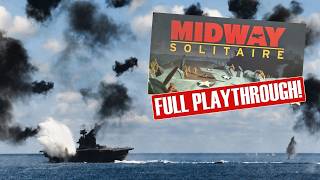
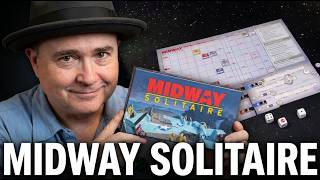


Midway Solitaire Deep Dive
What the Community Thinks About Midway Solitaire
Midway Solitaire commands consistent praise from the solitaire wargaming community. Both The Discriminating Gamer and Zilla Blitz identify it as one of the strongest entries in Worthington Publishing's travel solitaire series, with reviewers highlighting its elegant balance of accessibility and engaging gameplay. The dominant theme across all discussion is that the game tells compelling stories in a remarkably compact package. Reviewers note that while the system is intentionally light and streamlined, the card-driven unpredictability and multiple victory conditions ensure each session feels meaningfully different. There is broad agreement that the game deserves attention from solo players seeking both an accessible entry point and a game with genuine replayability.
Core Mechanics That Define Midway Solitaire
Card-Driven Japanese Movement
Japanese forces move according to action cards drawn each turn, with cards specifying movement directions (east, north, south, west) or conditional movement toward specific objectives. American players execute their orders first, then draw a card to determine how each of the three Japanese forces move orthogonally across the map grid. This system keeps players constantly uncertain about Japanese positioning; reviewers note that even though patterns emerge across cards, the sequence is unpredictable enough that you cannot simply memorize responses. The card system introduces friction between planning and execution, forcing adaptive decision-making rather than rote optimization.
Resource Management and Risk Engagement
Each American task force begins with three fuel reserves allowing double movement instead of the standard one-space orthogonal advance. Long-range attack tokens create another tactical constraint: task forces can engage adjacent Japanese units for a single round of combat, but spotting the Japanese first requires a risky die roll. Rolling a 1-4 succeeds and triggers combat; rolling a 5-6 causes friendly damage. These finite resources create constant pressure: when should you spend fuel to reposition? When is a long-range attack worth the one-in-three chance of self-inflicted damage? Reviewers emphasize the tension these decisions create, turning the game into a series of high-stakes wagers rather than a deterministic puzzle.
The Midway Solitaire Experience
Fog of War and Operational Uncertainty
The Discriminating Gamer explicitly praises how well Midway Solitaire captures the feeling of incomplete information despite its simplicity. You can predict likely Japanese movements and position to intercept, but you never know exactly where they will be. This uncertainty creates a distinct emotional arc: early turns are maneuvering and probing; mid-game oscillates between hope and dread as forces close; late-game explodes into resolution. The card mechanic simulates the friction of real naval warfare without requiring complex hidden unit rules. Players describe feeling genuine frustration when the Japanese slip past your prepared positions and exhilaration when plans align perfectly with the card draw.
Story Generation and Narrative Momentum
Reviewers consistently note that Midway Solitaire excels at spinning engaging narratives from card draws and dice outcomes. Each game generates a distinct story: sometimes the Alaskan invasion force moves swiftly toward its objective while you race to intercept the carrier strike force; sometimes the Japanese fleet stalls, giving you time to consolidate. Zilla Blitz specifically remarked that one playthrough unfolded remarkably close to the historical Midway, with American forces struggling in early carrier attacks before subsequent waves achieved overwhelming success. The game does not require or even encourage detailed historical flavor-text, yet the card system's logic naturally generates situations that feel plausible and emotionally resonant. Reviewers returned to games repeatedly because each session told a different story worth experiencing.
What Makes Midway Solitaire Stand Out
Six Mission Victory Conditions
Rather than offering a single win condition, Midway Solitaire presents six graduated objectives ranging from sinking only the Midway invasion force (easy) to destroying all three Japanese task forces without losing any American units (nearly impossible). Zilla Blitz singled this out as the feature that elevates the game above other entries in the travel series, explaining that the victory condition menu creates meaningful strategic variety. Choosing mission one, you learn the rules in a low-pressure environment; mission three presents a serious challenge; mission six may require perfect play plus favorable dice. This structure allows solo players to self-calibrate difficulty, ensuring the game remains engaging whether you seek a relaxing puzzle or a crushing tactical test. The multiple objectives also subtly shift how you approach positioning and engagement, adding depth that simple rethemeing would not provide.
Accessibility Without Sacrificing Engagement
Both reviewers marvel at how Midway Solitaire condenses meaningful solitaire gameplay into a 30-minute package that fits in a backpack. The rules are genuinely light; Zilla Blitz notes the system can be grasped in a single play. Yet the accessibility does not flatten the game. Reviewers describe the game as presenting challenging solitaire puzzles that require not just smart play but also a measure of luck (favorable card draws, good dice rolls). The Discriminating Gamer emphasizes that early games may prove winnable on easy difficulty, but stepping up to harder objectives immediately punishes overconfidence. This calibration, simple enough to teach casually yet challenging enough to reward mastery, is rare and valuable. The game never bores the experienced player, nor intimidates the newcomer.
Potential Drawbacks
Heavy Luck Dependence
While reviewers praise the card system, they acknowledge that outcomes remain heavily influenced by chance. Favorable or unfavorable card sequences can doom or salvage campaigns before strategic play fully matters. Dice rolls in combat introduce additional variance. Players seeking tight, nearly deterministic puzzles where optimal play guarantees victory may find Midway Solitaire frustrating. The game explicitly requires both skill and fortune; some players may perceive this as a weakness rather than a feature, viewing luck as randomness that undermines agency rather than as historical fog-of-war.
Extreme Abstraction and Light Simulation
Midway Solitaire is unapologetically simplified. The board abstracts the Pacific into a small grid; units are generic counters; the rulebook totals roughly 30 pages. Reviewers who desire granular historical simulation or tactical complexity will find the game unsatisfying. The abstraction is intentional and necessary for the 30-minute playtime and compact footprint, but it means players seeking to deeply explore the Midway campaign's mechanics or learn its nuanced history will need supplementary sources. The game prioritizes narrative and playability over historical authenticity.
If You Enjoy Midway Solitaire
The companion game Coral Sea, also from Worthington, explores the earlier carrier battle with a similar system. Reviewers identify Coral Sea as having the same accessibility and story-generation strengths, making it a natural next step for fans. More broadly, Worthington Publishing's travel solitaire series (Pacific War 1942, Taroa 1943) offers similar rules-light systems and quick playtimes, though Midway Solitaire and Coral Sea are specifically praised for their depth-to-complexity ratio. Players drawn to Midway Solitaire but seeking more strategic complexity might explore other Worthington wargames or, for a significantly heavier experience, the full solitaire designs from other publishers that offer richer decision spaces at the cost of longer playtimes.
What Reviewers Are Saying
"I really like that aspect. I think it does a good job of, as much as it can in this kind of a game, simulating a fog of war."
— The Discriminating Gamer
"I love the idea of picking the six different pathways to victory. If you're feeling like you want an easier game, you can pick that mission one. If you're feeling like you want something which I think might be close to impossible, you could pick that victory condition six, giving yourself a range of gameplay options with this thing and which creates depth of gameplay."
— Zilla Blitz
"They tell great stories and I really get sucked into them and they're nail-biters."
— The Discriminating Gamer