/pic5602089.jpg)
In the early Middle Ages, the peak of ecclesiastical power, no fewer than five monasteries were founded in a beautiful valley with the aim of spreading the Word of God.
As the dean of a cathedral school, you try to accommodate the novices entrusted to you in the monasteries, thus building up an unmistakable reputation. According to your talents, you send novices to monastery buildings, to the chapel, or to the cloister. The intercession of influential personalities or other monks should not be underestimated. You can also fulfill the special missions of the monasteries and build on the stained-glass windows of your cathedral to enhance the fame of your school.
After the three-year novitiate, it will become clear who has been able to earn the most fame and glory with their helpers.
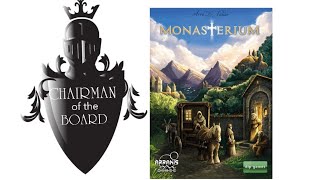
Monasterium (which is Latin for "Monastery") is a strategic game with an innovative dice mechanism that presents the players with ever new challenges. The game includes a double-sided game board: one side for the game for two and one side for 3-4 players.


Mechanics (from transcript analysis)
Video topics + discussion points
Quotes (from this video)
References (from this video)

- rich dice drafting with meaningful choices
- strong thematic flavor
- interactive player dynamics
- learning curve
- not optimized for two players
- religious life, devotion and community planning
- medieval monastery world with monks, donkeys delivering goods
- dice drafting with storytelling and tableau-building
- Weather Machine
Mechanics (from transcript analysis)
- Dice Drafting — roll dice and assign by value to actions; donkey cart route
- Dice Placement — place dice to build actions and stained glass windows progress
- dice placement and tableau building — place dice to build actions and stained glass windows progress
Video topics + discussion points
Quotes (from this video)
- this was truly scientific
- the reasoning that people were giving for why they picked what they picked was just crazy
- Beatrice the board game dog eating blueberries basically yeah
- it's a satire capitalism
- a euro game about monks and little tiny puppies
- the donkey cart
References (from this video)
- Strong mechanics
- Good four-player play
- Beige euro with solid depth
- Theme is less flavorful
- Beige aesthetic may be off-putting to some
- Beige euro with dry, engine-building focus
- Beige euro-style mechanism-driven thematic
- Mechanics-driven rather than thematic storytelling
Mechanics (from transcript analysis)
- Engine Building — Core engine-building mechanics drive actions and scoring
- engine-building / resource management — Core engine-building mechanics drive actions and scoring
- Higher player count interaction — Plays well at 4 players; interaction through shared market/resources
- Positive Player Interaction — Plays well at 4 players; interaction through shared market/resources
Video topics + discussion points
Quotes (from this video)
- it's reminiscent of Sentinels of the Multiverse in that each character has their own unique deck
- it's dry
- it's a beige euros
- the mechanics are so good
- it's very clean, streamlined and clever
- Co-op or competitive
References (from this video)

Mechanics (from transcript analysis)
Video topics + discussion points
Quotes (from this video)
- I adore this game this is on my Game of the Year winners a couple years ago and that is Guild Master
- it's a great game I love it
- don't pay a crazy price for it so if you want to pay 500 for it let me know and I will sell you mine for twelve hundred dollars
- I think Scott Caputo is one of the best tile laying designers out there
- I love the dice combat it's random as heck you lose you win it's just a great game
References (from this video)

- The host and wife liked the game.
- Host has a fan-made solo mode.
- Some players disliked it at 4 player count, feeling behind.
Mechanics (from transcript analysis)
- Dice Rolling — Players are trying to get specific dice.
- Player order — Some players felt disadvantaged by going late in the turn order.
Video topics + discussion points
Quotes (from this video)
- this is going to be the last monthly menu of the year
- all of us like that game and we got a four player game and oddly enough for as much as we all like the game for a couple of the players playing at 4 they actually liked it less and they felt like they were just behind the eightball and they couldn't get the dice that they wanted
- it is a hot mess of a game in regards to what what's on the table it sprawls it is huge there's constantly changing room abilities so there's a lot of stoping what does that do and there's a constantly changing Market it's like oh wait what does that do and there's all these spells they breaking the rules and all these things I adore it it is such a cool game
- this is one of those games that I will only play with the right people that's it and I truly don't care if I win or lose which is good cuz I keep losing but you play with the right people and it's just so much fun you have your little accusations flying around the table but it's just relaxed and it's fun and it's great and if you know the and if you know the TV show it is so very thematic
- it's a clever game it's a clever little game it's got these super cute little robots and super cute little animal assistance that you can get and use and it's a good light simple game I really do enjoy it's very clever I don't know that it reaches the heights of The Magnificent or revive for me but that's a real high bar and this is a game that I think is very much intended for more of a family audience bit simpler
- I love this game and Original Don and I we play it decently regularly when we're kind of at the end of the night and if it's just us we'll just pull it out we'll play it cuz it's now it's relatively quick for us to play and it's just delightful
- the metal dice for this thing are ridiculous there's they have no business existing and just the dice I think costs significantly more than the game but they're just amazing there are these awesome Dice
References (from this video)
- Innovative dice drafting that builds a dynamic engine as you unlock more options
- Clear and attractive visual language with a bright Euro aesthetic
- Tight pacing enabled by the three-round structure that keeps play snappy
- Strong player progression through upgrades on the personal boards
- Good scalability with different player counts and a useful double-sided board
- Multiple viable strategies and objective paths encourage varied play styles
- No solo mode available, which limits solo play options
- Three-round structure can feel rushed for some players, constraining long-term planing
- Religious life, community building, and competing for ecclesiastical influence within a town or region.
- A medieval monastic setting with churches, cloister, and chapels arranged on a central board; the layout is thematic to religious community life and pilgrimage routes.
- Euro-style strategic resource management with a strong emphasis on engine-building through progressive board and token unlocks.
- Yahtzee-style dice rolling (referenced as a point of reference for dice mechanics)
Mechanics (from transcript analysis)
- area control with round-based scoring — Pt allocation and majorities hinge on the distribution of worshipers across churches and cloister areas, with timing affecting scoring potential.
- Dice Drafting — Each player rolls a set of dice and drafts from pools laid out on the board. Dice values determine which actions are available, and some dice remain protected for a given player, preventing others from stealing them.
- double-sided board and scalable player count — The board and die pools scale with player count and are swapped to keep balance, maintaining a tight Euro feel across player configurations.
- pattern/board development and resource management — Players deploy worshipers into buildings and chapels by paying resource tokens (food, tools, books, and influence). Unlocking stained glass tiles and board rows expands future options.
- Point Salad — Points come from majorities in churches, the number of chapels occupied, and fulfillment of public objectives tied to church layout and completion timing.
- set collection and scoring via churches and cloister — Points come from majorities in churches, the number of chapels occupied, and fulfillment of public objectives tied to church layout and completion timing.
- tile and token upgrading — Stained glass window tokens and upgrade options on the player board allow new actions and points to be accessed as the game progresses.
- variable action selection per turn — Dice determine how many actions you can take per turn, with certain actions being limited or unique per turn. The system balances risk and reward by controlling how much you commit early.
Video topics + discussion points
Quotes (from this video)
- This one is a dice drafting game which is one of my favorite mechanisms.
- The dice drafted mechanism is something I really like.
- The balance of the game as well is really good.
- Extremely accessible but still has lots of interesting decisions throughout.
- The three-round structure keeps things tight and focused, and the rounds fly by.
References (from this video)
- smooth dice-drafting system
- well-rounded euro mechanisms
- compared to heavier dice-drafting titles, may not stand out as highly as top-tier euros
- monks, churches, and monasteries through dice allocation
- dice drafting within a monastic-themed setting
- light, abstract euro with a historical flavor
Mechanics (from transcript analysis)
- action allocation — players allocate dice to advance on different tracks and build up a scoring path
- Dice Drafting — dial-in actions by drafting dice values to take actions and progress on a road
Video topics + discussion points
Quotes (from this video)
- This is probably one of my favorite Uwe Rosenberg games I've played to date.
- it's a weird one because it's kind of like a full-size game but didn't quite feel like it
- the rules overhead was quite high in terms of remembering what they do
- usually trying to build these routes and establish these with blocks and then get the cards
- it's a pretty much a paint by numbers deck builder game