

Moonshine Deep Dive
What the Community Thinks About Moonshine
Moonshine is a dice-based engine builder in which every player runs a speakeasy, races to 12 prestige points, and tries to satisfy customers who want the same icons the dice produce. The reviews gathered here are warm. They praise the balance, the artwork, and a design that rewards patient engine building. Board Gaymes James compared it directly with NAR, the game from the same designer, and judged Moonshine much more balanced, because NAR felt runaway-leader prone. Watch It Played described playing it on Board Game Arena and said the reviewer really enjoys it.
Not every voice is independent. The Get into Games segment features Karina from Hachette Board Games UK, whose company is selling Moonshine and promoting it at UK Games Expo. Karina's praise, including the game's nomination for best dice game, comes from someone with a commercial stake in the game's success. The other channels were reviewing it as players.
Core Mechanics That Define Moonshine
Dice Rolling
The active player rolls, and every player then uses the icons that appear to satisfy their own customers. Because the pool is shared, a roll you did not make can still power your turn. As James explained, placing a moon token on a die color you lack lets you use that color during the action phase, even when another player rolled it. Some speakeasy abilities add a free reroll, and rerolls can apply to any number of dice once per roll. If no icon is usable, a player can take a moon token instead, but a full moon supply can force a player to discard a card they were working on.
Engine Building Through Customers
Customers are the engine. Validating one means paying its icon cost, such as five music icons and three moons in James's example. In return it grants a permanent bonus, which might be prestige points, a cocktail token, an extra card to keep, or an additional roll. Those bonuses are tucked under your speakeasy and make the more expensive customers reachable later. Karina said the engine softens the randomness of the dice, which matters to a player who is, in Karina's words, terrible at rolling dice. Watch It Played noted that the engine takes a little time to get going, but once it does, there is always a good option.
The Moonshine Experience
Everyone Stays in the Action
Once a table has learned the rules, Moonshine is played simultaneously. James recommended that the first turns be taken one player at a time so everyone learns the flow, then the table switches to simultaneous play. Karina highlighted that because everyone activates dice on each roll, nobody sits idle. Even a poor roll gives each player something, which Karina said kept them engaged despite a short attention span. The result is a game that keeps the table moving, with decisions that stay live for everyone.
Luck Swings and a Rough Start
The experience is not free of frustration. James had a run of bad card draws and said James was having terrible luck, while James's opponent was crazy lucky at the end of the game. Early on James also said James was unsure how the moon economy worked and asked when new customers could be drawn. Karina admitted to being terrible at rolling dice, and Karina's view was that building the engine is what carries a player through bad rolls. Karina's view is that the engine can recover from a bad roll, while James's game shows how the early turns can feel rough.
What Makes Moonshine Stand Out
Asymmetric Speakeasy Starts
Each speakeasy begins with its own ability, and James found the differences meaningful. One lets a player see more cards when drafting and gives an immediate moon, while another grants a free reroll. The random speakeasy variant changes setup so that players shuffle the customer cards and keep a number matching their plus sign, and the game then ends at 15 points rather than 12. James also observed that mixing the advanced and standard speakeasies made the setup feel a little messy, so the variants are best used deliberately.
Art and Production
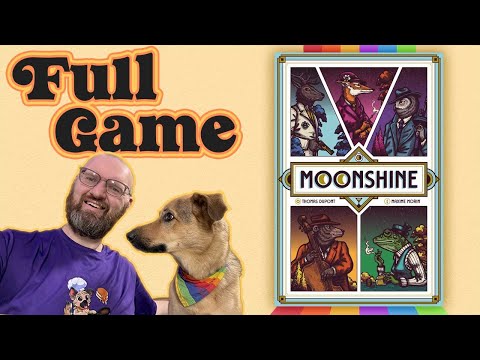
Watch It Played called the artwork stunning, and Karina described the cards as chunkier, tarot-sized stock that feels substantial on the table. The nomination for best dice game gives the game extra visibility at the convention, and Karina said the team plans to put it on a dedicated table where all the nominated games will be shown. For a dice game that asks players to look closely at icons and card text, clear and attractive production matters, and the artwork is the first thing Watch It Played praised.
Potential Drawbacks
Component Quality
James's copy had cards that were bent, which James attributed to humidity, and James found that bending them the other way did not straighten them out. James also said the holographic element on the cards was barely visible. These observations come from a single copy, so they may not represent the retail version. They are still the only component concerns in the reviews gathered here, and they are worth checking when a copy arrives.
Learning Curve and Luck
The rules bring together dice faces, moon tokens, customer costs, and speakeasy abilities, and James needed guidance through the early turns. James also questioned how useful some card abilities were, saying James had yet to see one that was really helpful during James's game. Because the game is driven by dice and card draws, luck can decide close games. James felt that luck was the deciding factor in James's own loss, saying James's opponent was crazy lucky late on. Players who prefer a tightly controlled decision space may find this randomness hard to accept.
If You Enjoy Moonshine
NAR is the obvious comparison because James linked Moonshine to the designer of NAR and judged it the better balanced of the pair. James disliked NAR for its runaway-leader tendency, so NAR is a reasonable pick only for players who want to compare the designer's earlier approach, not for players who want balance. Splendor is the other comparison. Karina described Moonshine as a nice evolution from something like Splendor, which is a good match for players who enjoy building an engine of permanent bonuses. The dice and speakeasy abilities add variance and a bit more strategic depth on top of that familiar rhythm.
What Reviewers Are Saying
"I did not like NAR. I mean, it's because I felt like it was very unbalanced, runaway leaderish. This was much more balanced."
— Board Gaymes James
"It's a dice game where you're building your little engine so it kind of mitigates the dice rolls because yet again I'm terrible at rolling dice."
— Get into Games
"It takes a little time for the engine to get going, but once you do, you're using some dice to unlock a new person, and you can use these moon tokens to unlock different special abilities as you go through. So there's always a good option."
— Watch It Played