







Munchkin Deep Dive
What the Community Thinks About Munchkin
Munchkin occupies a fascinating fault line in modern board gaming. For some, it remains a beloved gateway game that introduced them to the hobby. For others, it exemplifies everything wrong with a design that prioritizes chaos over coherence. Reviewers consistently praise its humor and social energy while simultaneously criticizing its fundamental mechanics. The consensus, if it can be called that, is split: Munchkin works brilliantly as a casual social experience with drinks and friends, but falters badly when played as a serious game.
Core Mechanics That Define Munchkin
Dice Rolling and Randomness
At its heart, Munchkin relies heavily on dice rolls to resolve combat and escape attempts. Players roll to see if their character survives monster encounters, and the outcome swings wildly based on that single die. This mechanic injects chaos by design into every turn. Steve Jackson Games has woven randomness throughout the system, but reviewers consistently identify this as the game's defining weakness: good play cannot overcome a series of unlucky rolls, and a fortunate draw of high-value items early in the game creates a structural advantage that strategy alone cannot overcome. The randomness isn't balanced by other mechanisms; it simply dominates.
Card-Based Trading and Deal-Making
Unlike traditional games where negotiation is optional, Munchkin makes deal-making central to survival. When facing a monster you cannot defeat alone, you must convince other players to help you, usually by offering them treasure, cards, or promises of future cooperation. This creates the game's most memorable moments: temporary alliances form and shatter as players balance self-interest against mutual benefit. Players can also trade equipped items with one another, further enabling the social negotiation that makes casual play enjoyable. However, this same mechanic enables the game's most frustrating dynamic: kingmaking, where players with no chance to win can decide who will.
The Munchkin Experience
Chaotic and Unpredictable
Munchkin feels like a game where the board state never settles. Monster encounters can chain together, curses randomly strike players, and player interference happens constantly. Players hoard cards, block each other's progress, and laugh (or groan) as someone's luck turns instantly from favorable to catastrophic. The chaos is deliberate and, for many, the point. Players aren't trying to solve an elegant puzzle; they're riding waves of madness and hoping to survive them. This works beautifully for 90 minutes with the right group.
Humorous and Party-Game-Like
The card design is heavily comedic, filled with puns, pop-culture references, and absurdist scenarios. Characters can become vampires, use enchanted weapons with silly names, and equip ridiculous items. The flavor text on cards reinforces the tone: this game doesn't take itself seriously, and it invites players into that irreverence. For groups already comfortable with banter and silliness, the humor lands consistently and drives replayability. For groups that prefer mechanical depth over comic relief, the same jokes grow stale quickly.
What Makes Munchkin Stand Out
Accessible Gateway Design
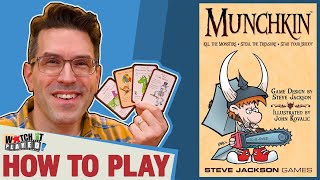
Munchkin's rules are genuinely simple: kick down doors, fight monsters, level up. The core loop is immediately understandable to players new to modern board gaming. The game teaches itself through card text and play. Unlike games with deep rulebooks and indexed exception lists, Munchkin lets players start playing within minutes and learn nuances as they go. This accessibility has made it an entry point for countless hobbyists who discovered modern gaming through Munchkin before moving on to heavier, more strategic titles. The game has spawned an enormous ecosystem of themed expansions (Marvel, Star Wars, Nightmare Before Christmas, and many others) that let players engage with the same mechanics in different intellectual properties.
Memorable Social Moments
When Munchkin works, it creates moments that players remember for years. Betrayals land harder because everyone is playing allies one moment and enemies the next. Improbable comebacks happen because a single die roll or card draw can flip the entire board state. Players form inside jokes around specific cards and recurring situations. The social fabric of the table becomes as important as the mechanics themselves, and for groups that value that social energy, Munchkin delivers consistently.
Potential Drawbacks
End-Game Stalling and Artificially Extended Play
As players approach level 9, one level away from victory, the game's worst impulses emerge. With victory in sight, other players collectively decide to deny anyone the final level. Players hoard cards, play defensive curses, and refuse aid in combat. A game that should last 90 minutes stretches to two or three hours of players preventing each other from winning while making no progress of their own. The designer's intent, punishing players who get too close, creates an anti-game state where nothing meaningful happens. Combined with the luck-driven nature of early game progression, many players find the final stretch unbearable.
Randomness Without Agency
The core problem reviewers identify is that Munchkin's randomness operates independently of player skill. A player who draws three high-value items in their opening hand will have a structural advantage no amount of clever play can overcome. Conversely, a player dealt poor starting items faces an uphill battle for the entire game. While catch-up mechanics exist (trailing players draw more cards), they don't actually solve the fundamental imbalance. Players report that winning often feels less like clever strategy and more like being lucky enough to draw the right cards at the right times. This undermines satisfaction for anyone playing to win.
If You Enjoy Munchkin
Players drawn to Munchkin's social deduction and chaotic backstabbing should explore Skull, which strips the same social energy down to its purest form. Skull delivers the bluffing, betrayal, and memorable moments that make Munchkin fun without the randomness and end-game stalling. It plays in 30 minutes, generates the exact backstabbing energy Munchkin aspires to, and never overstays its welcome.
What Reviewers Are Saying
"The humor on the cards is funny, especially if you have a background in role-playing games, and the backstabbing and temporary alliances can make it feel like a party game elevated by a geeky aesthetic. But we are a gaming group, and Munchkin does not hold up as a game. The randomness is completely unmitigated."
— Board Game Critique
"I still remember this about 15 20 years ago now where I had a player who was about to go for the win, did not want them to win. So it's like I convinced them to help them in the combat so I can share the win as well. However, I played change class of myself. I turned myself into a wizard and the wizard has a power. They can take their entire hand, discard it and get rid of the combat."
— One Stop Co-op Shop
"You're trying to get to the very end and get it, I think it's level 10 at the very end. And you're just like going and defeating monsters and kicking down doors. It has a lot of like those RPG elements which makes it a lot of fun."
— Board Games UnLocked