/pic7229381.jpg)
Mystery of the Abbey is a whodunit deduction game in the spirit of Clue. A monk has been murdered in a medieval French Abbey. Players maneuver their way through the Abbey examining clues and questioning each other to find out who is the culprit.
Monks are of three orders, fat-thin, bald-hatted, bearded-clean shaven. One monk card is hidden, and the rest of the cards are distributed. Turns consist of moving up to two spaces, and then asking a question of any other monks who are present there. (For instance, "how many fat monks do you have?".) Players may either take a "vow of silence" or answer truthfully; they then in turn get to ask the accuser a question. "Mass" occurs every four turns: all players go back to the Sanctuary, an event card is read, and they then pass an ever growing number of cards to their left neighbor. Various rooms have special events or cards associated with them, e.g. in a Cell you get to pick a card from a neighbor, in the Cryptorum you get to pick up a card to take an extra turn later. Unlike Clue you don't automatically win by making a correct Accusation: you get 4 points for getting it right, but you also get 2 points for each correct Declaration of a single trait, and lose points for incorrect declarations and accusations. So, e.g. a person could correctly Declare the culprit but lose the game. Unique Events cards add randomness to each play, and the game begs for House rules to limit the questions.

- Fun game
- Full of surprises
- Engaging deduction
- May not be in print
- Solving a murder
- A monastery in the 13th century
- Clue
- The Name of the Rose
Mechanics (from transcript analysis)
- Deduction — Great deduction game.
- Set Collection — you're asking other players uh you know about the monks they have. You know, do you have this monk? Do you have that monk?
Video topics + discussion points
Quotes (from this video)
- All right, ladies and gentlemen, going ahead to look at my numbers 90 through 81. Again, my top 100 games of all time.
- So, a lot of new games here and some older games that uh
- Really a lot of fun. So I really like Coober Libre.
- frankly is just a hoot. It is a lot of fun.
- But you cannot talk. You can't talk to each other. And so it's crazy trying to communicate just by placing these dice and hoping that the other guy understands what's going on.
- It is fantastic.
- This may be one of my absolute favorite Hex Encounter World War II games of all time.
- But this is the Barracks Emperors from GMT Games.
- Really fun cooperative game with that pandemic feel. One of the better of the pandemic games in my opinion.
- I really enjoy uh, Heat Pedal the Metal. fun racing game, fun system, very intense.
- Mystery of the Abbey is such a fun game.
- It is a very fun game. It's full of surprises and ups and downs, and you're trying to learn as much as you can without giving too much away yourself.
- Great deduction game.
- This is a game I really liked and wanted to see take off, but I just I never got never really saw too much happen.
- an absolutely fantastic game that really needs more love.
- It's just great fun and it's very inventive the way they're using the cards here.
- I really quite enjoyed it.
- I I I think Expeditions to me is just a much more fun game.
- I love the world building here and the artwork here, the components. They did a great job.
- really, really fun game.
- Do you like these games? Do you not like these games? Would you put them higher? Would you put them lower? not here at all. Let me know what you think.
References (from this video)

- classic deduction game vibe
- backed by Days of Wonder
- murder mystery deduction in a classic setting
- medieval abbey with a monk murdered; deduction in the spirit of Cluedo
- investigative, deduction-focused
- The Lost Code
Mechanics (from transcript analysis)
- Deduction — players deduce clues to identify the culprit
- questioning — players question others to gather information
Video topics + discussion points
Quotes (from this video)
- Evadale the board game about Sweet Little Critters just trying to get along until it isn't
- the theme paired with the art and the plain old whimsy
- the warm and cozy world full of cuddly cats Comes Alive as the quilts Bend under the weight of these felines roaming around
- you can pet them and you can shoo them away when they get in the way
- The Insider dun dun dun it makes sense
- almost Cooperative trick taking game where players try to complete as many missions as possible while The Insider gathers Intel and sabotages the team's work
References (from this video)

- Fun early deduction experience; thematic flavor
- Many newer deduction games surpass it now
- the Name of the Rose-inspired detective work
- monastic mystery with deduction
- deduction-themed with thematic humor
- The Name of the Rose (inspiration)
Mechanics (from transcript analysis)
- Deduction — Players deduce who did what as monks in a murder mystery.
- deduction / social inference — Players deduce who did what as monks in a murder mystery.
- hidden information / oath tokens — Players hold information privately and reveal it strategically.
- Hidden Roles — Players hold information privately and reveal it strategically.
Video topics + discussion points
Quotes (from this video)
- this was the game that put cooperative games on the map because I played this I played Lord of the Rings from Knizia, but this was the game that did it and also added that traitor aspect which was so interesting.
- I really enjoyed playing it.
- the cleanest version of Carcassonne I think
- Mystery of the Abbey is fantastic.
- It's a game of pure logic until it's not.
References (from this video)

- This game has dropped for me quite a bit
- the production was so problematic
- Logic deduction
Mechanics (from transcript analysis)
- Logic deduction — This is one of the first logic deduction games.
Video topics + discussion points
Quotes (from this video)
- Hey everybody, I'm Tom Vasel. Welcome to look back, a series where I take a look at games that I reviewed last year, 5 years ago, 10 years ago, and 20 years ago this week and tell you what I think about them now, if I think about them at all.
- So, let's jump back 20 years ago. I reviewed a game called Astro Plane, which was an abstract strategy game that almost required you to completely understand astrophysics to play it. It was not very good at all. I gave it a two out of 10 and it is one of the first times where the designer wrote me a very strong rant and went online and pretty much attacked me for being too stupid to understand this game, but it was pretty bad.
- I'm noticing games from 10 years ago didn't look necessarily great.
- And then surprisingly to me the game Face to Face. This is a two-player version of The Game. And I don't I think The Game is at best okay. But The Game Face to Face, that two-player version of it, I thought worked really well.
- So, this is a game where uh that Stonemaier Games did where I was like, "What is this Red Rising?" I went and read the the first trilogy so I could better play this game, which didn't matter because the theme is barely there.
- This is sort of like a Blackjack but with algebraic equations.
- Um algebra in a game, but I'm just amused by it.
References (from this video)
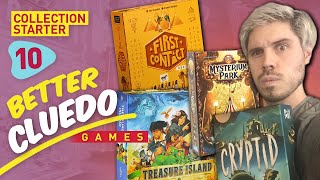
- dynamic room-based info and interactive questioning
- thematic gimmicks (abbey mass, room powers) add flavor
- replayable with bluffing and deduction tension
- heavy on rules for newcomers
- historical/clerical theme may feel niche
- murder investigation with monk-side actions and room-based information
- medieval abbey with monks
- humorous, clerical ambiance with bluffing and deduction
- Cluedo
Mechanics (from transcript analysis)
- hand/monk card information — players discuss and query others about the hand of monk cards to glean information
- periodic mass/ritual event — every four turns a mass occurs, resetting or reshaping information flow
- room-based information and powers — being in a room grants access to special information or abilities
Video topics + discussion points
Quotes (from this video)
- this is the collection starter and here are the top 10 games like cludo but better
- it's brilliant
- the perfect next step
- production-wise it feels like a million bucks
- it's quiet tense and thinky
- a tense beautiful little puzzle gameplay stuffed with side eye pirate paranoia
- you've got this map in front of you which can be broken up and arranged in many different ways depending on the scenario you're playing
- it's an awesome film about language the nature of communication