


New Cold War Deep Dive
What the Community Thinks About New Cold War
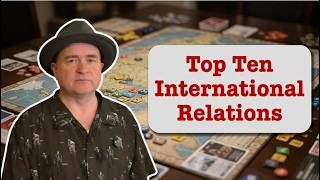
New Cold War has earned strong enthusiasm from the strategy board gaming community, particularly among reviewers who specialize in geopolitical themes and card-driven systems. The Discriminating Gamer ranked it number 7 on their all-time list of international relations games, positioning it just below Twilight Struggle itself. Zilla Blitz, who has covered the game multiple times, describes it as "Twilight Struggle on steroids," capturing the essential DNA of the modern classic while pushing the design in new directions. Reviewers consistently praise the game's scope, production quality, and educational depth, though they note its significant time commitment.
Core Mechanics That Define New Cold War
Card-Driven Event System
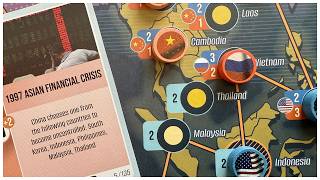
At the heart of New Cold War lies a card-driven engine featuring 135 event cards representing over 100 distinct historical events. Players deploy these cards to pursue geopolitical objectives, influence regions, and trigger major events that mirror the last three decades of modern history. What makes the system compelling is the breadth of events included: the game draws from Afghanistan, Iraq Wars, cybernetic warfare, the Tiananmen Square massacre, Putin's rise, and the Balkan Wars. These cards span three decades chronologically, meaning the game progresses through distinct historical eras. The simultaneous card-play mechanism, where how players orient their cards matters, creates tense moments of uncertainty as players commit resources without knowing their opponents' moves.
Regional and Sub-Regional Control
Victory in New Cold War comes through geopolitical dominance mapped onto the real world. The board divides into 7 major regions, each worth victory points, further subdivided into 13 sub-regions that hold their own strategic value. Players manage stability ratings within countries, nurture "orbit countries" aligned with their bloc, and battle for regional prestige. The system is sophisticated enough to reward careful long-term planning, since controlling both a region and its vulnerable sub-regions multiplies scoring opportunities, yet the visual design makes parsing each zone intuitive once learned.
The New Cold War Experience
Modern Historical Tension
New Cold War trades the classic Cold War atmosphere of Twilight Struggle for something rawer and more immediate: the geopolitical chaos of the past 30 years. Reviewers consistently highlight this shift as the game's greatest strength. Where Twilight Struggle evokes history textbooks, New Cold War feels like playing through the headlines you remember. The game begins in 1989, the fall of the Berlin Wall, and extends to 2019, spanning three distinct decades of international conflict, expansion, and realignment. This timeframe brings in events most players lived through or remember vividly, creating a visceral connection between the abstract board and real-world consequences.
Strategic Depth Without Sacrificing Pacing
Despite covering 30 years of history and offering multiple paths to victory, New Cold War maintains a streamlined experience. Players compete for direct control, prestige, and automatic victory through objective cards, and multiple win conditions prevent any single strategy from dominating. The game plays in roughly three hours, a tight window for managing a global power struggle. Reviewers note this as a deliberate improvement over sprawling geopolitical wargames, letting four players (or a solo player with the bot system) resolve an entire Cold War arc in a single evening.
What Makes New Cold War Stand Out
A Fully Realized Solo Bot System
The inclusion of a comprehensive solo bot system sets New Cold War apart in a crowded field. The rulebook devotes substantial space to managing AI opponents, with flowcharts and decision tables that feel genuinely fleshed out rather than tacked on. Zilla Blitz, while noting the box rates solo suitability at 8 out of 10, argues the actual implementation deserves a 10 out of 10, since the bot rules are so robust that players can confidently pilot the game solo or in any player-count combination. This makes New Cold War accessible to the solo wargamer or the player who occasionally has only one seat filled at the table.
VUCA's Uncompromising Production Design
VUCA Simulations has cultivated a reputation for visual and tactile excellence, and New Cold War delivers. The wooden tokens eschew stickers for markers burned directly into the wood, eliminating peeling and wear over time. The mounted map spans 22 by 34 inches, depicting Earth in a modern aesthetic that feels contemporary rather than historically recreated. The color palette, layout, and graphic design create an immediate sense of sophistication when the game unfolds on the table. Reviewers consistently praise the presentation as enhancing the experience, since the game does not merely inform players of its theme but immerses them through deliberate design choices.
Potential Drawbacks
No Shorter Scenarios or Entry Points
New Cold War offers one campaign experience: the full 30-year arc from 1989 to 2019. There are no shorter scenarios to teach the game, no single-decade quickstart options, and no introductory variant. Players must commit to learning the complete ruleset and playing through all three decades to reach a conclusion. For groups seeking a lighter alternative or a way to audition the system in a single sitting, this is a significant limitation. The learning curve is manageable thanks to clear rules and an extensive tutorial, but the time requirement, averaging three hours per game, means New Cold War is not a casual weeknight experience.
Heavy Rules and Mandatory Bot Management for Small Groups
With only one to four players and four mandatory superpowers, any table smaller than four must run one or more bot opponents. While reviewers praise the bot system's quality, managing bot flowcharts alongside human decision-making adds cognitive overhead. New players controlling even one human power while piloting a bot opponent can feel pulled in too many directions early on. The rulebook, though well-laid-out and graphically supported, spans 48 pages, 24 of which cover core rules, with another 10 devoted to bot mechanics and 8+ for reference. This is not an overwhelming volume, but it signals that New Cold War rewards players who invest time in mastery.
If You Enjoy New Cold War
The obvious recommendation is Twilight Struggle, the classic two-player card-driven wargame that shaped New Cold War's design DNA. Twilight Struggle focuses on the original Cold War between the US and Soviet Union, delivering tenser head-to-head play with less administrative overhead. If you find New Cold War's geopolitical scope and modern events thrilling, Twilight Struggle offers a deeper, longer-playing experience with a narrower historical lens. Both games share the card-driven event system and the tension of making hard choices with imperfect information, but where New Cold War spreads competition among four powers across 30 years, Twilight Struggle concentrates two superpowers across four decades of brinkmanship. Players who love modern geopolitics and the 1989–2019 span should start with New Cold War; those seeking the definitive two-player Cold War experience should graduate to Twilight Struggle.
What Reviewers Are Saying
"This one to four player game covers the span from 1989 to 2019. In many ways it reminds me of Twilight Struggle on steroids. There's a full solo bot and it's playable by as many as four players."
— Zilla Blitz
"It's hard, as you look at this game, not to draw comparisons with it to Twilight Struggle, and one of the key differences between this game and Twilight Struggle is this game feels modern. I mean, the game listed goes up to 2019, but a number of these historical figures, events, and activities are happening in modern times. So this game has a much more modern feel to it than Twilight Struggle, which to me feels more of that classic Cold War historical element to it."
— Zilla Blitz
"New Cold War is a great game, again, taking a look at fairly recent history. Players four players take on the roles of the United States, the EU, China, and Russia. And this is cool because you kind of play your cards down simultaneously, but how you orient them kind of matters. And then you play the cards, but you're competing, of course, for international influence, but also for, obviously, the prestige that comes with that. We have a lot of little kind of area control battles around the world, around the periphery of the board, that you're trying to score these different regions. It's a very fun game, New Cold War."
— The Discriminating Gamer