





Noobs in Space Deep Dive
What the Community Thinks About Noobs in Space
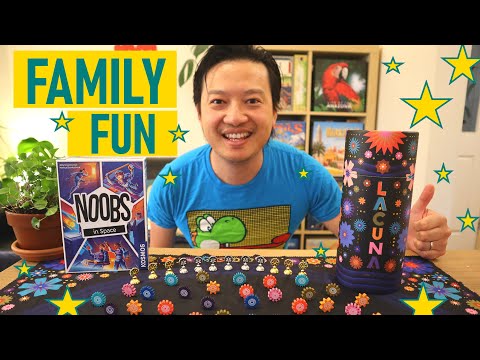
Reviewers describe Noobs in Space as a small, distinctive cooperative game that rewards talking through a problem out loud. The Dice Tower calls it one of the host's favorite little games, praising how unusual and fun it is. Board Game Sanctuary places it among games that are easy to teach and that non-gaming family members tend to enjoy. Chairman of the Board is the most measured, calling it a pleasant niche option rather than a standout, appreciating the time pressure and cooperative focus while finding the design less rich than the genre's more celebrated titles. The consensus: a lively, short session for a group that does not mind a loud, chaotic table.
Core Mechanics That Define Noobs in Space
Hidden Partial Information and Verbal Communication
The defining mechanic is that every player holds only a fragment of the solution. The Dice Tower explains that everyone is dealt cards, solved by speaking aloud, with the only restriction being that players cannot show their cards to one another. Board Game Sanctuary describes holding a quarter or a third of a puzzle and needing to communicate with teammates to solve it collectively. Chairman of the Board observes that each individual task is easy to understand, and the real challenge comes from coordinating under time pressure, which makes the game feel closer to a team-building exercise than a logic puzzle.
Sequencing Across Mini-Game Style Missions
The campaign is organized into missions built from tasks the group must complete in a specific order. Board Game Sanctuary frames the core as sequencing rather than deep puzzle solving: getting the right player to play the right card first, in the correct order, through call-and-response tasks and puzzles that require laying things out correctly. Chairman of the Board notes the same cards are reused in different ways across puzzles, calling that recycling very clever, though it also becomes a focal point of criticism discussed below.
The Noobs in Space Experience
Pressure, Laughter, and a Race Against the Clock
The Dice Tower says the game is hilarious and fun, pointing to the cacophony that results when players with different instincts try to explain tasks to each other. Board Game Sanctuary argues a countdown timer improves the experience because it adds pressure the game needs; without it, players can spend minutes describing every card in detail, pulling them out of the game. Chairman of the Board frames the central challenge as keeping a cool head while the clock encourages rushing and talking over one another.
Novelty Early, Familiarity Later
Board Game Sanctuary says the novelty of the puzzle types in the opening missions was a highlight, particularly a call-and-response challenge involving every player, contrasting that early variety with later stages where familiar components recur. Chairman of the Board notes that once the group settles into a rhythm, the game becomes enjoyable and clever.
What Makes Noobs in Space Stand Out
An Approachable Escape-Room Alternative
Chairman of the Board suggests it suits players who enjoy the escape-room concept but are feeling fatigued by the format, describing a session of roughly an hour to an hour and a half for the whole campaign. Once a group finishes, the game can be passed along without being destroyed, so it does not clutter a collection. Board Game Sanctuary stresses that it is simple to teach and quick to set up, recommending it to people who want to practice teamwork and clear communication.
Cooperative Design in the Cosmos Tradition
Watch It Played notes that publisher Cosmos has built a reputation for cooperative, mission-based card games with limited information, with trick-taking titles like The Crew and Inside Job working well with groups. That lineage explains why the game feels distinct: rather than one shared puzzle, it distributes fragments of the solution across the table, so communication itself is the gameplay.
Potential Drawbacks
Reused Puzzle Components
Board Game Sanctuary says the puzzles begin to recycle across missions, with levers and diary entries pointing to instruction sets reappearing; after around the fourth mission, the reviewer wanted entirely new puzzles rather than reused cards, and suggested a competitive two-team mode could add energy. Chairman of the Board echoes that the game can feel a bit too sticky after a few rounds, even while praising the cleverness of the recycling.
Pacing Risk and Limited Depth
Board Game Sanctuary warns that players can spend minutes talking over every card, and recommends keeping the pace brisk rather than overanalyzing. Chairman of the Board adds that the game is more about sequencing than cracking puzzles, which may disappoint players wanting a deeper logic challenge.
If You Enjoy Noobs in Space
Watch It Played points toward the Cosmos catalogue as a natural next step, particularly The Crew and Inside Job, cooperative, mission-based card games with limited information that share the feature of distributing knowledge across players. For players who want the escape-room feel without a long session, Chairman of the Board frames Noobs in Space as a sensible bridge for groups who have grown tired of that format.
What Reviewers Are Saying
"Noobs in Space is one of my favorite little games that's so unique and interesting. You have a deck of cards, you deal them out to everybody. Everybody has cards in their hand, and then you just solve those cards by saying things out loud, working together to play cards, and hopefully you solve it."
— The Dice Tower
"And all these tasks by themselves are are very easy to understand. Um but it's the it's the pressure of the time and trying to get it done quickly and working together."
— Chairman of the Board
"I think what I really enjoyed about this game was that in the first three or four missions I really enjoyed the novelty and the freshness of the different types of puzzles that appeared. In particular, the one where you had to do a call and response, I felt that was quite a really cool puzzle to do because that kind of involved everyone who had the cards."
— Board Game Sanctuary