



Northwest Deep Dive
What the Community Thinks About Northwest
Northwest has captured reviewers' attention as an elegantly simple yet strategically rich tableau-building experience. The game, published by Brickhouse Games, presents an abstract design that combines beautiful components with accessible gameplay. Reviewers consistently praise the game's ability to deliver complexity through elegant mechanics, creating something that feels both immediately understandable and deeply satisfying to play. The hunting theme centered on collecting memories from a hiking journey in the Pacific Northwest resonates with players seeking thematic coherence alongside strategic depth.
Core Mechanics That Define Northwest
Dice Drafting with Shared Movement
The heart of Northwest lies in its innovative dice-drafting system. A single shared hiker meeple moves across the exploration board, and its position determines which die each player can claim. Rather than players choosing freely, the type of momento you collect dictates how the next player must move. If you draft a mushroom, the next player can move to any of the eight adjacent spaces. A fern forces orthogonal movement only. Maple leaves allow diagonal moves. Bees move in an L-shape like a chess knight. Bigfoot offers the freedom to move any distance in a single straight line. This creates a chain reaction where every decision simultaneously advances your strategy and constrains your opponents' options, generating constant tension and tactical interplay.
Tableau Building with Interconnected Scoring
Your collected dice form a personal 4x4 journal where placement is everything. Each momento scores in a completely different way, creating a multi-layered puzzle. Mushrooms give you points for each one you own, plus a bonus if you have the most. Ferns only score when they connect orthogonally to other ferns. Maple leaves score when placed diagonally adjacent to other maple leaves. Bees reward being surrounded by different types of momentos. Bigfoot demands isolated placement far from other bigfoot sightings. This tension between collecting sets and placing them strategically transforms every turn into spatial decision-making. You must think ahead about how the dice you draft will sit on your board, how they'll interact with future collections, and how your placement patterns will develop over the game's duration.
The Northwest Experience
Elegant Simplicity with Strategic Depth
Northwest can be taught in three minutes yet rewards careful planning and spatial awareness. Reviewers describe a game that feels almost inevitable once you understand the rules, as though it has always existed but simply needed discovery. The interface between simple rule explanation and intricate puzzle-solving creates an unusual satisfaction. Players spend the bulk of the game managing a continuous optimization problem: placing dice within a 4x4 grid where every position matters, every connection counts, and every choice has ramifications. The speed of play masks the cognitive engagement happening at each turn.
Beautiful Physical Presence and Accessible Theme
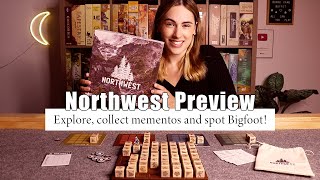
The components demand attention. The exploration board filled with 64 colorful dice cubes, the wooden hiker meeple, the tabletop aesthetic of the personal journals, and the deluxe components in the crowdfunded version create a game that belongs on display. The hiking theme provides enough flavor to anchor the abstract mechanics without requiring thematic immersion. The competition feels like friendly hikers collecting mementos of their journey, making the spatial puzzle feel purposeful rather than arbitrary. The game's visual design and tactile quality enhance rather than distract from the strategic core.
What Makes Northwest Stand Out
A Perfect Intersection of Accessibility and Elegance
What distinguishes Northwest is its rare ability to feel immediately understandable while remaining genuinely smart. Reviewers emphasize that games in this design space often either oversimplify into filler or overcomplicate until they're inaccessible. Northwest threads the needle. It delivers a balance of luck and strategy that works for casual play and engagement from experienced gamers. The shared movement mechanic ensures all players stay involved even on turns that aren't theirs, since everyone influences the next player's options.
The Bigfoot Hunt as Thematic and Strategic Hook
The presence of Bigfoot in the game serves dual purposes. Thematically, it adds whimsy and memorable flavor to the hiking adventure. Mechanically, Bigfoot sightings represent the highest-risk, highest-reward scoring opportunity. Because Bigfoot must be placed far from other Bigfoot to score five points each, claiming these rare dice creates exciting decision points. Players must commit to spatial strategies that isolate their Bigfoot findings, leading to memorable moments and surprising scoring swings. The hunt for these special momentos keeps play dynamic and prevents the game from becoming purely mathematical.
Potential Drawbacks
Shared Movement Constraints May Feel Limiting
The movement rules tied to the previous player's choice, while elegant, occasionally produce situations where no legal moves exist, forcing the game to end before all players fill their 4x4 journal. This can feel deflating when a player sits one or two spaces short of completion. While reviewers acknowledge this as part of the game's design, some players may prefer drafting systems that guarantee equal turns for all players regardless of movement legality.
Point Salad Complexity Requires Mental Tracking
Because every momento scores differently based on placement, adjacency, and connectivity rules, players must mentally simulate placement options before committing dice to their tableau. While the scoring rules themselves are straightforward, the combinatorial nature of placement decisions in a 4x4 space can create analysis paralysis for some players. Reviewers praise this depth, but it means Northwest appeals most to players who enjoy spatial puzzles and don't rush their turns.
If You Enjoy Northwest
If Northwest resonates with you, seek out other games that combine elegant tableau building with spatial constraints. Cascadia shares Northwest's focus on arrangement and adjacency bonuses within a compact grid, though with a gentler theme of Pacific Northwest ecosystems. For players drawn to the dice-drafting core, Calico similarly uses shared resources with placement puzzles. Arboretum offers the quick play and spatial elegance that Northwest delivers, though through card placement rather than dice. Splendor provides a lighter take on tableau building with economic strategy. If the abstract spatial element appeals most strongly, Azul's tile-placement puzzle and tight decision space create that same satisfying constraint.
What Reviewers Are Saying
It's simple, but it's so smart. It's just one of those wonderful games that feels like it should already have existed for a long time.
- Watch It Played
Honestly, legitimately, this has shot up the top of the games I want to hunt down. Like, it's Bigfoot. It really looks like it does what I specifically like. Me specifically. Hello, I'm Matthew. This one's really got me fired up.
- Watch It Played
This one has quite the table presence and honestly in my opinion like this would look absolutely amazing just like sitting on your coffee table this is something that I would put out on my coffee table kind of adjacent to like a chest set or something like that.
- The Board Game Garden