/pic4357658.jpg)







































On Mars Deep Dive
What the Community Thinks About On Mars
On Mars occupies a rare and contested space in board gaming: it is simultaneously celebrated as one of the most rewarding heavy euros ever designed and acknowledged as a game that will never reach a casual crowd. Reviewers who love Vital Lacerda's dense, interlocking systems tend to place On Mars near the very top of his catalog. Monique from Before You Play put it plainly, calling it one of her all-time top five games while admitting that "out of all of Lacerda's games, it probably has the largest overhead" in terms of rules to internalize. That tension, the gap between the effort required and the payoff delivered, defines how the community talks about On Mars.
Players consistently describe the experience of a first game as disorienting in a specific way: the systems are not opaque, exactly, but the connections between them take time to click. Getting Games captured this feeling vividly, comparing a first play to "stumbling around a dimly lit room pressing buttons and pulling levers," with new players doing things without fully understanding the strategic purpose behind them. That description resonates because the game's depth is not surface-level complexity for its own sake. Once the engine starts firing, something shifts. The same reviewer who described that stumbling first play called On Mars their favorite Lacerda game after just one session and said they were "looking forward to more plays," which speaks to the genuine pull the design has even before full mastery arrives.
What draws players back is the sense that mastery is genuinely achievable and worth pursuing. Three Minute Board Games framed it this way: On Mars is "an intricately woven game that combines a lot of subsystems into a larger whole," and that for players who want something they can "really dig into," the game rewards system mastery in ways few others do. The consensus is not that On Mars is for everyone. It is that for the right player, it is extraordinary.
Core Mechanics That Define On Mars
The Orbital Cycle and Location-Based Actions
The structural spine of On Mars is a movement system that forces players to choose between taking actions in orbit (the space station) or on the Martian surface. Unlike most worker placement games, you cannot simply go wherever you want on any given turn. Your player marker sits in one location, and moving between the two zones depends on the shuttle, a shared vessel that travels between orbit and colony on a schedule that slows as the game progresses.
Early in the game, the shuttle moves frequently, so players can alternate between the two zones every other turn. But as the colony advances and technology levels rise, the shuttle lingers longer in each location. This means the cost of being caught on the wrong side of the board increases dramatically over the course of the game. Getting Games described this arc clearly: at the start, you take a space action, catch the shuttle, take a planet action, repeat. Later, "it'll head up into orbit and it'll stay there for two turns and then go down to the planet and stay there for a couple turns," meaning a misplaced marker can strand you in an inopportune zone for several turns in a row. Players can build their own personal ships to travel independently, but doing so costs victory points, making the timing question a genuine strategic burden.
Orbit locations provide blueprints, technology tiles, scientists, contracts, and resources from Earth. Surface locations let you place building tiles on the Martian grid, advance your robots, construct advanced buildings, and trigger the colony track that pushes the game toward its end. Neither zone is optional. A player who ignores orbit starves their engine; a player who lingers there too long misses scoring opportunities on the surface. The interplay of when to commit to each zone, and how long to stay, is what Before You Play described as "a lot of forward planning" that rewards players who can read the board several turns ahead.
Tech Trees, Blueprints, and the Colony Track
Building on Mars is not as simple as spending resources to place tiles. Each of the four building types (habitat, oxygen, energy, and water, roughly) corresponds to a technology track. To build a structure at a given advancement level, the matching technology must have been pushed to that level by at least one player on the board. Crucially, this does not have to be your own technology. If an opponent has the oxygen tech at level three, you can build a level-three oxygen structure using their advancement and they receive a bonus for the use of their technology.
This shared-tech system threads a fascinating interdependency through what would otherwise be a purely solitaire engine-building experience. Three Minute Board Games noted that "the matching technology must also be advanced," explaining how collective progress unlocks individual opportunity. Getting Games elaborated on the texture of this, describing how "collectively somebody needs to have the right technology level to expand out that type of building" and how using another player's tech benefits them. It creates situations where you are tracking opponents not to block them but because their advancement opens doors for you, and vice versa.
The colony track itself acts as the game's central clock and scoring mechanism. Each time a building type is placed below the track's current level, the colony marker advances and the active player scores points and claims the track bonus. When all four building types reach the same level, the colony advances once more. Players who understand how to trigger these advances consistently can control the pacing of the game's end in ways that catch opponents off guard. Combined with blueprint cards, which let you claim projects that become advanced building sites, the construction loop in On Mars rewards players who can plan several moves ahead and sequence their orbit-to-surface transitions accordingly.
The On Mars Experience
The Feel of a First Play
Almost every reviewer noted the same thing about a first game: the rules teach in a reasonable amount of time, the component quality immediately signals that something special is in the box, but the strategic picture takes a full game to start forming. Getting Games played with an expert, Matt, who was listed on the rulebook as a lead playtester, and described the teaching taking about 30 to 40 minutes before a full four-player game that ran under two hours. The expert "pushed a lot of the endgame triggers" in ways the other players did not yet understand, but the reviewer still came away impressed. The gap between what new players accomplish and what an expert accomplishes is wide, but the experience of playing never felt meaningless.
That first-game learning curve is a feature and a barrier simultaneously. Three Minute Board Games was direct about it: "saying On Mars is complex is a bit of an understatement and no casual gamer is going near it." The reviewer also noted that the timing of executive actions and awareness of opponents' technologies "can grind the game to a crawl." These are real costs. But they are also the costs of learning any system complex enough to generate genuine strategic depth. Players who have made peace with that learning investment tend to describe the first full play as an introduction rather than a finished experience, and subsequent plays as the real game.
Emergent Paths and Table Presence
One of the qualities reviewers return to repeatedly is that On Mars does not play the same way twice. Three Minute Board Games described the game following "its own emergent path each play," a consequence of the combination of variable blueprints, different scientist abilities, player-driven tech advancement, and the shifting pace of the shuttle. No two games build the same colony, and the strategies that score well in one game may be closed off or less optimal in another.
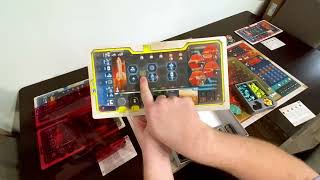
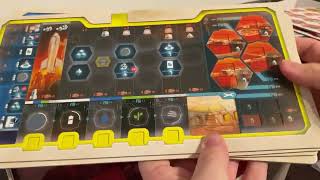
This variability is matched by physical presence. Three Minute Board Games called the table presence "the best thing about this game," describing it as massive. Board Game Coffee's unboxing captured the same quality from a component standpoint: the double-layered player boards that hold pieces snugly in place, the thick cardboard building tiles with 3D cutouts, the wooden robots and astronauts in distinct player colors, the blue crystal gems that multiple reviewers singled out as particularly beautiful. Ian O'Toole's art direction gives every piece a consistent visual vocabulary that is clean, thematic, and immediately recognizable. Before You Play's Monique described Lacerda's design philosophy as creating systems "that you need in order to form one larger thing," and that quality extends to the physical design of the game itself.
What Makes On Mars Stand Out
Lacerda's Signature Interconnection
Vital Lacerda is a designer with a recognizable style. Getting Games described it plainly: his games have "systems that feel very him," where interlocking subsystems feed back into each other to create a larger whole. Before You Play's Naveed described this as the thing that draws him to Lacerda in the first place: everything connects. "He designs all these components that you need in order to form one larger thing." On Mars represents that philosophy at its most ambitious scale.
What separates On Mars from its Lacerda siblings in many reviewers' assessments is that the connective tissue feels navigable once learned. Getting Games, speaking as someone who found Lisboa difficult to parse in play, said On Mars was different: "My head did not get bogged down in the details of how do I actually get this thing done. It seemed like I wanted to do a thing and I was able to relatively easily figure out how to do that thing." This is a meaningful distinction. The game is dense, but purposefully so. Each system points toward the goal of building and scoring. There is no subsystem that exists merely to add complexity. Every mechanism has a function in the larger colony-building logic, and once that logic clicks, the game opens up rather than closing down.
Strategic Depth and Mastery
On Mars rewards replay in a specific way. Three Minute Board Games noted that "there are a huge number of ways to score points and to build engines," which means that optimal play is not a single fixed path that experienced players memorize. The combination of tech trees, blueprint cards, scientists that unlock advanced building abilities, ships that provide additional workers and executive actions, and the colony track's timing incentives creates a strategy space that experienced players continue to explore.
Before You Play's Naveed described a favorite mechanic within this space: "over time as you're building up on Mars, your dependency on going back to that space station is a lot less, but sometimes you can get stuck up there and you're taking inopportune turns there." This observation captures something essential about the game's texture. It is not just a point-optimization puzzle. It has a flow that players must feel and navigate. Monique described "the life cycle of everything" as her favorite quality, the way resources chain into buildings chain into colony advancement chain into scoring, all while the shuttle runs its increasingly slow circuit. That life cycle creates a sense of watching something grow, and when it works, it produces the kind of satisfaction that brings players back.
Potential Drawbacks
Complexity and Accessibility
On Mars is not a game with rough edges that could be smoothed with a redesign. Its complexity is fundamental. Three Minute Board Games acknowledged that the game missed "an awful lot of rules and exceptions" even in a three-minute overview, and that the combination of many rules with many exceptions creates real friction at the table. New players will make suboptimal decisions not because the decisions are hidden but because the full picture of consequences is not yet visible. A player who does not fully understand the colony track, or who does not realize that personal ship construction unlocks new executive actions, will operate at a significant disadvantage.
Before You Play's Monique described the barrier as rules overhead: "the rules overhead is quite large on On Mars." Getting Games estimated the teach at 30 to 40 minutes even with an expert teacher, and noted the full four-player game ran under two hours only because the expert was controlling the pacing. With four new players, the game would likely run longer. These are practical considerations. On Mars requires a group willing to invest in learning it together, ideally with at least one experienced player to guide early sessions, and with the patience to accept a first game that will feel incomplete.
No Comeback Mechanics and a Passive Mars
Three Minute Board Games identified two structural design choices that some players find limiting. The first is the absence of come-from-behind mechanics: "if you get behind early you'll likely stay behind." In a game this long and complex, an early mistake or a misread of the colony track can create a score gap that is effectively insurmountable. Players who enjoy games where a late-game surge can overturn the standings will find On Mars less forgiving than they might prefer.
The second critique is more thematic. Three Minute Board Games noted that "Mars also isn't a character." There are no random environmental events, no hostile conditions to survive, no threat of the colony failing. The game is fundamentally a competitive optimization puzzle among players, not a struggle against the planet itself. Compared to something like Terraforming Mars, which shares the theme, On Mars does not use the setting to generate narrative tension. Players who want their science-fiction setting to feel alive and reactive may find the experience more abstract than the stunning production suggests. Those who want pure strategic depth without randomness or external threats will find the design more honest to their preferences.
If You Enjoy On Mars
Players who love On Mars tend to gravitate toward other games in Vital Lacerda's catalog. Three Minute Board Games recommended CO2: Second Chance for players who want a different Lacerda experience, and Before You Play's reviewers ranked both Kanban EV and Lisboa alongside On Mars in their all-time favorites. Lisboa shares the card-driven, multi-system structure, while Kanban EV offers tighter spatial and timing puzzles in a different setting. Escape Plan is Lacerda's lightest game and a good entry point for players curious about his style without the full weight.
Beyond Lacerda, Gaia Project is a frequent comparison point for players who appreciate tech trees, faction asymmetry, and deep strategic planning in a space setting. Before You Play's reviewers discussed Gaia Project at length as another game they love for its "tech tree of options that dictate how strongly you can perform certain actions," which rhymes with On Mars's advancement system. CO2: Second Chance also shares the cooperative puzzle logic that Meeple University highlighted in the Alien Invasion expansion's cooperative mode: the sense of "urgency and racing to complete missions" against a shared goal. If the appeal of On Mars is specifically the satisfaction of interlocking systems building toward a collective outcome, CO2's cooperative mode replicates that feeling in a shorter, more accessible package.
What Reviewers Are Saying
"I missed an awful lot of rules and exceptions in the player turn section and that's because On Mars is an intricately woven game that combines a lot of subsystems into a larger whole. If you're someone who wants a game that they can really dig into, that is complex and rewards system mastery, you can really look at On Mars."
— 3 Minute Board Games
"I liked how everything worked back and forth together like a Lacerda game does, but my head did not get bogged down in the details of how do I actually get this thing done. It seemed like I wanted to do a thing and I was able to relatively easily figure out how to do that thing. Maybe not necessarily how to do it well or properly for an overall end game strategy, but I was impressed with On Mars and I'm looking forward to more plays."
— Getting Games
"It is extremely difficult and that is why it is my number five, because there's such a barrier to playing it, to introducing it to other people. You have to really pay strong attention when you play this game. My favorite part is how all the elements connect. That is why I like Lacerda's games in the first place, because his design style is very much so where he designs all these components that you need in order to form one larger thing."
— Before You Play