/pic5720347.jpg)
Game Info
Year
2020
Collection
Your Tier
Loading…
Mechanic profile
Not enough video data yet
Vibe profile
Not enough video data yet
Description
Two countries are coming together to place satellites in orbit. Each rocket has satellites from all countries but only one satellite can be placed into one orbit. Now, each country is trying to place their satellite into the orbit.
This is a 2 or 4 player game.
This is simple space themed family game with a focus on numerical strategy and probabilities. The game is hyper-tactical and lighter on long term strategy. It uses a new game mechanism called "CCPP" (Common Cost, private profit) in "game theory" terms. Most seasoned game testers have found the new mechanism to be "intriguing", although it is not for everyone.
—description from the designer
Featured Videos
Review

Orbital Velocity
Ask a Rules Question
All mentions
Browse transcript mentions, sentiments, pros/cons, mechanics, topics, quotes, and references.
Total mentions: 1
This page: 1
Sentiment:
pos 1 ·
mix 0 ·
neu 0 ·
neg 0
Showing 1–1 of 1
Video 5QW9gSrg1Fc
Brains On Games Review at 0:24 sentiment: positive
video_pk 90731 · mention_pk 295235
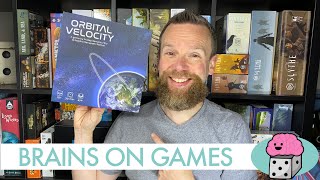
Click to watch at 0:24 · YouTube ↗
Overall sentiment (raw)
positive
Pros
- Scientifically accurate representation of orbital mechanics in a light, accessible format.
- Encourages probability thinking and risk assessment.
- Short playtime (~30 minutes) with strategic depth.
- Clear, color-coded components and intuitive mechanics.
Cons
- Relies on arithmetic intuition and probability; may be challenging for math-averse players.
- Deck luck can influence options and late-game choices.
Thematic elements
- space exploration, probability, risk management
- 1950s space program, early satellite launches
- educational analysis with demonstration of mechanics
Comparison games
none
Mechanics (from transcript analysis)
- card-based movement — players use numbered cards to move a single booster around a board; numbers determine forward progress, with minus cards to slow progress.
- deck composition and probability — the deck is weighted with many high numbers and fewer low numbers, plus minus cards that permit deceleration.
- Hand Management — after each turn, players replenish to full hand size; overshooting can reduce hand size and cost cards.
- orbit control — only one satellite can occupy each orbit; endgame winner is the player with the most satellites placed.
- push-pull movement — both players move the same booster, creating competition for placement of satellites.
- Risk Management — players must assess probability and risk to avoid enabling the opponent to reach the target space.
- risk management and probability reasoning — players must assess probability and risk to avoid enabling the opponent to reach the target space.
Video topics + discussion points
No key topics recorded for this video.
Quotes (from this video)
- it's about the 50s space program
- it's an award-winning game that was sent to me by the designers
- you draw back up to your full hand size
- the strategy here is trying to make sure that you are not the player who puts the rocket in range of the target space
- the math is really under the hood in orbital velocity
- an award-winning game with lots of math under the hood that works hard to be scientifically accurate
References (from this video)
No references stored for this video.
Transcript Navigation
Showing 1–1 of 1