/pic8797234.jpg)
Game Info
Year
2025
Collection
Your Tier
Loading…
Mechanic profile
Not enough video data yet
Vibe profile
Not enough video data yet
Description
Unleash your strategic genius, playing as one of four beloved book characters, to outflank your opponents and dominate the board!
This game can be played with 2-4 players, as well as by yourself! Enjoy the solo play mode where you play against the board, with customizable levels of difficulty. Gameplay lasts about 15-30 minutes. For those with younger family members who want to join, the content is appropriate for all ages.
This game can be enjoyed by anyone whether they are familiar with the Love, Lies, and Hocus Pocus universe or not. If you're already a fan of Lily and her intrepid friends, you'll love the beautiful new art and strategic interaction inspired by the stories you've read.
—description from the publisher
Featured Videos
Rules Teach

How to Play Outflanked
Ask a Rules Question
All mentions
Browse transcript mentions, sentiments, pros/cons, mechanics, topics, quotes, and references.
Total mentions: 1
This page: 1
Sentiment:
pos 1 ·
mix 0 ·
neu 0 ·
neg 0
Showing 1–1 of 1
Video 7WKGuqjaMiI
Hungry Gamer Rules Teach at 0:12 sentiment: positive
video_pk 87296 · mention_pk 292633
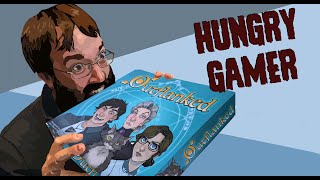
Click to watch at 0:12 · YouTube ↗
Overall sentiment (raw)
positive
Pros
- Simple core mechanic that’s easy to learn (card placement and coverage).
- Clear rules around orthogonal placement and arrows.
- Supports 2–4 players with variants for 3p/4p games.
- Prototype status acknowledged with potential changes and stretch goals for flavor.
Cons
- Game is still in prototype phase and subject to change.
- Arrow/orientation rules can be fiddly and require careful setup.
- Endgame conditions require tracking visible cards and arrows for tiebreaks.
Thematic elements
- Arrows-based territorial control with abstract tactics
- Two-to-four player board game centered on strategic card placement and board control
- Abstract/strategic
Comparison games
none
Mechanics (from transcript analysis)
- Arrow mechanics — Cards feature arrows; placement must consider the number and direction of arrows.
- Card placement — Players place cards onto a shared grid, aiming to control spaces by placing orthogonally adjacent cards.
- End conditions — The game ends when a deck runs out (everyone gets equal turns) or when a player cannot make a legal move.
- Mulligan — Players may redraw if they have no cards with orthogonally facing arrows or if their hand has a suitable count of arrows.
- Orthogonal adjacency — A valid placement must be orthogonally adjacent to an existing card and oriented toward an arrow.
- Rotation/orientation — Cards can be oriented by the player when placed to influence subsequent moves.
- Scoring/tiebreaks — Winner is determined by the number of visible cards; ties are broken by the total number of arrows.
- Variants and stretch goals — Optional stretch goal cards introduce flavor text and once-per-game abilities.
Video topics + discussion points
No key topics recorded for this video.
Quotes (from this video)
- two to four player game in which you are trying to control the board and it's a very simple game of placing down cards and covering other people's cards
- for now I'm going to show you how a two-player game works
- this game is still in prototype phase and is also subject to change
- these four stretch goal cards
- these cards are very simple they have a little bit of flavor text down at the bottom and they have a once per game ability that you'll be able to activate whenever you want on your turn
References (from this video)
No references stored for this video.
Transcript Navigation
Showing 1–1 of 1