












Overlords of Infamy Deep Dive
What the Community Thinks About Overlords of Infamy
Overlords of Infamy is a profoundly underappreciated strategic game wrapped in a genuinely funny premise. Reviewers at Board Games UnLocked consistently praise it as a hidden gem that combines clever mechanical depth with thematic charm rarely seen in competitive board games. The consensus is clear: this game deserves far more table time than it currently receives. One reviewer describes it as uniquely positioned within the hobby, noting that the core mechanics are strong enough to sustain engagement even after repeated plays, while the thematic wit maintains freshness across sessions. Rather than split opinion, reviewers highlight different aspects as their favorites, but all agree the game delivers on its promise of bringing wacky supervillain plotting to life through strategic play.
Core Mechanics That Define Overlords of Infamy
Worker Placement with Escalating Pressure
At its foundation, Overlords of Infamy is a worker placement and resource management game where players send out lackeys to gather resources and construct their zones of influence. However, the game transforms dramatically as it progresses. A world tension tracker escalates with every action players take, and once sufficient tension accumulates, random world events are triggered that can help or hinder everyone at the table. This timer creates mounting pressure without requiring a physical countdown, forcing players to accelerate their plans as the game nears its conclusion. One reviewer notes that the game initially plays like a traditional worker placement experience, but this escalation mechanism ensures the pacing naturally accelerates rather than grinding into the late game.
Espionage Actions: The Strategic Spine
The true differentiator is the espionage system. As players accumulate infamy through completing plots, they unlock increasingly powerful covert actions that let them directly interfere with opponents. Early espionage is relatively mild, but high-infamy villains can sabotage plots, steal relics required for completion, and even eliminate rivals' lackeys. This mechanic is so central to the game's identity that reviewers highlight it as the reason Overlords of Infamy stands out in the crowded worker placement space. One reviewer describes the moment when espionage transforms the experience: the game shifts from "I'm going to steal candy from babies" casual scheming into ruthless sabotage and theft. The system is thematically tight, too; even the decision to undertake espionage versus other actions is grounded in the overlord fantasy, creating a rare alignment between mechanical depth and thematic resonance.
The Overlords of Infamy Experience
Genuine Wit Embedded in Every Component
This game has humor woven throughout, not as window dressing but as a core element of design. The flavor text on plots, world events, and character backstories is consistently clever and unpredictable. Reviewers note that navy-level plots are comedic in their pettiness (stealing candy, enforcing vegan restaurants while secretly serving meat, playing terrible pop songs on repeat), while villainy and domination plots escalate into genuinely dark territory (capsizing oil freighters, denying the existence of pandemics). The world events range from silly (forcing everyone to stand and swap seats) to thematically inventive (events that reference pop culture or ask players to perform real-world actions). This creates a game that takes itself seriously mechanically while maintaining levity, which reviewers identify as exceptionally rare and valuable in competitive board games.
Escalating Cutthroat Play Without Early Kingmaking
The game's structure means early rounds feel cooperative and exploratory as players establish their footholds, but mid and late game shifts into aggressive player conflict. The espionage system ensures that once players unlock powerful interfering actions, the game becomes genuinely cutthroat, with players targeting rivals' nearly-completed plots and stealing critical resources. However, this escalation prevents early kingmaking because the espionage tools are balanced and unlocked gradually, ensuring all players come online with similar power levels. One reviewer emphasizes that the game stays engaging throughout because the texture of play fundamentally changes: it starts as resource competition and transforms into a race with significant direct player interaction, keeping everyone invested until the final world events conclude the game.
What Makes Overlords of Infamy Stand Out
A Thematic Concept That Hasn't Been Explored
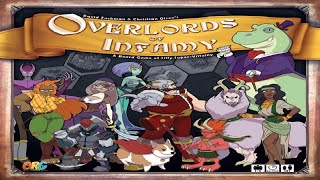
The central appeal is raw thematic novelty. Reviewers struggle to name any other game that explores the fantasy of playing as an incompetent or comedic supervillain with strategic depth. While games exist about evil and villainy, Overlords of Infamy leans into Megamind-style humor and absurdity within a legitimately tactical framework. The character roster reinforces this: overlords range from sentient corgis to insufferable roommates to dark lords, each with unique special abilities and flavor-driven backstories that explain their descent into villainy. The plots players complete reference contemporary life and internet culture, grounding the supervillain fantasy in recognizable absurdity rather than high fantasy tropes. This combination of theme and mechanics appears nowhere else in the modern board game landscape, making the game's identity feel entirely distinct.
Balanced Player Powers That Enable Wildly Different Strategies
Every overlord has a unique player power, and reviewers emphasize how broken and unbalanced these powers appear when taken in isolation. Waffles the Corgi can gain resources more easily, Monseur Beavo can wall off their zone with free wall tiles, and other characters have equally powerful abilities that seem, at first glance, unequally strong. However, reviewers consistently note that because every power is overpowered, none of them are overpowered. The asymmetry leads to wildly different viable strategies: some overlords benefit from aggressive espionage, others from turtling behind walls, still others from maximizing resource output. In tournament and casual play, no single character dominates across different playstyles, meaning player choice creates genuine strategic differentiation without requiring complex rebalancing. This is rare in competitive games and represents excellent design work from designer David Chott.
Potential Drawbacks
The Opening Hours Are Pure Setup Before Espionage Arrives
The game's earliest phase feels like standard worker placement, and some players find the opening rounds less engaging than later play. Reviewers acknowledge that players begin by placing workers and gathering resources without significant conflict, and this can feel slow relative to the increasingly tense play that follows. The game deliberately escalates rather than front-loading conflict, which works strategically but means players must sit through a relatively calm opening to reach the espionage-driven middle and late game. For groups that prefer immediate direct conflict, the pacing may feel off. However, reviewers note that even with this structure, the game rarely extends beyond its target 90-minute playtime, and the escalation keeps momentum from genuinely stalling.
World Events Are Randomly Polarizing and Occasionally Dated
World events add random chaos that keeps players engaged and prevents predictable snowballing, but their effect is inconsistent. Some events benefit all players, some harm everyone equally, and some disproportionately impact single players based on board state. Reviewers mention that while most world events land well, some reference internet culture that has aged (notably an event requiring players to lose the game after announcing a specific meme), and individual tables may find certain political or social humor grating. The game includes enough events to allow curation, and reviewers suggest building custom world event decks if your group finds particular cards off-putting. This is a minor friction point but worth noting: the game requires group comfort with occasional absurdist or topical humor to hit its intended tone.
If You Enjoy Overlords of Infamy
Consider exploring Blood Rage, which shares the escalating stakes and player conflict of Overlords but leans heavier on area control and miniatures. Dead of Winter and Forgotten Waters also deliver thematic storytelling alongside mechanical depth, though without the comedic tone. Familiar Tales provides similar character-driven asymmetry but in a lighter, cozier package. For the pure espionage and cutthroat interaction without the worker placement, Roll for the Galaxy delivers tableau-building and subtle conflict in a sci-fi setting. Roll Camera offers the same combination of wacky theme with strategic card-drafting depth that Overlords achieves through placement. Finally, if the supervillain fantasy alone appeals, Despicable Me (the board game) or themed variants of more traditional games offer lighter experiences in the evil-overlord space, though with less mechanical substance.
What Reviewers Are Saying
"The game turns from being like, oh, stole candy from babies, to, okay, now I'm going to assassinate all of your lacky. I'm going to steal your relic and you're not going to get to play anymore. Like, it becomes very, very cutthroat."
— Board Games UnLocked
"It's a worker placement game that you play as a super villain, and it's one of the more comical sides of the super villain. I always have Megamind in my head whenever I'm kind of like describing the theme. These wacky, over-the-top, bombastic plans, grand plans."
— Board Games UnLocked
"This game is so smart, and not so much in mechanics — the mechanics are great. Like, I have — like, this game is awesome. It's a nine point five out of ten for me."
— Board Games UnLocked