




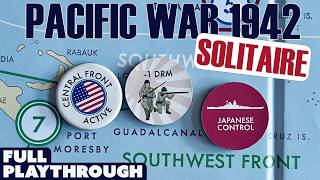
Pacific War 1942: Solitaire Travel Game Deep Dive
What the Community Thinks About Pacific War 1942: Solitaire Travel Game
Pacific War 1942: Solitaire Travel Game divides the wargaming community cleanly along lines of design philosophy. The channels that embrace it see a focused, portable experience that respects players' time and travel constraints. Zilla Blitz, who has documented the game across multiple videos, views it as a success in what it sets out to do: deliver a complete narrative experience in 15 to 20 minutes with enough strategic texture to reward thoughtful play. The Dice Tower, by contrast, found the heavy reliance on random action points frustrating, criticizing the game as luck-dependent with minimal meaningful decision-making. The Discriminating Gamer, having played the first edition and now exploring the second, appreciates the elegance of the design but zeroes in on one critical truth: mastering the game's central mechanical tension requires understanding how ocean control dominates every turn.
Core Mechanics That Define Pacific War 1942: Solitaire Travel Game
Action Point Economy
Each turn, the Allied player rolls a die to determine how many action points they receive, then spends those points on discrete actions like advancing on a front, attacking a Japanese sea area, or flipping a stalled front back to active. This mechanic is what most divides reviewers. The Dice Tower saw it as pure randomness, pointing out that consecutive rolls of one action point made the game feel predetermined by luck rather than choice. Zilla Blitz reframed it as a realistic constraint: the pace of the campaign ebbs and flows, sometimes giving the player a surplus of resources and sometimes forcing difficult prioritization. The system ensures every turn presents a tactical puzzle: which front needs momentum now, which ocean to contest, and whether the player can afford to stabilize a crumbling position.
Ocean Control and Tactical Modifiers
The three oceans, Indian Ocean, Southwest Pacific, and Central Pacific, form the backbone of effective strategy. Controlling them is not just a victory point sink; they provide concrete die roll modifiers that reduce enemy attack success thresholds and improve Allied action outcomes. The Discriminating Gamer emphasized that "having control of those water lanes is huge in this game," highlighting how this mechanic forces players to balance the temptation to push forward on land with the strategic reality that air and naval superiority cannot be ignored. Reviewers observed that prioritizing ocean control early, even at the cost of stalling a land offensive, pays dividends as the war progresses and Japanese forces have fewer tools to push back.
The Pacific War 1942: Solitaire Travel Game Experience
Portable Urgency
The game's greatest strength is its physical footprint and playtime. A 7-inch by 14-inch map, fewer than 20 counters, a single die, and a ruleset digestible in five to ten minutes mean this game actually lives up to the "travel" promise. Zilla Blitz demonstrated playing it on airplane tray tables and in waiting rooms, the game neither dominating a space nor asking for elaborate setup. The experience is lean and purposeful: you sit down, you know the rules, you know what you need to win (capture Japan, control oceans, secure regional objectives), and you execute a campaign from opening move to atomic bomb event or final turn within 15 to 20 minutes. There is no waiting for rules lookups or component searches. The rhythm rewards quick decision-making.
Narrative Tension Against the Autonomous Opponent
The Japanese forces, controlled entirely by die roll and reaction tables, create a sense of opposition that feels substantial despite lacking human agency. Zilla Blitz's playthrough revealed how the game tells a coherent story: early turns see the Allies struggling to build momentum and flip ocean control, mid-game becomes a race to advance on multiple fronts before Japanese reserves arrive, and late-game hinges on whether the atomic bomb will end the war early or force a final desperate push. The tension is real: you can lose, and you often feel like you're fighting at a disadvantage. But the game never feels arbitrary. When you lose, it is because your strategic choices (which fronts to prioritize, how aggressively to contest oceans, when to use reserves) were overmatched by the tactical hand dealt by the die. The game respects the player enough to let that outcome sting.
What Makes Pacific War 1942: Solitaire Travel Game Stand Out
Artwork Grounded in History
The Discriminating Gamer took specific note of the artwork and photography used throughout the components. Rather than abstract illustrations, the game uses period photographs from actual Pacific War operations, creating an implicit connection between the tokens on the map and the real soldiers, sailors, and events they represent. This choice grounds the "light strategy" in historical reality without overwhelming the ruleset. The game looks serious because it draws from serious source material, even as the mechanical execution remains accessible to players seeking a quick solitaire session.
Focus and Restraint in Design
Zilla Blitz repeatedly praised the game's refusal to overreach. It is not trying to be a comprehensive Pacific War simulation. It is a tour of the Pacific Theater: four fronts (Chinese, Indian, Australian, Hawaiian), a handful of strategic objectives, and an antagonist that reacts rather than plans. The designers, Mike Wylie and Grant Wylie of Worthington Games, built a game that knows its scope and executes within it. There are no hidden units, no fog of war, no complicated supply mechanics. What you see on the board is the full state of the war. The clarity enables focus on the decisions that matter.
Potential Drawbacks
Random Action Points Create Frustrating Droughts
The Dice Tower's complaint carries weight: some players will find themselves rolling consecutive ones and twos on the action point die, turning entire turns into dead weight. Zilla Blitz encountered similar cold streaks during their replay but contextualized them as part of the campaign narrative. Not every turn in a real war offers opportunities for decisive action. But this framing does not erase the fact that for some players, multiple turns of minimal action will feel punishing rather than thematic. A three-turn run of one action point each can make you restart the game, as The Dice Tower discovered.
Luck Dependency Overshadows Strategy for Some Players
The Dice Tower made the provocative claim that the game might as well be "roll a die and see if you win," suggesting that strategic choices are so constrained by randomness that they become illusion. Zilla Blitz and The Discriminating Gamer disagreed, pointing to ocean control and front prioritization as genuine strategic levers. However, the complaint is not baseless: a player can make all the right strategic choices and still lose if the die roll gods are cruel. Players seeking a game where tactical brilliance consistently overcomes bad luck will find Pacific War 1942 maddening. It is a game where you can play perfectly and still see your campaign collapse because you could not roll above a three for four consecutive turns.
If You Enjoy Pacific War 1942: Solitaire Travel Game
The obvious next step is War of 1812 Solitaire, the sibling game also from Worthington Games. Zilla Blitz noted that both games share the same design vision: portable, fast, light on rules, heavy on narrative generated by an autonomous opponent. If you enjoy the Pacific War's specific theme, exploratory wargamers may find depth in the larger, more complex tactical systems like Old School Tactical or Advanced Squad Leader, which offer richer solo bots and deeper systems. If you enjoy the portability and travel angle, the broader Worthington Games travel solitaire line (French and Indian War, Shogun Solitaire, and others) offers thematic variety while maintaining the same mechanical DNA.
What Reviewers Are Saying
"It's fun, it tells a neat narrative. It's trying to be, I think, a focused travel game that's light strategy, gives you some interesting decisions, and yes, of course the die rolls play a huge factor in kind of spawning narrative and kind of leading to your ultimate success and failure, but if you do make better decisions you're going to win more often than if you make poor decisions for sure."
— Zilla Blitz
"Definitely stay in control of your water lanes. That is the one thing I remember about this. Oh, man. Having control of those water lanes is huge in this game."
— The Discriminating Gamer
"I'm just getting random action points every turn? Things can be light and not complicated and still give me some strategic choices. This one's a four out of 10. I'm just not impressed with this at all."
— The Dice Tower