/pic7216355.png)
India is a land of villages. The word "panchayat" comes from a Sanskrit word that means "a collection of five". In ancient times, a group of five elderly people collectively made decisions for the village. In this game, you take on the role of the panchayat and help turn the barren land into the most blossoming village. Will you succeed in making your village the best?
Each round of Panchayat consists of choosing two building tiles, placing the building tiles on your village board, and scoring points. When you select tiles to place on your village board, you also get the ability to hide some of the unused tiles. Points are earned by placing building tiles near or in natural landscapes, near other buildings, or at the end of the game.
You can also earn points from three types of bonus tiles: placement bonus, adjacency bonus, and endgame bonus. While you balance all of this, you also need to consider placing building tiles in their groups of commercial, industrial, utility, and residential sections.
The game lasts eight rounds, and the player with the most points wins.
-description from designer

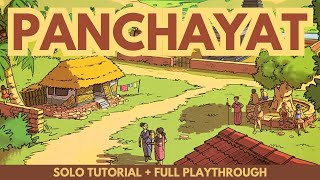
- engaging tile drafting and placement loop with clear scoring logic
- strong thematic flavor through the Indian village setting
- effective solo mode with a predictable yet challenging AI opponent
- bonus tiles and special abilities (e.g., Post Office, Railroad) add strategic depth
- compact playtime with approachable rules for families and hobby gamers
- the Zamindar AI can feel punishing and has a brisk pace, which may be stressful for new players
- the scoring system includes multiple overlapping rules (adjacency, town center, type-based groups) that can be overwhelming at first
- replayability relies on scenario variety beyond the one demonstrated in the video
- tile drafting and placement within a developing village; balancing growth, utility, and community landmarks
- A barren patch of land in rural India gradually transformed into a village with houses, schools, temples, granaries, and various special buildings.
- instructional live-playthrough with scenario-based objectives and a deterministic solo opponent
Mechanics (from transcript analysis)
- adjacency and proximity scoring — certain buildings gain points for proximity to rivers, schools, farms, or other features; placement choices influence multiple scoring vectors
- color-coded building types — buildings are categorized by color (blue, green, red, purple, yellow) and scoring benefits hinge on clustering by type and strategic adjacency
- largest contiguous groups — end-game scoring awards points for the largest contiguous group of each building type (excluding general yellow)
- opponent (Zamindar) AI — an imaginary opponent that discards tiles and moves tiles between rows to challenge the player
- scenario-based objectives — each scenario defines specific goals; in Scenario 1, you must create a house, school, granary, and temple adjacent to each other and hit a minimum score
- special tiles — tiles like Post Office and Railroad provide ongoing or one-time abilities that modify drafting, placement, or movement rules
- tile drafting — each turn you flip a new row of tiles and select two to add to your collection, balancing immediate gain with future opportunities
- tile laying — place tiles on your board to create connected structures and optimize scoring locations
- Tile Placement — place tiles on your board to create connected structures and optimize scoring locations
Video topics + discussion points
Quotes (from this video)
- This is a sponsored playthrough that means I was paid to show you how this game plays.
- Panchayat is a quick playing family friendly tile drafting and tile laying game where we play leaders trying to turn our barren piece of land into a thriving Village in India.
- the post office will let us draft our tiles from now on, as well as whatever is on top of the discard pile.
- we're going to score two points for each building in a largest contiguous grouping of each of the four different types of buildings
- the game ends when we've completely filled our board
- scenario one A New Beginning requires building a House, School, Granary and Temple adjacent to each other and finish with at least 80 points
- The Granary and the Temple came out; Zamindar discards the temple and the house; this is perfect for us.
- we filled up our board; we went around once; the tally puts us at 85 points
- we reveal three new tiles and now when we're selecting we can select the topmost tile so we can get that flower stall if we want
- we're going to take the school and the house and let's place this house over here