/pic1055672.jpg)
From BGG News (Eric Martin): "In Pantheon, players enact the comings and goings of various peoples in the Mediterranean: Egyptians, Romans, Iberians, Germans, etc. They accumulate as many raw materials as possible to build monuments to the gods, but the ways of the gods are unpredictable.
"On a turn, a player has a number of options. He can choose to travel with his people by using the big wooden footprint piece, then smaller footpints to mark their path and block other players. He can buy materials to worship the gods: dancers, farm produce, impressive temples, or prayers. He can use these offerings to take a god token, which may grant him special abilities as well as victory points. Finally, he may build monuments that are worth victory points at the end of the game. The game lasts six rounds with two scoring periods."


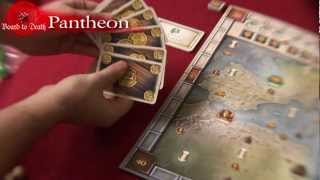
- Good production quality.
- Artwork is perfect for the game.
- Great rulebook (despite typos).
- Variety of actions gives good replay value.
- Really good game when balanced.
- Similar feel to other Rio Grande games.
- The 'money god' was too powerful.
- Needed to remove three and four sacrifices for god acquisition.
- Some spelling mistakes and typos in the rulebook.
- Some players might steamroll.
- Building monuments and getting the favor of the Gods
- Europe and its surroundings
Mechanics (from transcript analysis)
- area influence — Players place 'feet' tokens on the board, connecting to a temple, and can place columns in column spaces.
- Bag Building/Drawing — Booty tokens are drawn randomly from a cloth bag and placed on the map.
- Card Drafting — Players draw action cards which can provide movement, gold, and extra sacrifices, and civilization cards influence the game's progression.
- Resource Management — Players use gold to buy sacrifice tiles, feet, and columns, and manage resources to acquire gods.
- Set Collection — Players acquire god tiles by meeting specific demands, which likely involves collecting certain types of sacrifice tiles.
Video topics + discussion points
Quotes (from this video)
- The game is really good and the production quality is nice.
- The artwork is perfect for this game and the rule book is great.
- We're giving it a 7.5 out of 10 it would have been higher if we did not need to make those house rules to balance the game out.
References (from this video)

Mechanics (from transcript analysis)
Video topics + discussion points
Quotes (from this video)
- it's it's fun
- it's it's very light
- not every old grognard who's cranky about um the new versions of D and D coming out has is you know a sexist a racist a misogynist it's not everybody
- It's just a [ __ ] bottle of water
- I I wanted to just say something like but I you know saying something in an airport is definitely not you don't want to do that
- I'm gonna say so like I all so you can guess because he can't hear you like what would you think if he had to pick the thing
- We need another Sherlock Holmes too
- This is pretty Swank
- I I regret all of it
- I don't know what's going on no one ever post anything in in my slack at midnight
- He died doing what he loved increasing the shareholders value
- I'll never dance in somebody's grave but I will read obituaries
- it's one of those things where you eventually like I mean you hate to say that like Forest hit the nail on the head there
- what extent you're gonna get a hit put out on you
- I think he'll get caught I'm very suspicious about it though
- well on that bombshell I'm GNA start going to my gate
References (from this video)

- Dynamic auction system that rewards bidding strategy and bluffing
- Variable domain values create replayability and strategic depth
- Strong thematic flavor and art direction (prototype visuals discussed)
- Steep learning curve for new players due to multiple interacting rules
- Money management and tracking can be intensive in longer sessions
- divine influence, territorial control, auctions
- Greek pantheon with evolving domains and a 1920s thematic twist
- mythic flavor with lighthearted, competitive play
Mechanics (from transcript analysis)
- adjacency and chaining — bonuses for connecting owned domains; longest chain yields extra payoff
- Auction — multi-round bidding on domains and artifacts; auctioneer role can shift per turn
- Auction / Bidding — multi-round bidding on domains and artifacts; auctioneer role can shift per turn
- domain value manipulation — each domain has a randomly assigned value each game, affecting scoring and strategy
- private/public auctions — some auctions reveal values publicly, others occur privately for surprises
Video topics + discussion points
Quotes (from this video)
- We are Greek gods.
- Auctions are the whole point of the game and it keeps it dynamic.
- The bank is my sugar daddy.
- This game is crowdfunding, prototype.
- The art is beautiful.
References (from this video)
- Adds new depth and variation to Acropolis
- Expansion fatigue; players may already own base sets
- civilization-building expansion with mythic elements
- Expansion to existing Acropolis family of games; pantheon-themed add-ons.
- expansion-driven, lore-friendly
- Acropolis
Mechanics (from transcript analysis)
- expansion content (new powers, gods, or rules) — Adds Pantheon-themed expansion content to the Acropolis base game.
Video topics + discussion points
Quotes (from this video)
- People love that cover.
- Flamecraft, which is their evergreen game, has sold 400,000 copies. That is crazy.
- Rain as a title is pretty uninspired.
- Pantheon has another expansion coming.
- Cichlades has an expansion coming. I love how they go and they go and make this the ultimate edition.
- Unmatched Stars and Stripes is releasing very soon in June.
References (from this video)

- Engaging strategy and high replay value
- Good portability and scalability with multiple gods
- Variety from gods and city cards
- Rulebook can be confusing and require rereading
- Summary cards contain mistakes that can affect play
- Initial setup can be lengthy due to sorting tokens and cards
- Divine politics, conquest, and city-building
- Mythological world where gods vie for followers and city domination
- Epic mythic
Mechanics (from transcript analysis)
- action phase with cards and tokens — Actions are taken using god cards, city cards, and tokens to manipulate the game state.
- challenge phase — Players play cards during a challenge; highest number wins if colored as ruling color; color matching rules govern plays.
- city-building and victory points — Cities are won by achieving required challenge victories; followers placed on cities count as victory points.
- color-dominance and ruling color — The color of the top city card or ruling color determines which cards are strongest and must be followed.
- multi-epic rounds — The game proceeds in three epics, each with its own setup and a new ruling color.
- token economy and divine acts — Tokens enable actions such as drawing cards, destroying cities, or protecting cities.
Video topics + discussion points
Quotes (from this video)
- it's a really fun game and it gets addictive you always want to play that one more game choosing a different God
- portable with some good strategy and lots of replay value
- the two major problems we have with the game have nothing to do with the game play itself
- an 8.5 on 10
- the rule book you'll be reading it a couple of times over before fully understanding it
- the second thing that was really annoying was the mistakes on the actual summary cards
- setup a takes a while and is kind of annoying to separate all the tokens into groups
References (from this video)

- pleasing aesthetic
- gateway-friendly
- mechanics learning curve not deeply explored in transcript
- tile collection and point scoring through lanterns
- mythic lantern-lit waters and color tiles
- visual and thematic
Mechanics (from transcript analysis)
- set_collection — acquire cards/tiles to gain points
- tile_laying — lay tiles to form a lantern-filled tableau
Video topics + discussion points
Quotes (from this video)
- Carcassonne is one of those beginning games and it's a gateway classic
- number two is Umbra Alhambra plays 2 to 6 players and it was published by Queens games
- Lantern family favorite
- Petropolis number one comes the story
- let's open your mind up and it's a great tile laying game
References (from this video)

Mechanics (from transcript analysis)
Video topics + discussion points
Quotes (from this video)
- Every day this week you guys are getting content whether it's podcast or YouTube channel
- This is where we get into our in-depth reviews of different games and we thought hey this was pretty popular with folks so why not drop it on YouTube and use it as a litmus test
- The Easter eggs in that are my all-time favorite
- 4X meaning for an exchange cannot wait for that game
- I do wish I could have delved in a little bit on SpaceX but I wasn't allowed to