


Paperbag Dungeon Deep Dive
What the Community Thinks About Paperbag Dungeon
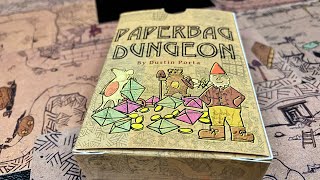
Paperbag Dungeon reads in reviews as a small, quiet puzzle with a surprisingly strong personality. The Dungeon Dive covered a copy supplied by designer Dustin Porta and described it as a tableau-building puzzle with touches of tower defense and resource management. Daniel of that channel calls it "a neat little game," more of an activity than a deep strategy experience, and says it is "pretty mellow" in a way that leaves you with a pleasing feeling while you play.
Reviewers agree that the appeal depends on what you want from a dungeon game. Daniel contrasts it with the typical dungeon crawl built around combat and recommends it for players who enjoy puzzles and tile-laying games and want a dungeon theme without the fighting. Daniel also admits it is not a game that gets played all the time, but one to pull out when the mood strikes.
Ryan and Bethany Board Game Reviews is more enthusiastic about the format than the design. Covering it in a solo game roundup, the channel praises how portable the package is and calls the game "very cool." Board Gaming Ramblings takes a very different angle in its shelf-clearing episode. The copy had been kept as a solo option, never played, and is now being culled from the collection. That verdict says more about a crowded shelf than about the design, but it is a useful reminder that a solo game has to compete for table time.
Core Mechanics That Define Paperbag Dungeon
Tile Placement
The core loop is building a dungeon one card at a time. Tunnel paths have to match, and when a card does not quite line up, the gap becomes an open tunnel that gives monsters a route toward your gate. Daniel notes that cross-hatched edges can be overlapped to bridge a near miss, which keeps the puzzle moving rather than stalling. The game offers two ways to win: use every card in the deck, or seal every passage with dead ends into a closed "perfect dungeon." Daniel points out that sealing off one area early can rule out the perfect dungeon entirely, so every placement carries consequences.
Placement also feeds the resource system. Gems printed on some cards are spent by flipping the card they sit on, and those flips can arm traps or activate other cards. Daniel demonstrates spending a gem to arm a trap that will catch a rat king trying to reach the gate, which shows how a tile you lay now can protect the dungeon later.
Image Deciphering
In Paperbag Dungeon, the art is the rulebook. Daniel explains that in most games of this kind the illustrations exist only to set a mood, but here "there are game mechanisms and icons kind of hidden on the card as art." A skull shows that a monster is dormant, musical notes on a card wake a sleeping giant, and goblin icons trigger a chain reaction that flips every other goblin in the dungeon. The illustrations also teach you what monsters can do: spiders moving through a grate can pass grates, and mad dwarves tunneling through stone can break stone walls. Reading the picture is as much a part of the game as laying the tiles, and that is what makes the design feel distinctive.
The Paperbag Dungeon Experience
A Mellow Puzzle With a Pleasing Rhythm
Daniel describes the play as "more of an activity" with a puzzle-like rhythm rather than a tense contest. The game eases you in: during the first nine turns, monsters cannot be played, which gives you time to build a dungeon before anything tries to escape. Daniel's point is that the game is not built around combat or escalation, so the pleasure comes from quietly solving a layout and watching how the pieces fit together.
Hunting for Hidden Details
Several reviewers keep returning to the art as a source of delight. Daniel compares the experience to a Where's Waldo situation, spotting an easter egg such as a goblin tunneling behind a wall to reveal a hatch on the other side. Once the dungeon is built, Daniel enjoys admiring the sprawling layout on the table and imagining the ecology of how the monsters interact with one another. For players who like finding small secrets in illustrations, that search is a large part of the fun.
What Makes Paperbag Dungeon Stand Out
Art That Doubles as Rules
The strongest praise in these reviews is for the way the art is woven into the rules. The Dungeon Dive calls it one of the neatest things about the game that the art on the cards "really does dictate the play." Because a skull, a note, or a tunneling dwarf is both a picture and an instruction, the game rewards close attention and makes every card worth a second look. That double role is what separates it from the many card games where illustrations are purely decorative.
A Solo Game Built Around a Pencil
Ryan and Bethany Board Game Reviews praise the solo package for being unusually compact. The game comes as a notebook and a pencil, and the pencil has die faces printed along it, so you roll the pencil across the table to generate results. Each notebook's pages are algorithmically generated, so every copy is unique, while the challenge level stays consistent and grows harder as you progress through the pages. Health and coins are tracked on the paper, and the channel's takeaway is that it is a tiny dungeon crawl you can take anywhere, even on an airplane.
Potential Drawbacks
Rules Squeezed onto Cards
The most common complaint is the rulebook. Daniel points out that the game's rules are printed on cards, and that a single-deck box leaves too little room to do the rules justice, especially the examples, which are very small. Daniel would have preferred a larger set of rule cards with clearer illustrations of how to play. Daniel found the designer's own video explaining the rules helpful, which suggests that new players may need to look beyond the box to learn the game comfortably.
Icons That Are Hard to Read
Because the mechanics live inside the artwork, the iconography can be inconsistent and easy to miss. Daniel describes it as a double-edged sword: a skeleton-looking icon turns out to be a scorpion monster, and some icons are hidden by other art on the card. Daniel expects that familiarity will fix much of this as you learn the cards and their combinations, but new players should expect a stretch of squinting before the symbols become second nature.
If You Enjoy Paperbag Dungeon
- Sherlock Solitaire: Ryan and Bethany Board Game Reviews describes it as a solitaire game in a Sherlock theme with a couple of objectives to meet. The channel says it "successfully gamified solitaire," and it is a good match for players who enjoy small, portable card games.
- Players who like tiling and tile-laying puzzles: Daniel tells fans of that style directly that Paperbag Dungeon "would probably be a perfect game for you," since the appeal here is the same puzzle of fitting pieces together rather than any fighting.
- Players who want a dungeon theme without the combat: Daniel contrasts the game with "a typical dungeon crawl style game with lots of combat," recommending it to players who want the atmosphere of a dungeon with none of the fighting.
What Reviewers Are Saying
"One of the neatest things is that the art on the cards really does dictate the play a lot of times. And these kinds of games that we enjoy looking at on the dungeon dive, the art is just for decoration. It's just to set a mood."
— Daniel, The Dungeon Dive
"It's a neat little game. It's very different than anything I have in my collection, and because of that I kind of admire it."
— Daniel, The Dungeon Dive
"What a cool system. You can take it on an airplane, you can take it anywhere."
— Ryan and Bethany Board Game Reviews