



Paris: New Eden Deep Dive
What the Community Thinks About Paris: New Eden
Paris: New Eden puts players in charge of a shelter in a Paris reclaimed by jungle after an apocalyptic event. The most detailed discussion comes from Before You Play, which played a full two-player game and came away impressed with the physical product and with how tightly the four rounds fit together. Getting Games, Board Gaming Ramblings, and Pair of Dice Paradise cover the game as a preview, working from the rulebook and the box rather than a finished session. Their attention centers on the dice drafting, the survivor recruitment, and a play time they expect to be around 45 minutes, which makes the game look approachable for lighter groups.
Core Mechanics That Define Paris: New Eden
Resource Management
Resource management here is largely about keeping the survivors fed. Cans of food come from the restaurant, and at the end of each round every survivor in your buildings has to be covered. Before You Play found the feeding step to be the hardest part of the game, since a can of food is spent for each farmer a player lacks. Feeding is scored against a chart, so a shortfall of farmers costs real points, and the reviewer noted that feeding "is truly what makes it hard to actually play a game." Food is scarce enough that taking it early can feel necessary, even when another die would be more useful.
Dice Drafting
Dice drafting drives every round. Dice are rolled onto the five areas of the board, and players take turns picking one die at a time, each one granting the action of the location it came from. The restaurant gives food, the train station adds an extra survivor, the bridge hands out mission cards, the city center offers equipment, and the tower lets the first player to arrive choose which event tile will score. Pair of Dice Paradise described the dice as carrying five survivor faces and one wild face. Before You Play explained that slackers, the wild survivors, can only be used alongside a die or chit of the color they stand in for. Once drafting ends, each player announces strength by survivor type, starting with tinkerers, and the strongest player in each category picks a building first. A player with a larger total in a category gets first pick, which makes the order in which you draft as important as what you draft.
The Paris: New Eden Experience
Scarcity Turned Around
Before You Play argued that the two-player game flips the theme. Reviewers described the feeling of scarcity as the setting, but the pressure at the table comes from having too much. As the reviewer put it, "instead of fighting over scarcity, which is kind of the theme of this, you're fighting with overabundance." Every building that adds survivors also raises the number of farmers you need to feed, so taking the building you want can cost you later. The reviewer found that in a two-player game players often end up taking whatever is left, and that with fewer players the buildings are less contested.
Quick Rounds, Real Choices
Each season runs through three phases: drafting, claiming buildings, and then resolving the event and feeding the people. Before You Play called the result "simple" and "quick," with the core task being to find combinations of survivors that meet your mission cards and the event tiles. The most engaging moment, according to that reviewer, is the building phase, where the management of slackers is the real strategy because whoever goes first has to declare how many they are committing. Getting Games summed up the appeal in the same spirit, noting that the game stacks dice drafting, building construction, and a light engine-building layer into a 45-minute package.
What Makes Paris: New Eden Stand Out
Components and Presentation
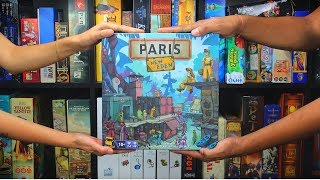
The physical product drew strong praise from Before You Play. The board was described as looking like a painting, the cardboard as thick, and the cards as high quality with very vibrant colors. The reviewer noted that the insert gives every component a place, which makes setup and teardown easy. Board Gaming Ramblings also singled out the artwork, and saw the post-apocalyptic styling as a good match for a game about rebuilding a city.
Accessibility and Replay
Before You Play said the game could move toward the Gateway category, since it is easy to teach and nothing in it punishes a player harshly. Losing a race for buildings just means fewer points, not losing pieces you already own. The same reviewer pointed to the tinkerer cards as the source of replay value, because the ones that grant abilities, such as taking two actions back to back, change how a turn plays out. Those abilities are strong enough that they reward careful timing of which card to keep.
Potential Drawbacks
A Theme That Feels Applied
Before You Play felt that the theme is layered onto the mechanics rather than growing out of them. The reviewer agreed that healers never actually fight anything and that medicine tokens rarely do more than count toward a set. The survival framing lands most strongly in the scarcity of food and the need to feed people, while the rest of the game reads as a set collection and scoring puzzle with an apocalyptic coat of paint.
Light for Strategy Fans and Mean Mode Wishes
The same reviewers felt the game is light enough that players who love heavy strategy may not find it challenging. Before You Play suggested that a harsher variant would appeal to experienced gamers, since the current version lets a player who fails to feed their people simply lose the points rather than suffer a real penalty. Scoring also takes some effort to track, with many end-game conditions and buildings that each add their own points, which can slow down the final tally.
If You Enjoy Paris: New Eden
Players who like the dice drafting in Paris: New Eden should look for other Gateway-weight dice drafting games that let you pick dice from a shared pool and decide where to spend them. If the set collection and secret mission scoring appealed to you, look for light engine builders where hidden objectives drive every turn. Players who enjoy the city-building side of the theme, with buildings that add to your capacity and unlock new abilities, will also find a good match in compact tableau and city-building games. Reviewers framed the game as a pleasant entry point for families and casual groups, so it is a natural pick for anyone who wants a quick, low-punishment game night.
What Reviewers Are Saying
"Instead of fighting over scarcity, which is kind of the theme of this, you're fighting with overabundance."
— Before You Play
"It's got dice drafting, it's got building construction, it's got some engine building."
— Getting Games
"It should be like it's a 45-minute games, it's like it quit it pretty quick the dropping game, but it, yeah, I think it's gonna be fun."
— Board Gaming Ramblings