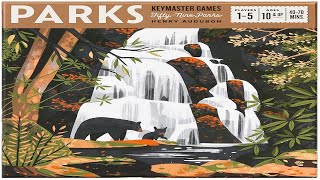
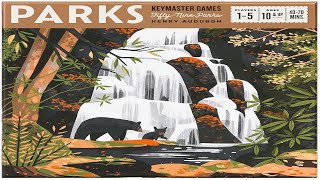
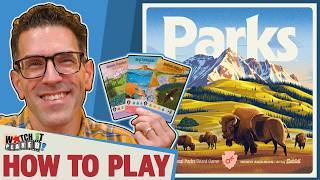
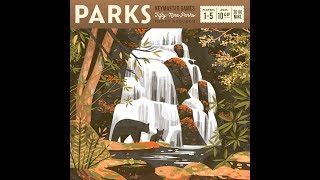
PARKS is a celebration of the US National Parks featuring illustrious art from Fifty-Nine Parks.
In PARKS, players will take on the role of two hikers as they trek through different trails across four seasons of the year. While on the trail, these hikers will take actions and collect memories of the places your hikers visit. These memories are represented by various resource tokens like mountains and forests. Collecting these memories in sets will allow players to trade them in to visit a National Park at the end of each hike.
Each trail represents one season of the year, and each season, the trails will change and grow steadily longer. The trails, represented by tiles, get shuffled in between each season and laid out anew for the next round. Resources can be tough to come by especially when someone is at the place you’re trying to reach! Campfires allow you to share a space and time with other hikers. Canteens and Gear can also be used to improve your access to resources through the game. It’ll be tough to manage building up your engine versus spending resources on parks, but we bet you’re up to the challenge. Welcome to PARKS!
—description from the publisher
Peaks Review: Peaky Climbers
Trails - How To Play
Parks 2nd Edition Playthru
- Good addition of new mechanics and simpler maintenance in the second edition.
- Gear is a good addition and feels ramped up.
- Enjoyable gameplay loop.
- Nice aesthetic and components.
- Hiking and visiting National Parks
- National Parks of the United States
- Parks (first edition)

Mechanics (from transcript analysis)
- action selection — Players choose from a variety of actions available on the board spaces and through gear.
- Dice rolling — Used for various effects, such as resource acquisition or triggering special abilities.
- Photography — A mechanic involving taking pictures of parks for points or other benefits.
- resource collection — Players gather various resources (sun, water, forest, mountain) to spend on actions.
- set collection — Collecting specific sets of resources or visiting certain types of parks contributes to scoring.
- Trail movement — Players move hikers along a trail to different spaces, with actions available at each space.
- Variable player powers — Players have unique badges or gear that grant special abilities.
- worker placement — Placing hikers on specific board spaces to take actions.
Video topics + discussion points
Quotes (from this video)
- The goal of this game is to keep the parks pristine by visiting as few as possible. That's my theory. Leave no trace. Leave no trace.
- Women are the best shoppers.
- This game is kind of cheap.
- So, it's... It's like a... It's like a really smooth formations inside the cave that are just crazy like stripes of different colored sandstone.
References (from this video)
Mechanics (from transcript analysis)
Video topics + discussion points
Quotes (from this video)
References (from this video)
- Can be played outside in a park.
- Lots of fun to play with Bo.
- Has multipliers.
- Coming soon to a store near you.
- Rolling dice towards a target in a park setting.
- Horseshoes
Mechanics (from transcript analysis)
- Area Majority/Target — The goal is to get dice closest to the park, which acts as a target.
- Dice rolling — Players roll dice in an attempt to get them towards the park.
- Score Multipliers — The game includes multipliers that affect the points earned.
- team play — The game can be played in teams.
Video topics + discussion points
Quotes (from this video)
- This is a new game that you can play outside.
- It's a lot like um horseshoes.
- Park should be in a game near store near you soon, brought to you by Yello.
References (from this video)
- Beautiful production
- Satisfying die and action upgrading
- Interesting experience track
- Fun companions
- Lots of fun rewards
- Amusing player interaction during climbs
- Fiddly card taking/discarding mechanism
- Superfluous board
- Slightly too long
- Potential for downtime
- Can feel like scratching along for equipment
- Majorities might not come out
- Climbing mountains
- Around the world
Mechanics (from transcript analysis)
- action selection — This is a game where you're going to take different actions. You're going to put a cube in that action to take that action.
- area majority — You will also get to put out more flags in each area where you have the most flags.
- Deck building — You'll start with deck A where the mountains are not necessarily as high or as famous, but eventually you'll get into deck B where you might recognize the names of some of these mountains more as you climb them.
- Dice upgrading — When I have three prepares, I'm going to upgrade one of these dice here. These dice are going to be turning around and getting better each of them.
- Experience track — There are things on you have an experience track that will let you move these up. So, this action is when I take a rest action, I get to do everything here. Moving up experience is one way to upgrade your actions and dice.
- hand management — I'm trying to get climb these mountains in my hand.
- set collection — The bonus cards you can draw, which will give you more flags at the end of the game. So, the number of climb mountains that have this reward, if I had that four of those, I get an extra flag. Five of those, two extra flags.
Video topics + discussion points
Quotes (from this video)
- Tangerine Games always does an absolutely fantastic job with how their games look.
- I really enjoy the die upgrading. I think that's that's fun.
- One mechanism I did not particularly care for in this game was every one time you take a card, you also discard a card and move cards over, which means if multiple people do that action in a row, it just feels really fiddly.
- The board felt a little superfluous.
- It was slightly longer than I'd want it to be and there can be some downtime where someone sits there and goes, 'Okay, what card do I want to do?'
- Tangerine is just knocking out of the park with how their games look and and feel and this is much better than the last game I played from Tangerine Games.
References (from this video)
- Thematic and accessible
- Family-friendly
- Solid solo mode as well
- Rules can be dense for new players
- Photography and exploration of natural landscapes
- National Parks in the United States
- Casual travelogue
Mechanics (from transcript analysis)
- Movement along a path — Players move hikers along a board to take actions.
- Resource collection / hand management — Collect water and supplies to enable actions and scoring.
- Set collection / photography scoring — Photographs collected grant points based on scenes.
Video topics + discussion points
Quotes (from this video)
- Canvas is a game where each of us we are creating our own art pieces so you have like different clear like translucent pieces of art that layer on top of each other to create a painting
- Whoever has the best Gallery wins
- we're going to play the game off camera and you'll see one of us will be in an unfortunate predicament
References (from this video)
- Gorgeous presence on the table; great thematic fit
- Tight market with blocking adds tension without being mean
- Scales well and has additive modules
- Can feel lengthy at higher player counts; consider season cards to tighten
- Nature, exploration, conservation
- Walking through U.S. national parks, visiting various parks across the country
- Relaxed, thematic exploration
Mechanics (from transcript analysis)
- Blocking/interaction on spaces — Other hikers on spaces can limit where you can go; strategic timing matters.
- Resource collection and park conversion — Collect resources (trees, water, sunshine) to claim parks.
- Season/seasoning cards to adjust pacing — Season cards impact game length and scoring, tailoring difficulty.
- Terrain/board variability via shuffled map tiles — Tiles create a changing map; layout influences planning.
Video topics + discussion points
Quotes (from this video)
- It's a really nice thinky puzzly type of game.
- The action selection mechanism... pointers that say 1 2 3 4 or 1 through four.
- The art is gorgeous.
- Not cutthroat by any stretch.
- It's a calming experience.
- It's a good one to pull out with the kids.
- Not deep. It's not heavy. It's a lighter weight co-op.
- Creature Comforts always hits for us and I would highly recommend giving it a shot.
- It's a gorgeous and stunning presence on the table.
- It's a very small pencil-first solo-only game.
References (from this video)
- strong thematic appeal
- replayable with rule familiarity
Mechanics (from transcript analysis)
- set collection — collect scenic elements to build a personal park tableau with variable scoring.
- set_collection — collect scenic elements to build a personal park tableau with variable scoring.
Video topics + discussion points
Quotes (from this video)
- Arc Nova was our most played game last year in terms of the length of time that we played it.
- the audio bit is holy cow nine days it's such a difference
- I love cats Explore and Draw every single day of the week
- it's just it's great to have a framework for fun
References (from this video)
- satisfying engine building
- beautiful artwork
- thrives with a lot of players
- light and quick to pick up
- can 'muscle in' behind somebody else and kind of coil riding and getting some cheap points
- climbing mountains
- Tiny Epic Galaxies
Mechanics (from transcript analysis)
- area influence — There's a whole bunch of area influence where you're trying to get your flags out on the map and there's some ingame points for that.
- engine building — The engine building part is very satisfying on your own player board so you can upgrade things so when you do rest you gain more things.
- Leapfrog — When you go and climb a mountain someone else can tag along and you don't get a choice in the matter. It's a little bit beneficial to you both or to you all if you tag along and climb together cuz it costs less energy.
Video topics + discussion points
Quotes (from this video)
- calendars are not wall art you have to change them month to month you can't just get attached to a one particular month's picture and leave it there forever
- this is a spatial auction so you will be placing buildings down you're trying to set you're trying to ultimately Place buildings onto a map and place them in the most beneficial way to meet some objectives to make clusters to do all those sorts of good map types of things
- it feels old you know how sometimes like the original version came out I think it was around 2008 and you can feel it's not of that modern era you can feel it comes from a time where board game rules could be a bit more brutal and have less Square ups and things like that
- Phil Walker Harding's known for is like Simplicity with a lot of layers of strategy which this one is
- most of the points come from these objective cards so it's not a set of common there's a couple of common objectives but most of your points you're picking up what you're going to score from
- the engine that's driving it is a deck building engine
- the way you score those resources it's it feels relatively restrictive because you have to get certain resources in certain patterns
- each crisis and each card has got QR code that you can scan and that this relates to information in real life about the global crisis or environmental things in the world like the trees the pollution everything else that you can find there
- as a Euro for me as a Euro gamer when I like theme it's when the mechanics it can still be a a bland kind of euro thing but when the mechanics really are true to that theme it's something I quite like
- you have limited amount of resources that you can have in your board which makes it even harder to you know um like this resource you have to take that you need this you need this to do this action so which one you're going to take you can't do everything at once
- this has that as well because you in order to build your network every time you reach a a corner of a grid there has to be a station doesn't have to be yours can be someone else's so being near someone else lets you build further and when you make a connection to someone else you both get a benefit much like Tera so you get some energy and the other players get coins
References (from this video)
- beautiful art and approachable pace
- versatile for family games and teachable sessions
- second edition can shift balance and may benefit from a deep dive
- some players want deeper interactivity and tension
- exploration of natural spaces and conservation-inspired scoring
- nature-focused park-building with a broad scenic aesthetic
- tableau-like with scenic board art and light narrative cues
Mechanics (from transcript analysis)
- multi-edition comparison — two editions (base and improved) provide nuanced rule tweaks and streamlined play.
- set collection and engine-building — players collect parks, landmarks, or elements to build an efficient engine for scoring.
Video topics + discussion points
Quotes (from this video)
- hands down one of the best modern games I have ever played.
- No, this is not a sponsored video, but it's just so good.
- Definitely my favorite party game by far this year. It's so easy because you just grab chips and everyone gets a little overwhelmed by the ability so far, but after one round, everyone's just chilling.
- Andromeda's Edge has been played this month. Yes, it's still my favorite game, but I'm going to highlight some other games to say that it was the one that I enjoyed the most for this month.
- This is also the first time we played with the metal mechs and it really elevated the experience.
References (from this video)
- gorgeous art
- accessible for new players
- strong gateway appeal
- some may find it light for long games
- nature appreciation, conservation
- American national parks and hiking culture
- gateway-friendly with lush art
Mechanics (from transcript analysis)
- collection/point optimization — scoring cards provide varied routes to victory
- set collection — players collect park cards to build a cohesive tableau
- tile placement — tiles/buildings placed to form scenic routes and scenery
Video topics + discussion points
Quotes (from this video)
- it's what I always hope exploration games are gonna be
- it's the right amount of deep and simple
- it's so inviting how everything is put together
- Meadow is gorgeous I mean the artwork is incredible
- this is a racing betting game
- the cards for the national parks all look lovely
- it's basically Jane Austen and Downton Abbey in a satirical form
References (from this video)
- Beautiful artwork
- Nature theme
- nature
- Hiking the national parks
Mechanics (from transcript analysis)
Video topics + discussion points
Quotes (from this video)
- wingspan is bringing a lot of people into the board gaming hobby right now
- if you like wingspan because you want some more games to check out here's a few
- if you like wingspan because you like the creator of the game well then check out her follow-up game mariposas
References (from this video)
- Beautiful artwork
- Track changes each season
- Plays best at 2-3 players
- Can be harder to plan ahead with more players
- National Parks
- Dog Park
- Tokaido
Mechanics (from transcript analysis)
- One-way track movement — Moving moving throughout the the track and then starting over uh at the beginning with a different setup or something.
- set collection — Trying to collect the stuff that you want to get the cards
Video topics + discussion points
Quotes (from this video)
- For me it's no longer eligible for my list since it is a game that we published took Tokaido Duo and soon this year Namiji.
- the track changes almost every round because all of your everybody's generally building buildings as you go through that track.
- This is kind of a masterpiece of of oneway action tracks.
- It uses this mechanism three times throughout the game in really three different ways. So, I guess three different one-way action selection tracks.
- My first thought when I think of one oneway track are all of the kids games of like um life and Monopoly and Shoots and Ladders and Candyland and stuff.
References (from this video)
- compact turns with rich options
- layered strategy and discovery
- engaging dice drafting and scoring
- round length can extend beyond four turns; varies with play.
Mechanics (from transcript analysis)
- asymmetric animal helpers — animal critters serve as assistants providing bonuses.
- dice drafting — players draft dice to assign to building robots; dice can be claimed by others.
Video topics + discussion points
Quotes (from this video)
- we completed the 24 games of My Island the campaign
- end chapters felt like a lot
- this game you only have four turns
- it's basically a contract um fulfillment game where you're putting on a firework festival
- Spectacular would you call it spectacular of course it's my number one game of August
References (from this video)
- not specified in detail here
Mechanics (from transcript analysis)
Video topics + discussion points
Quotes (from this video)
- There are very few things that are as relaxing as going for a long walk on a nature trail
- the game is played over a series of turns starting with the first player and then going clockwise around
- you'll be hiking throughout the day across a beautiful trail collecting objects in order to complete objectives that reward you with points and other bonuses you might also gather some pictures and do a little bird watching
- if you enjoyed the look of this game you might also like parks by the same designer and publisher team
References (from this video)
- Stunning artwork and strong production quality
- Quality components (wooden tokens, tree-trunk-style inserts)
- Compact box size with good insert design
- Two-player experience may be less tense or depthful than with more players
- Resource acquisition and photography-driven scoring
- National Parks
Mechanics (from transcript analysis)
- Endgame scoring and player interaction — Rounds extend as the trail grows; players discuss and compete over card acquisition and photo tokens for points.
- National park cards and photo tokens — Acquire national park cards by spending resources; photography actions discard resources to gain photo tokens worth points.
- Trail expansion and technology cards — After each round, a new advanced tile is added to the trail, and technology cards provide new abilities for endgame scoring.
- worker placement — Move a single worker along a track that cannot go backwards; landing on spots interacts with other players depending on a lit campfire condition.
- Worker placement on a forward-moving track — Move a single worker along a track that cannot go backwards; landing on spots interacts with other players depending on a lit campfire condition.
Video topics + discussion points
Quotes (from this video)
- this game does a really good job of packing a good amount of punch in like a 30 minute or so game
- the artwork in this game is just stunning
- it's a party style game let's just keep it going
References (from this video)
- fresh feeling of the action-selection board
- interlocking mechanics that interact across players
- deep strategic possibilities and variety
- not a fan of area-majority or dudes-on-a-map design
- the complexity can feel heavy and intimidating at times
- Cyclades
Mechanics (from transcript analysis)
- action sequencing — activate actions in a fixed sequence determined by advisor strength
- area control and combat — attack actions move warfare track; casualties are determined via scheme cards; revolts/neutrals provide bonuses
- auction programming / advisor placement — place advisors into columns on an action board; bribe to increase strength; determine order of actions
- bribery / coin economy — bribe coins to boost advisor strength before the strategy round
- scheme cards and agendas — scheme cards grant bonus actions and can impose casualties; cards can be stacked for traps
Video topics + discussion points
Quotes (from this video)
- this is the neat game like I think mechanically it's very streamlined
- I'm not a train game type of person
- downtime wasn't particularly bad
- it's a filler dice game
- the biggest plus to me is just the fresh feeling of that action selection board like I've not played something like that before
References (from this video)
- art and park theme are a major draw
- rules are straightforward and vibe is calm
- interaction is mostly positional; can feel like multiplayer solitaire at two players
- tracking decisions can be challenging at higher player counts
- hiking, nature photography, and park exploration
- US national parks theme
- calm, nature-forward experience
Mechanics (from transcript analysis)
- positional movement — move two hikers along a shared trail of sight tiles
- resource collection and market — gather sunshine, water, and gear; shop park cards
- seasonal progression — four seasons with a seasonal refresh and scoring elements
Video topics + discussion points
Quotes (from this video)
- Multiplayer solitaire shouldn't automatically be a red flag.
- The real takeaway is that multiplayer solitaire isn't a problem if the mood matches.
- You're mostly in your own 15 card puzzle, glancing up occasionally when someone takes a meadow card or a limited event.
- The bird theme and real species facts pull in players who might never touch a typical sci-fi or fantasy hero.
- It's the best of multiplayer solitaire.
References (from this video)
- Engaging, strategic design that involves all players
- Layered mechanics with meaningful branching (gear, dice upgrades, tiles, and upgrades)
- Dynamic endgame with sneaky finishes and varied scoring opportunities
- Ability to accommodate up to six players increases table dynamics
- Quality presentation and theme alignment even in prototype stage
- Prototype status may lead to changes in final production
- Complex rules can be challenging and may require thorough playthroughs
- Could present analysis paralysis for some players due to multiple options per action
- Area-majority control via climbing mountains to place flags
- Global mountain climbing expedition across continents
- Strategic planning with layered actions and player interaction through tagging and cooperative climbs
Mechanics (from transcript analysis)
- Action selection per turn — On your turn you choose one of three actions (rest, prepare, or climb) and place a large cube on that action to indicate your choice.
- Bonus cards and flags — Bonus cards grant additional flags or other benefits; some require meeting conditions to activate.
- Companions — Companions slot into the top areas to provide dice upgrades, bonuses, or experience.
- end game bonuses — Endgame includes flags on the board, regional bonuses, and tiered scoring influenced by card bonuses and proximity to neighbors.
- Endgame scoring and bonuses — Endgame includes flags on the board, regional bonuses, and tiered scoring influenced by card bonuses and proximity to neighbors.
- Experience track and die upgrades — Experience is accumulated to upgrade dice, increasing action effectiveness.
- Gear and energy/stamina management — Gear tokens are used during climbs and are consumed; energy and stamina track resting and climbing costs.
- Ladder climbing — Other players can join a climb if they meet the card's requirements, sharing costs and escalating competition.
- Mountain cards and climbing — Publicly available mountain cards show requirements to climb; paying energy and possibly using gear to meet those requirements.
- Negotiated climbs — Plans can be negotiated with other players to form climbs that benefit multiple participants for reduced costs.
- Tag-along climbing — Other players can join a climb if they meet the card's requirements, sharing costs and escalating competition.
Video topics + discussion points
Quotes (from this video)
- This is an area majority game where you compete to climb mountains and ultimately have the most flags on the map.
- The design allows for some sneaky finishes with a player triggering in game at 16 Flags but another player can win additional Flags after the fact.
- This game impressed me in one way more than others.
- The theme for me is right there on top.
References (from this video)
- Clear, approachable setup and playthrough demonstration
- Strong thematic integration with national parks and photography
- Season and gear card interactions create depth and replayability
- Appealing components and art that align with the theme
- video focuses on demonstration rather than in-depth critique
- solo mode is not demonstrated beyond mention
- Nature, park exploration, photography
- United States national parks depicted as park cards; photography theme
- instructional demonstration
Mechanics (from transcript analysis)
- card drafting — gear cards provide discounts or special actions; year cards influence start setup and end scoring
- End-game scoring — points come from park cards, pictures, and gear; end-of-four-seasons scoring decides winner
- gear / card drafting — gear cards provide discounts or special actions; year cards influence start setup and end scoring
- Season mechanics — season cards modify rules and rewards each round, influencing token generation and actions
- set collection — collect park cards to gain resources and points; each park card represents a park and its points
- token management — track and use tokens (Sun, Water, Trees, Mountains, Campfire, etc.) to take actions
- worker placement — hikers move along a trail; spaces can be blocked by others or require campfire to enter
- worker placement / blocking — hikers move along a trail; spaces can be blocked by others or require campfire to enter
Video topics + discussion points
Quotes (from this video)
- hey everyone this is boardgame Brodie
- this video I'm just going to go at it without editing much and just kind of show you if you just got your game how to set it up how to play it
- the art was already done before the art was done by the 59 parks print series and they teamed up with key master games to bring this together
- the turns are so awesome with these combos
- count all your park cards and count up all the numbers of those you're going to count all your pictures they're all worth one point
- the person at the end of the four seasons with the most points will win the game
- this is Parks by Keymaster games
References (from this video)
- Array
- Array
- Hand management with upgrade tokens and crown tokens to influence scoring.
- Array
- Abstract card game focused on hand management and token economy; no strong narrative theme.
- Array
- Array
- Array
- positive
Mechanics (from transcript analysis)
Video topics + discussion points
Quotes (from this video)
- This is a great card game.
- I like the crown option.
- I think if you enjoy card games, this is one you should consider checking out.
- This is now available from Grand Gamers Guild and it is a very fun card game.
- I prefer what's called the crown action.
- I do like that they're multi-use.
- it's a very fun card game.
References (from this video)
- Outdoor exploration and nature appreciation
- A celebration of national and state parks; scenic nature, hiking trails across the United States
- Cozy, family-friendly exploration with light competition
Mechanics (from transcript analysis)
- card drafting — draft cards into your hand to optimize park selections
- set collection — collect cards representing parks to build a collection
- set_collection — collect cards representing parks to build a collection
- tile placement — place tiles on a map to create scenic layouts
- tile/board placement — place tiles on a map to create scenic layouts
Video topics + discussion points
Quotes (from this video)
- the most annoying box that the board game world ever made
- Clank amazing
- I can't wait to play Parks again
- I love physical media let me know if you still have or collect DVDs
References (from this video)
- Beautiful art and high-quality components
- Teachable in about 10 minutes
- Family-friendly gateway game with light competition
- Thoughtful storage design and quality parts
- Limited variability in the base game; playthroughs feel similar
- Depth may be lacking for players seeking heavier strategy
- At 4-5 players, the board can feel cramped and trafficier
- outdoor adventure, nature appreciation, photography
- National park exploration with a trail that unfolds over four seasons, visiting parks and taking photos.
- abstract, light thematic storytelling
- Ticket to Ride
Mechanics (from transcript analysis)
- Action selection/trade — Use resources to perform actions such as trading for wild resources, taking photos, or scoring parks.
- Campfire and temporary ally interactions — Campfire allows a one-time shared action; a 'friend' mechanic interacts per round.
- Card-based goals and canteens — Goal cards and canteens provide scoring bonuses and special actions.
- End-of-season scoring and park visits — After four seasons, tally parks and photos to determine scores; nightfall expansion adds more end-game goals.
- Expansion-driven variability — Nightfall expansion adds new goals, campsites, and parks that modify end-game strategy.
- Movement on a track — Hikers advance along a trail; each space can hold at most one hiker.
- Resource gathering — On spaces you collect resources depicted by the space.
- Resource management — On spaces you collect resources depicted by the space.
Video topics + discussion points
Quotes (from this video)
- it's a light gateway game that puts players into the rugged shoes of hikers
- it's teachable in 10 minutes
- parks is an ideal game for new gamers
- the art and the bits all feel classy they're just fun to look at and to play with
- it's a best score system but the rangers make it feel a bit more dynamic
- this is what sets parks apart from most
References (from this video)
- beautiful art and components
- calming, scenic theme
Mechanics (from transcript analysis)
- set collection — player collects cards to create scenic hikes along a one-way path
- set_collection — player collects cards to create scenic hikes along a one-way path
Video topics + discussion points
Quotes (from this video)
- this is specifically for two players
- it's moving cubes around um it's like chits that are hidden
- the panda you're moving and you're chomping away at the bamboo
- it's a great theme
- it's just such a beautiful relaxing game
- two players so i think basically everything on our list does work pretty well for two
- this is a terrific gateway game absolutely
- you can feel his pain as the panda continues to gobble up all of his bamboo
- it's a 10 minute game that does tend to take us half an hour
- it's so pretty and i think the standard edition still is really pretty as well
References (from this video)
- visually stunning with full-art park cards
- high-quality, thick components and organized inserts
- excellent unboxing experience
- strong solo mode with Park Rangers obstacles
- high replayability due to many park cards, gear, seasons, and year cards
- well-paced with campfire refresh increasing strategic choices
- supports 1-5 players and plays under an hour
- theme and artwork strongly convey National Parks atmosphere
- rulebook could use more clarifications; some details missing
- print rulebook had incorrect component listings and some clarifications are in the FAQ
- insert design can be finicky; lid may not close properly when fully stored
- reservations of parks can be confusing and counterintuitive
- gear/park reservations sometimes feel underpowered or hard to optimize
- five-player games can drag and reduce pacing
- rulebook lacks sufficient examples; some interactions not well explained
- visiting parks, photography, and personal bonuses
- American national parks across four seasons
- non-narrative presentation with emphasis on visuals and mechanics
- Lords of Waterdeep
Mechanics (from transcript analysis)
- campfire mechanic — campfire token refreshes when a hiker finishes a trail site, affecting pacing
- gear and canteen cards — gear and canteens provide permanent buffs and flexible resource interactions
- Resource management — limited spaces and resource costs require careful planning and spacing of moves
- Seasonal/round structure — four seasons per year; end of round when all hikers have landed on trail tiles
- set collection / park cards — visiting parks and acquiring park cards for points and personal bonuses
- token/resource management and spacing — limited spaces and resource costs require careful planning and spacing of moves
- worker placement — players move hikers to trail spaces to gain tokens and take actions
Video topics + discussion points
Quotes (from this video)
- Parks is a visually stunning game with beautiful components
- unboxing is amazing; the inserts are some of the best I've seen
- it's a light to medium weight worker placement game that plays under an hour
- this game makes me want to visit national parks
References (from this video)
- Beautiful art and production quality
- Deluxe packaging and inserts
- Tactile components feel premium
- Array
- National Parks in the United States
- Informational/nature-inspired
- Wingspan
Mechanics (from transcript analysis)
Video topics + discussion points
Quotes (from this video)
- "this game is so beautiful"
- "I love these trays I love these inserts"
- "unboxing experience 10 out of 10"
- "it's unbelievably high quality"
- "we got a bunch of punch-out boards inside shrink-wrap"
References (from this video)
- delightful trail tension and blocking interactions
- immersive theme with National Parks feel
- pace can lag for some players
- optimal play may hinge on experienced group dynamics
- trail exploring and sightseeing
- national parks across America
- adventure-themed with nature immersion
Mechanics (from transcript analysis)
- set collection — collect sightseing moments and park cards to score
- set collection / tableau — collect sightseing moments and park cards to score
- worker placement — players place to claim trail actions while blocking opponents
- Worker placement with blocking — players place to claim trail actions while blocking opponents
Video topics + discussion points
Quotes (from this video)
- board games are tactile they're made to be played with
- it's such a thematically rich fun experience
- this game is about attracting different types of birds into your habitat
- I love word games because not only do they represent a lot of IDs that we have in everyday life
- the tension points of the trail ... there's weather that plays into it
References (from this video)
- Organized and dedicated player boards improve ownership and clutter
- Faster setup and snappier pacing
- Ability to buy multiple parks per turn enables bigger combos
- Streamlined production and box integration
- Bright, modern artwork
- Photography scoring reduced; camera replaced by badge
- Badge requires additional resources for extra photos
- Arctic Wolf token could be game-breaking
- Some long-time players may miss the suspense of first edition endgame bonuses
- nature, exploration, resource management
- National parks exploration and photography tour across multiple seasons
- informal reviewer commentary; personal insights
- Dwellings
- Andromeda
- Nightfall
Mechanics (from transcript analysis)
- Arctic Wolf token — One token counts as 10 wild resources (overpowered per reviewer)
- Backpack/canteen row bonuses — Activating water or other resources yields row bonuses on the board
- Box/consolidation — Second edition consolidates components into a streamlined box and modular upgrades
- Canteen crafting — Second edition allows crafting customizable canteens by combining cantens on the board
- card crafting — Second edition allows crafting customizable canteens by combining cantens on the board
- customizable player boards — Backpack and canteen boards organize resources and actions for each player
- end game bonuses — First edition used year cards; second edition uses passions with optional ongoing bonuses and transparent endgame scoring
- Endgame scoring options — First edition used year cards; second edition uses passions with optional ongoing bonuses and transparent endgame scoring
- Modular board — Second edition consolidates components into a streamlined box and modular upgrades
- Multi-park purchases — Second edition lets players buy multiple parks in one Parks action for big combos
- Photography scoring — Original camera-based photo bonuses; second edition replaces with badge and different costs
- Player Board | Main Board — Backpack and canteen boards organize resources and actions for each player
- Resource management — Gaining sun, water, mountain, and other resources slots into a dedicated backpack area
- Season cards and predetermined seasons — Season effects modify costs and bonuses mid-round; second edition uses predetermined seasons for predictability and competition
- tile placement — First edition uses variable trail length with changing tile order; second edition uses a fixed length with randomized trail tiles from a bag
- Trail die — Die rolled when visiting trail sites to grant bonuses like resources or canteen actions
- Trail tiles and layout — First edition uses variable trail length with changing tile order; second edition uses a fixed length with randomized trail tiles from a bag
Video topics + discussion points
Quotes (from this video)
- I'm definitely going to be keeping the new edition of Parks and probably going to get rid of my old one.
- Backpack/canteen boards alone... having this playerboard alone is a huge huge win for me.
- The second edition is way more streamlined because you only have one entire box and it fits everything.
- Photos are way more incentivized in the first edition.
- Arctic Wolf token... counts as 10 wild resources. I don't know why that was included in the second edition because it seems broken.
References (from this video)
- Accessible and thematically fitting for July
- Beautiful components and accessible gameplay
- Good fit for a casual outdoorsy theme
- May have downtime with more players
- Some players may prefer deeper engine-building
- Ecology, conservation, and outdoor appreciation
- National parks exploration and outdoor recreation
- Abstract thematic with light storytelling and map-based visuals
Mechanics (from transcript analysis)
- action selection / resource management — Choose actions to gain resources and build toward park-related goals; players balance cards and map actions.
- set collection — Collect resources and points through themed objectives and park upgrades.
- set-collection / resource optimization — Collect resources and points through themed objectives and park upgrades.
- tile placement — Place tiles or map elements to shape park layouts and scoring opportunities.
- Tile placement / map drafting — Place tiles or map elements to shape park layouts and scoring opportunities.
Video topics + discussion points
Quotes (from this video)
- Arc Nova solo I really enjoy.
- the solo variant is so easy and so quick.
- Parks was a great fit for July.
- freaking pencil crayons for cartographers.
- the gameplay it is quick and challenging and I really enjoyed it.
References (from this video)
- stunning artwork and thematic feel
- easy to teach and play with many players
- accessible yet satisfying engine for families
- art-driven setup can feel simple for experienced gamers
- Nature, landscapes, and outdoor exploration
- National parks exploration through park cards
Mechanics (from transcript analysis)
- engine building — Invest resources and gear to improve future turns and scoring potential.
- engine-building / resource management — Invest resources and gear to improve future turns and scoring potential.
- set collection — Collect park cards and gear to increase points while progressing along the trail.
Video topics + discussion points
Quotes (from this video)
- I really enjoyed this multiplayer I don't know what it is about it multiplayer but it's very very enjoyable
- Cubitos this is one that a lot of people have always chatted about
- I really enjoyed Flamecraft multiplayer, I enjoyed it even more than I did solo
- Parks is one of my favorites, the art in Parks is absolutely amazing
- Ready Set Bet is a really fun horse racing party game
References (from this video)
- Gorgeous artwork from the Parks print series
- Celebrates US National Park System
- Accessible to families and gamers alike
- No drawbacks explicitly mentioned in the transcript
- Nature appreciation and park-building
- US National Park system, with trail-based exploration
- Celebratory and scenic
- Meadow
- Cascadia
Mechanics (from transcript analysis)
- set collection / tableau scoring — Acquire park cards and build a tableau to maximize points from resources and memories.
- worker placement — Place workers to gain actions along a trail; avoid backtracking and sharing spaces without campfire tokens.
Video topics + discussion points
Quotes (from this video)
- This game contains over 200 cards with stunning hand painted watercolor illustrations of landscapes, plants, insects, birds and other animals.
- The rule book also contains scientific facts about every plant and animal in the game so you can learn something while you play.
- The result is so lovely and really captures the beauty of nature.
- Parks is a 1 to four player worker placement game
- these gorgeous prints feature a mix of artists and were made to celebrate and support the US National Park system
- Cascadia is a fabulous game that the entire family can enjoy from experienced Gamers to new players I highly recommend
- Naturop is a one to two player light 18 card micro game that plays in 15 minutes
- you'll have a different set of goal cards each game it packs Unlimited replayability in just 18 cards
References (from this video)
- joyful theme and comfort factors
- easy solo implementation
- two expansions add flavor
- expansions require additional purchases for more depth
- outdoor exploration and conservation
- road trips through national parks with nature-driven goals
- accessible, cozy
Mechanics (from transcript analysis)
- Resource management — managing gear and park visits to optimize scoring.
- Resource/gear management — managing gear and park visits to optimize scoring.
- set collection — players collect resources and park-related cards to gain points.
- solo AI opponent — a lightweight autonomous player simulates competition.
Video topics + discussion points
Quotes (from this video)
- I honestly can say that I enjoy playing solo more than I do multiplayer
- I freaking love Cascadia solo
- Hadrian's Wall is my number one solo game
- it's such a fantastic solo puzzle
- I am obsessed with the way that the solo variant works
- this is one of the crunchier Roll-and-Writes that I have
- I love the sister thing, it's fun
- I love to combo things in Castles of Burgundy
- it's so easy to implement a solo variant
- this is such a wonderful game it just brings me so much joy and comfort
References (from this video)
- beautiful production and art
- easy to teach and learn
- high replayability via expansions
- solo mode not deeply explored here
- outdoor exploration and nature preservation
- National Parks across the United States
- pictorial, light-theme exploration
Mechanics (from transcript analysis)
- engine building — player boards develop as parks are completed
- Network/route building — players optimize paths to visit parks efficiently
- progression engine — player boards develop as parks are completed
- route-building — players optimize paths to visit parks efficiently
- set collection — players collect different park resources and scenery cards to score points
Video topics + discussion points
Quotes (from this video)
- I just love Parks so much
- I really enjoyed this one
- this is my favorite game of all time
- the coziest most relaxing just chill game that I really enjoyed
- I would love to stream it on YouTube and like do a little series
References (from this video)
- Beautiful art and serene theme
- Two-player variant is excellent
- Solo play option available
- Can be fiddly with multiple expansions
- nature, scenery, photography
- trail-based exploration across national parks
- campaign-like progression with scenic cards
Mechanics (from transcript analysis)
- Resource and card collection — Gain sun, water, mountains, trees, etc. to visit Parks and take pictures.
- route progression — Move along a trail to visit camps and collect resources.
Video topics + discussion points
Quotes (from this video)
- it's a calm and therapeutic game
- it's a fascinating two-player experience
- the art is absolutely stunning by Andrew Bosley
- it's a hoot
References (from this video)
- Stellar art across 50+ cards by multiple artists
- Beautiful table presence and overall aesthetic
- Nature, travel, and national parks with multiple artists contributing.
- National parks across the United States, explored via a scenic route/path.
- Vibrant, panoramic wildlife and landscape artwork across cards and board.
Mechanics (from transcript analysis)
- card drafting — Draft cards that represent parks and track a route to score points.
- Card drafting / set collection — Draft cards that represent parks and track a route to score points.
- Network/route building — Progress along a scenic path that weaves through the national parks.
- route/path building — Progress along a scenic path that weaves through the national parks.
Video topics + discussion points
Quotes (from this video)
- the art on the cards are absolutely stunning
- the cards are gorgeous
- I absolutely love the art in Similar
- the art in this game is so freaking cute
- Meadow is one that everyone talks about how beautiful the cards are
- the art is absolutely stunning
- the artwork is absolutely fabulous
References (from this video)
- solo-friendly and approachable
- engaging theme with appealing components
- less optimal at higher player counts (from solo-focused discussion)
- nature exploration and park-building
- National Parks themed in the United States
- visual, nature-forward
Mechanics (from transcript analysis)
- set collection — collect park cards/tokens to maximize scoring
- tile placement — place park tiles to build scenic routes and gain points
Video topics + discussion points
Quotes (from this video)
- this game is so much fun solo
- I immensely enjoyed myself
- I really really enjoy this because there's two different phases
- I absolutely love the theme I love the art and just the vibe of this game
- Welcome To Your Perfect Home was so much fun to play on a live stream
- Dungeons Dice and Danger is a fantastic roll and write
- I think I enjoy Tiny Towns solo more than I enjoy it multiplayer
- Coffee Roaster is the only solo game that I have so it is very special to me
References (from this video)
- popular, accessible
Mechanics (from transcript analysis)
- set collection / tableau building — exploration-themed board with park paintings
Video topics + discussion points
Quotes (from this video)
- it's happening it is no longer going to be in my collection
- Katan it is happening
- I am going to call Katan
- I need to pair down this collection
References (from this video)
- beautiful art and theme
- versatile multiplayer and solo modes
- strong thematic cohesion with worker placement
- Outdoor exploration and park visitation
- National parks and natural scenery
- Adventure-forward, celebratory of nature
Mechanics (from transcript analysis)
- worker placement — two workers can be sent to various park locations to collect resources and trigger actions, with round-based sequencing
Video topics + discussion points
Quotes (from this video)
- I absolutely love just the journey you go on
- this is such a fantastic work replacement game
- you are tourists going on a little adventure
- remember you're somebody's reason to smile
- I promise I won't bug you too much we just upload every Wednesday and Saturday
References (from this video)
- Stunning production and art
- Highly relaxing while offering strategic depth
- Can run longer in group settings
- nature, hiking, wildlife tourism
- national parks in the United States
- beautiful yet calm exploration with scenic artwork
Mechanics (from transcript analysis)
- set collection / pattern scoring — Score via scoring cards and patterns based on the park you build
- tile drafting — Draft landscape tiles and paired park tokens to build your park
Video topics + discussion points
Quotes (from this video)
- This is our top 10 relaxing games.
- Cascadia is such a wonderful game.
- Parks is an underrated gem and very relaxing indeed.
- Baron Park. Great game.
- It's a coffee shop game.
- Relaxation is about creating inner harmony.
- Let’s have a nice little stroll in the park to these 10 games.
- Cascadia. Such I feel relaxed now.
References (from this video)
- beautiful park-art aesthetic
- strong family appeal
- solo mode is approachable with AI interference in players’ favor
- the solo variant introduces an AI that interferes rather than scores, which some players may find odd
- Nature, hiking, and park visitation
- Group exploration of U.S. National Parks
- Array
Mechanics (from transcript analysis)
Video topics + discussion points
Quotes (from this video)
- I love Wingspan
- the solo play is a beat your own score type of thing
- it's a puzzle you're building a honeycomb as a puzzle to function as an engine while also taking worker placement actions
- this is a euro game with your family that you can also play solo
References (from this video)
- beautiful art and theme
- gentle, relaxing play with steady decisions
- can be less appealing to players seeking high complexity
- hiking route and park collection
- national parks / nature exploration
- calm, scenic, resource-management vibe
Mechanics (from transcript analysis)
- card drafting — draft park and gear cards; take photos for points
- card drafting / photography — draft park and gear cards; take photos for points
- Resource management — collect resources to visit parks and fulfill objectives
- route/path progression — progress along a path, deciding how far to advance
- Track advancement — progress along a path, deciding how far to advance
Video topics + discussion points
Quotes (from this video)
- "Miabi is one of my favorite polyomino games it is number 70 here on the list"
- "Seas of strife is absolutely fantastic it is such a fun game"
- "Merchants Cove I do think that if I played this one more it actually can play solo as well"
- "The Search for Planet X is my number 65"
- "Parks is my number 62"
- "Boku is my number 61"
References (from this video)
- stunning art and accessible rules
- pleasant table presence
- not the deepest game mechanically
- nature appreciation and tableau-building
- national parks with scenic visuals
- calm, scenic
Mechanics (from transcript analysis)
- set collection / tableau-building — Collect cards to build scenic tableaux for points
Video topics + discussion points
Quotes (from this video)
- yelling is cathartic, it's good for you
- my asian parents won't be too disappointed
- it's the warm-up, but you're doing great
References (from this video)
- beautiful art and components
- great gateway to nature-themed games
- table presence depends on art quality
- Nature exploration and painting
- National park landscapes
- Bright, scenic, approachable
- Wingspan
- Everdell
Mechanics (from transcript analysis)
- set collection — collect park tiles and art to score
- tile drafting — draft landscape tiles for layout and scoring options
Video topics + discussion points
Quotes (from this video)
- these shelves are too cool to suggest anything
- i'm drooling and looking at games
- i really like the looks of it
- best looking arrangement shelf
- i want this collection as well
References (from this video)
- Stunning artwork and tactile components create a strong first impression.
- Tense, competitive gameplay that emerges from space control and timing.
- Better experience with more players (3–4), where space contention becomes meaningful.
- Production overreach can feel overbearing to some players
- Depth and replayability for two players may be limited
- Some park goals can feel impossible with the park card lineup in a given run
- Nature exploration, conservation, and outdoor travel with a strong aesthetic focus on landscape art.
- American national parks represented through illustrated cards and walking trail mechanic.
- Art-driven, thematic presentation that foregrounds beauty and atmosphere over heavy confrontation.
- London Underground
- Ticket to Ride
- Carcassonne
Mechanics (from transcript analysis)
- Blocking / area denial — Players influence space availability, using the shared board to hinder others from reaching desired spots.
- Resource collection and usage — Players collect resources and spend them to visit park cards, balancing timing and blocking rivals.
- Worker placement / movement — Two hikers per player move along a shared trail to reach spots that yield park cards and actions.
Video topics + discussion points
Quotes (from this video)
- Parks is a really fun game that I'm giving actual love to.
- it's the prettiest game I've played this year
- the main goal of the game is to spend the resources you've collected to visit these park cards
- I love how much the game forces you to get in each other's way to fight for resources
- the game creates a pressure on the players to jump in ahead of their rivals to grab the ones they want
- it's interactive because everything is shared your board and your goals and every move they make will impact you
- the main downside to the game is that you're not really able to plan your turn ahead
- this game was originally released in 2006 and it's a refreshing hark back to a time where euro games were more interactive
- the crucial element that makes Sherlock Files succeed is that you're not spoon-fed the answers even with all the cards in play
- it's really hard to know early on which things will prove importance
- you play one of your cards into the center that is now public for everyone to discuss
- the game slowly reveals its case through the cards and forces discussion between every player
- it's a nice change for a crime solving game to be so sure but they don't feel thin because of it
- That's Not Lemonade is sly and some people won't find the joy that I found, but it's a huge plus that they've distilled the fun of push-your-luck down to such a simple game
- the end of the round the surviving player with the most lemons wins
References (from this video)
- Visually stunning and thematically soothing, which suits a cozy Christmas vibe
- Deep enough for thoughtful decisions while remaining approachable
- High interactivity without cutthroat competition; meditative balance
- Requires careful reading of park interactions to optimize moves
- A bit more planning than pure party games; may not be ideal for extremely casual groups
- nature, photography, and incremental point collection through park visits and equipment choices
- A nature-and-park exploration theme, with card-driven park visits and scenic park cards.
- calm, meditative, and aesthetically pleasing; emphasizes relaxation and reflection during a family gathering
- Clank in Space
- Viticulture
Mechanics (from transcript analysis)
- area-control/resource management via cards — Two workers/visitors navigate parks, collecting resources and completing park-related objectives for points.
- deck-building-like progression — Players build up a cycle of park and equipment cards, shaping strategies and potential point scoring.
- interactive placement — Taking a space restricts others from using it, unless they possess special abilities, encouraging strategic interaction.
Video topics + discussion points
Quotes (from this video)
- it's quick it's really really funny and it has some twists and turns
- which actually is a public domain game
- it's simple it's straightforward
- it's very quick and funny
- one player plays the victim... another player plays the criminal and all the other players play detectives
- the other team has a summary
- you have to sing the opposition
- it's silent game where you can't talk and create this story by texting each other
- the cinematic music in the background
- it's meditative for sure as well
References (from this video)
- beautiful visuals
- family-friendly
- some may want deeper strategy
- Nature appreciation and light engine-building
- National parks and nature exploration
- Beautiful art, accessible to families
Mechanics (from transcript analysis)
- hand management / set collection — collect park cards to build a scenic tableau
- set collection / pattern building — collect park cards to build a scenic tableau
Video topics + discussion points
Quotes (from this video)
- it's a gateway game
- the artwork will make you hungry
- we love talking to you guys we do we love it
- awesome to see the final product
- Parks just looks beautiful
- we're going to check it out
References (from this video)
- Stunning visuals and compact, space-efficient box
- Deep decision space despite simple core rules
- High replayability due to randomized setup and multiple decks
- Two-player experience works very well
- Randomness at four players leading to downtime and unpredictability
- Longer play sessions with more players
- Rules can feel dense for a family audience
- Nature exploration, park conservation
- Hiking through national park trails to collect park cards and score points
- Abstract, scenic theming with park imagery
- Canvas
- Glen More
Mechanics (from transcript analysis)
- card actions — Acquire park cards that grant points or special abilities
- end game bonuses — When a hiker reaches the end, end-game scoring with bonuses
- endgame trigger — When a hiker reaches the end, end-game scoring with bonuses
- Movement — Move one of two hikers forward along the trail; you may not move backward
- player interaction — Spaces may be blocked by another player's hiker; spaces and choices affect others
- Positive player interaction — Spaces may be blocked by another player's hiker; spaces and choices affect others
- randomized setup — Decks and park tiles are randomized each game to vary setup
- resource collection — Land on spaces to gain resources or trigger actions
- Variable Set-up: Board — Decks and park tiles are randomized each game to vary setup
Video topics + discussion points
Quotes (from this video)
- it's one of those games where you know this like the analysis paralysis could be a thing
- the looks... it's an art gallery for me
- it's a family game right we're gonna agree on that
- this is the chess-like feel but not as intimidating as real chess
- it's very random at four players
- there's so much to think about if you really want to
- it's a meditative walk through a park
- it's worth it
References (from this video)
- beautiful artwork
- evokes pleasant memories
- great mechanics
- includes expansion 'Memories'
- nature
- hiking
- outdoor recreation
- national parks
Mechanics (from transcript analysis)
Video topics + discussion points
Quotes (from this video)
- We need to respect one another regardless of race, creed, color, gender
- Let's just try to work together and be more proactive and productive as a society
- Games that just make us smile - when I think about them I just go yeah this makes you smile
- You can smile on every game because you win all of them
- I love the world that Ryan Loughton put together and it makes me smile
- When I know we're gonna put Dune on the table, I smile
- Parks gives me these pleasant memories
- I know I'm gonna have fun with my family and friends playing Ticket to Ride
- Now I can play in that Star Wars universe with Boba Fett and it makes me smile
- Our lists are like night and day
References (from this video)
- Strong thematic appeal with iconic park art (older design preferred by speakers)
- Accessible decisions and family-friendly weight
- nature appreciation and exploration
- National parks of the United States
Mechanics (from transcript analysis)
Video topics + discussion points
Quotes (from this video)
- SETI, I learned it, loved it. My type of game.
- This is by the creators of Terraforming Mars, and it’s a castle defense game set within a Viking theme.
- Parks is a fantastic game.
- It's a basic worker placement, right? That's the base feel of Russian Railroads.
- I absolutely love Tissue. It’s a richly thematic game with different modules that carry the theme.
- Galactic Cruise is my number two. I am so in love with this game.
- Heat Pedal to the Metal is my number one. It’s a quick, fast card-driven race that just sings.
- In the Footsteps of Marie Curie is based upon Marie Curie's lifetime and the research she did.
References (from this video)
- Exceptional art and component quality; 48 art pieces from 35 illustrators create strong thematic immersion.
- Beautiful box art and premium components; the game feels like a centerpiece on the table.
- Strong thematic integration from iconography to mechanics (canteens, weather, trail, photos).
- High replayability thanks to a large park deck and modular board; each game feels different.
- Solid expansion (Nightfall) that improves spacing and adds depth without breaking core flow.
- Supportive to National Park Service (portion of sales donated); adds good cause to purchase.
- Base game can become crowded at higher player counts; potential for cutthroat play that designers didn't intend.
- Nightfall expansion adds complexity, increasing analysis paralysis for new players.
- One particular gear card (Parks Pass) can feel overpowered, doubling park-taking opportunities.
- Outdoor recreation, nature, and photography as core scoring mechanics
- Seasonal exploration of National Parks, with park visits and photography
- Procedural, thematic progression as seasons change
Mechanics (from transcript analysis)
- card drafting — Draft or reserve park cards and gear to shape your trail and scoring opportunities.
- hiker movement on a trail — Two hikers are moved along a trail; cannot move backward or onto a space with another hiker, with campfire exceptions.
- Photography scoring — Taking photos earns VP; camera token modifies costs/bonuses on photos.
- Resource management — Gaining and spending tokens like sunshine, water, and wildlife to perform actions.
- seasonal board tiles — Each season introduces new trail tiles and weather-pattern bonuses, reshaping the board.
- set collection / scoring — Points come from visiting parks, year cards, and photos.
Video topics + discussion points
Quotes (from this video)
- it's almost packed like an expert hiker might prepare for a backpacking trip
- the parks pass effectively allows you to double your park visiting opportunities
- Parks is a phenomenal game and coupled with the Nightfall expansion... it's a must-have for any collection
References (from this video)
- newest on the list with immediate appeal
- art from the Parks poster series creates a poster-quality aesthetic
- warm palette and cohesive visuals without becoming visually busy
- recency bias noted by the presenter
- component variety can feel busy on the table
- nature poster art; exploration
- National Parks of America
- recreational homage to parks
Mechanics (from transcript analysis)
- action selection / resource management — choose actions that reveal cards and progress on trails
- set collection / stream of actions — collect park cards and hike a generated trail to earn points
Video topics + discussion points
Quotes (from this video)
- this is my list and my subjective opinions are objectively correct
- you could fry an airgun
- it's mysterium with a traitor mechanic
- i've never wanted to eat a board game piece
- the rule book has just the nicest texture
- one of the nicest box covers in the hobby
- the whole experience is crafted with such love and care
- be warned playing this game will make you want to take a holiday you can't afford