




Penny Press Deep Dive
What the Community Thinks About Penny Press
Reviewers agree that Penny Press is built around a tense race for the front page, but they disagree about how much that tension pays off. The most thorough review found a sharp, tactical game that rewards careful reporter placement, while another reviewer came away frustrated by how hard it is to recover from a bad print cycle. John Gets Games, after a single playthrough, said the game "didn't hate it at all" and did not think it was a bad game, yet still felt let down by the experience. Penny Press impresses many players with its ideas and presentation, but it can leave a lasting sting when the scoring swings against someone early.
Core Mechanics That Define Penny Press
Reporter Placement and Majority Claiming
Each turn a player can place reporters on a story, reassign one of their reporters to another story, recall reporters to their player mat, or go to press. Reviewers focus most on the press step, where the player with the most reporters on a story claims it, and every other player with at least one reporter there scores scoop points based on the beat marker. Actualol framed the tension clearly: if a rival goes to press first, they "could steal the story out from under you," so players must decide whether to publish now or wait for a better story. Board to Death TV described the luck-free decision space this creates, noting that the luck "would be you pressing it" and that the real skill lies in jockeying reporters before someone else goes to press.
Front-Page Assembly
Once stories are claimed, each player arranges them on a front-page grid on their player mat. The top news beat has to be placed as much as possible along the top edge, advertisement tokens cannot be covered, and unpublished stories and empty spaces cost points. John Gets Games singled out this part of the turn as a highlight, saying "I really liked building little newspaper that was really cool" even though the rest of the game did not fully land for them. The physical act of fitting stories together gives the scoring a tangible, puzzle-like texture that sets Penny Press apart from simply counting cubes on a map.
The Penny Press Experience
Newspaper-War Rivalry
The dominant feeling in these reviews is competition for scarce stories. Actualol compared the game to "fighting over the best slice of cake" with a table of soon-to-be bitter rivals, and that sense of stealing a story at the last moment comes through in every description. The theme of rival papers racing for the public's attention is reinforced by the design, with the news beats moving up and down in importance so that the stories a player chases keep shifting, as John Gets Games noted when describing how the beats "go up and down as far as how important they are."
Publish-Early or Publish-Late Timing
Timing is the other emotional center of Penny Press. Actualol noted that going to press too early costs points, while waiting too long means "the public will lose interest in your topic." That pressure makes every press decision feel loaded, because a player must weigh a sure score against the chance of a better front page. Board to Death TV explained that the end of the game is triggered when a player goes to press a set number of times, so the late rounds carry their own timing pressure. The result is a steady anxiety that many reviewers found engaging, even when it occasionally tipped into frustration.
What Makes Penny Press Stand Out
Tactical Depth Without Luck
Board to Death TV singled out the way Penny Press balances tactics and accessibility. The reviewer said the game "allows strong tactics and strategy for experienced gamers while making it really accessible to newcomers," and noted that not many bidding-style games manage that balance. Because there are no dice or random draws deciding the outcome, the reviewer felt that luck "has no place in this game," and that any randomness was only the choice to press forward. That clean decision space is a big part of why reviewers who enjoy strategy games took it seriously.
Art and Physical Presentation
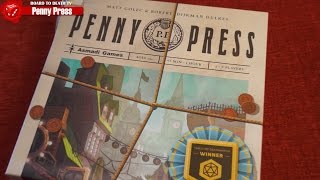
The production drew consistent praise. Board to Death TV described the minimal art as something that "works extremely well for the topic," with each player mat designed to look like a desk in a newspaper room. Tokens came out of the punchboard with ease, and the reviewer was pleased with the box, which resembles a stack of newspapers. John Gets Games also highlighted the "great production value and art" even while being disappointed by the play. For a theme built around printed news, this attention to presentation suits the subject well.
Potential Drawbacks
A Hard Catch-Up After an Early Stumble
The most serious criticism came from a reviewer who fell behind after the first print cycle. Because players can place many reporters at once after publishing, a rival with a stockpile can take majorities quickly and leave others far behind. John Gets Games described having fun until that first newspaper cycle, after which the reviewer spent the rest of the game "trying to stay on top of" the opponents. The reviewer felt the area majority element was "too big of a deal in the game," and while the advertisements offer a bit of a bring-back-the-leader effect, the reviewer found it "too hard to catch back up." A player who falls behind early may find the rest of the session hard to enjoy.
Repetitive Loops and Thin Replay Value
Board to Death TV found that the game can fall into a repetitive pattern. The reviewer described a session where "everybody kept taking the reassign action where we ended up in this repetitive loop," and felt that after a few games the experience might feel familiar. Replay value was the reviewer's main worry, even though the game plays quickly and the reviewer still recommended playing it several times. For players who want fresh decisions every session, that familiarity may be a real concern.
If You Enjoy Penny Press
None of the reviewers named a direct comparison, so these suggestions follow the mechanics and feelings they described. If the appeal is contesting shared spaces with scoring that swings on who has the most presence, look for area majority games where a single decision can change who controls a region at the next scoring. If the pleasure is in timing a payoff against rivals, look for games where the value of an action depends on what other players are doing, much like the bidding-style choices Board to Death TV highlighted. And if the front-page assembly was your favorite part, look for compact puzzle-like games where arranging tiles or cards under constraints carries most of the scoring.
What Reviewers Are Saying
"What it does extremely well is how it allows strong tactics and strategy for experienced Gamers while making it really accessible to newcomers for bidding games not many board games have that balance luck has no place in this game."
— Board to Death TV
"If they go to press first they could steal the story out from under you. You're not ready to publish but you don't want to be beaten to the punch and miss out."
— Actualol
"I was having fun until that first newspaper cycle where I kind of was a little bit behind the boat and I was just just like drowning the rest of the game trying to stay on top of my opponents."
— John Gets Games