
Persian Wars Deep Dive
What the Community Thinks About Persian Wars
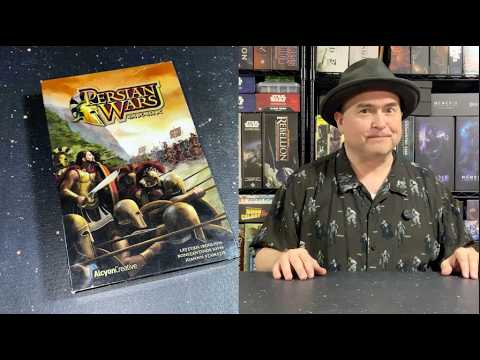
Persian Wars is a card-driven wargame from Alcyon Creative that covers the struggle between the Persian Empire and the Greek city-states from 494 to 466 BC. Both reviewing channels worked from a prototype, and both stress that components, artwork, and rule wording may change before the crowdfunding campaign. Within that caveat, the consensus is favorable. Zilla Blitz calls the game a solid design that works, and The Discriminating Gamer describes it as a light to medium war game built around meaningful decisions.
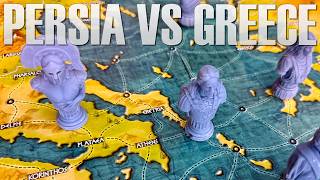
The most common point of agreement is that a very small number of units still produces the feel of a large historical conflict. Zilla Blitz notes that the Persian Invasion scenario uses only five units on the map, three Persian and two Greek, and admits to being unsure whether such a sparse game could function as a war game at all. After several hours of play, Zilla Blitz concluded that it does. The Discriminating Gamer, for its part, calls the game an easy-to-learn, easy-to-play strategic war game and recommends it on that basis.
Reviewers diverge mainly on the solitaire experience and on how much the prototype's shortcomings affect the play. Zilla Blitz regards the game as a two-player design at heart, one that can be adapted for three to five players by sharing leaders. The Discriminating Gamer is more positive about the game's teaching value, while Zilla Blitz is more focused on the practical details that still need work.
Core Mechanics That Define Persian Wars
Card-Driven Action Play and Leader Hands
Each side has its own action deck, and each leader draws a hand from it at the start of a turn. The number of cards depends on the event card played that turn, which gives either the upper or the lower limit for each leader. Zilla Blitz explains that the cards are unique to each leader, so players are not pooling a shared hand. Action cards carry several functions: strategic actions such as mobilize, engage, conquer, and liberate for movement and territory; red battle cards that are reserved for combat; and utility cards such as trader and espionage that let a player strip an opponent's cards. The Discriminating Gamer highlights the cancellation cards and the timing of plays as the source of the game's tough choices, since a card held back for combat cannot be used to move an army.
Zilla Blitz describes what the reviewer calls a game within the game. In that opening turn as the Persians, the reviewer used espionage and trader cards to discard Greek mobilize cards before moving a single army, leaving the Greek leaders with almost nothing to play. Because each side plays cards to limit what the other can do, a turn can be decided by hand management as much as by map position.
Combat Resolution Through Card Steps
Battles begin with a simple sum. Each army has a morale, a training, and an army size value, and Zilla Blitz notes that players add these three numbers to produce a starting combat value. Card play then modifies that total. The combat procedure moves through steps in which the defender may withdraw or mislead, the attacker and defender may play reinforcements, and both sides may answer with ambush, desertion, scouts, or dense fog. In Zilla Blitz's example, the attacking leader held back a reinforcement card until a late step, then played dense fog so that the event card's bonus became the only modifier. Zilla Blitz also points out that the winner's margin on the combat results table determines the losses, and that the winner gains morale while the loser may be pushed one or two spaces. Each battle is then recorded on a battle track, which matters as a tiebreaker in the Persian Invasion scenario.
The Persian Wars Experience
Tension of Hidden Intent
Much of the tension comes from information the players do not share. The Persian player secretly draws one of five objective cards, each listing nine cities to conquer. Zilla Blitz explains that the Greek player cannot know which nine cities are targeted, so the Greeks must guess where the blow will land. The Discriminating Gamer describes the same bluffing dynamic: a Persian player might conquer a city that is not really needed simply to make the enemy believe it is a target. Players who enjoy reading an opponent's intentions will find that this hidden layer shapes almost every turn, and that the cards in each hand add a second layer of secrecy.
Epic Clashes Without Front Lines
Zilla Blitz frames the game around a particular kind of ancient warfare, one with no fixed front lines in which large armies forage across the landscape and then meet in decisive battles. Zilla Blitz credits the design with modeling that movement convincingly, and says the historical flavor keeps players grounded in the period even though the game is not a simulation. The Discriminating Gamer agrees that the game brings the historical theme of the Persian Wars to the tabletop, and describes the conflict as a fascinating period. Zilla Blitz remembers the Spartans under Leonidas facing Xerxes and the epic defenses and attacks that followed, moments Zilla Blitz describes as bubbling up naturally from the events of the period.
What Makes Persian Wars Stand Out
Depth From a Small Piece Count
Zilla Blitz repeatedly returns to the contrast between the game's sparse board and its strategic range. Zilla Blitz expected a war game to need dozens of pieces, and found instead a modest rule set that still delivers depth and subtle decisions. Zilla Blitz also points to the way the cards carry the rules: most actions are spelled out on the cards themselves, so the players rarely needed to consult the rulebook. The Discriminating Gamer, for its part, describes the design as offering a lot of great decisions in a light to medium package, where the timing of each card play matters more than the amount of material on the table.
A Defensive Side That Stays Engaging
Many asymmetric wargames leave the defender with little to do, but Zilla Blitz found that playing the Greeks was among the most engaging parts of the experience. Rather than waiting to be attacked, the Greek player can block maneuvers, erode the Persian capacity to act with cards, or pounce on an isolated army. In that two-player game, Zilla Blitz used these options to take down Xerxes, and the game remained close to the end. Zilla Blitz describes the Greek side as one that demands aggression, which makes the defense feel like a real contest rather than a passive role.
Potential Drawbacks
Combat Needs Clearer Player Aids in the Prototype
Zilla Blitz found that the combat sequence was the one area that needed a clearer reference. The prototype has no player aids, and Zilla Blitz and the opponent had to work out the steps from the rulebook, sometimes reading between the lines to infer the intended interaction. Zilla Blitz recommends that each player receive a combat aid that tracks the sequence. Zilla Blitz also suggests that the gray miniatures for both sides could be given distinct colors, so that the two forces can be told apart at a glance. These are described as prototype issues that may be resolved in production, and Zilla Blitz says the rules were still clear enough to recommend.
Weak Solitaire Play Because of Hidden Information
Zilla Blitz, reviewing the game for solo play, judges that the hidden hands and secret objectives reduce its appeal as a solitaire experience. Zilla Blitz suggests that solitaire players must be willing to play both sides and accept the loss of the hidden information that makes the game so engaging against an opponent. This is a consequence of the design rather than a prototype issue, so players who want a solo option should look for it elsewhere.
If You Enjoy Persian Wars
Persian Wars suits players who like card-driven wargames in which the hand is as important as the map. Reviewers describe it as approachable enough for newcomers to the genre, so it is a good fit for a wargamer who wants to learn a game and play it in a single evening. Players who enjoy bluffing and hidden objectives will find the Persian secret city cards especially rewarding. Those drawn to ancient warfare, where armies move across open land and clash without fixed lines, will recognize the kind of conflict the game tries to model. Finally, players interested in the combined campaign, which lets each side take a turn on offense across 14 turns and 28 years, will find a long-term arc that reviewers are eager to see in the final version.
What Reviewers Are Saying
"The game features a lot of tough decisions as you are maneuvering your generals around the board, but at the same time as you are trying to find out the exact right times to play the cards for the specific actions that you can. These actions have a lot of significance and repercussions in the game, and you must play them at the optimum time."
— The Discriminating Gamer
"I'm happy to say I didn't feel that way at all playing the Greeks. If anything, I felt like you have to be aggressive as the Greeks, whether it's either to block maneuvers or erode the ability of the Persian army to perform its actions and do things, or just find a weak Persian army and attack it and wipe it out."
— Zilla Blitz
"I think this is going to be a game that's going to work well for introducing beginners to war games, but there are also a number of interesting aspects, both in terms of the army strength, in terms of all the actions, in terms of the event cards that are played."
— Zilla Blitz