






































Photosynthesis Deep Dive
What the Community Thinks About Photosynthesis
Photosynthesis stands out in the board game landscape as a rare achievement: a game that merges thematic elegance with pure strategic gameplay. Reviewers consistently praise its intuitive representation of natural competition, with the sun mechanic serving as both the game's central metaphor and its defining resource system. The game has garnered respect from both casual players and design enthusiasts, though some find its deep strategic nature demands more attention than games with lighter themes.
Core Mechanics That Define Photosynthesis
Resource Management Through Light Energy
At its heart, Photosynthesis uses sunlight as its primary currency, making abstract resource management feel tangible and thematic. Players generate light points each round based on tree placement and size relative to the moving sun. The moving sun creates asymmetrical board states that shift each round, meaning players cannot rely on static strategies. A tree that benefits from sunlight in one round might find itself in shadow the next, forcing constant reassessment. This mechanic transforms what could be a dry economic system into something that mirrors real forest ecology where competitive positioning is everything.
Strategic Depth Through Line of Sight Shadows
The shadow mechanic introduces a three-dimensional chess element that rewards forward thinking. Taller trees cast shadows that block sunlight from reaching smaller trees, creating both opportunity and vulnerability. Players must visualize future sun positions and anticipate where shadows will fall. This spatial reasoning requirement makes Photosynthesis intellectually demanding, as the most rewarding plays often involve placing trees strategically to both maximize personal light generation and block opponents from optimal positions. The consequence is a game where pure mathematics guides play, with every decision carrying transparent cause and effect.
The Photosynthesis Experience
Elegant Mechanics Supporting Natural Theme
What makes Photosynthesis remarkable is how cleanly its mechanics map to real-world forest ecology. Planting seeds, growing them to saplings, then mature trees, and eventually harvesting them for points mirrors actual forestry cycles. The seed planting mechanic requires trees already on the board to propagate, encouraging players to balance growth with reproduction. Harvesting mature trees only becomes valuable late in the game, creating natural arc where early investment yields late payoff. Reviewers consistently note that every action in Photosynthesis feels justified within the game world, with no mechanics feeling arbitrary or pasted on.
A Game of Pure Strategy Without Luck Elements
Photosynthesis distinguishes itself in an industry filled with randomization by offering completely deterministic gameplay. There are no dice rolls, no card draws that determine fortune, no elements of chance. Everything that happens is the direct result of player choice and forward planning. This purity appeals to players seeking strategic mastery but can feel unforgiving; there is no luck to blame for poor positioning, only miscalculation. The clarity of consequence means players always know exactly why they won or lost, making the game simultaneously satisfying and occasionally brutal.
What Makes Photosynthesis Stand Out
Visual and Tactile Presentation
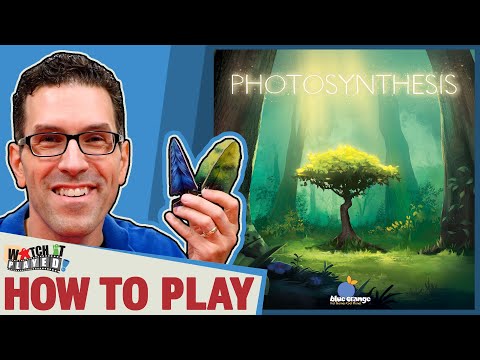
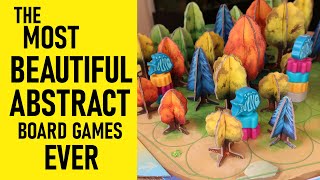
The game's 3D cardboard tree pieces create an immediately striking table presence. Unlike many abstract games that rely purely on concept and board layouts, Photosynthesis features components that naturally draw the eye. The trees themselves become visual anchors that help players mentally model the game state. The relatively simple set of components means the production remains elegant rather than overwhelming, allowing the tree sculptures to serve as the focal point without distraction. This restraint in component count combined with strong visual design creates one of the most iconic game presentations in the modern hobby.
A Rare Balance of Theme and Abstraction
Most board games force designers to choose between deep thematic implementation and clean mechanical systems. Photosynthesis exists in the narrow intersection where thematic language directly supports the mechanics and vice versa. Players learn to think like trees competing for resources, and the game world reinforces every mechanical choice. This integration means players intuitively grasp why actions work the way they do rather than having to memorize arbitrary rules. The result is a game that feels immediately accessible to explain yet contains surprising depth for those willing to engage with positional planning.
Potential Drawbacks
Demanding Spatial Reasoning Requirements
The shadow system requires players to mentally rotate the board and project future sun positions, a task that can challenge those with spatial visualization difficulties. Since Photosynthesis lacks any built-in assistance for visualizing shadows, players with certain cognitive profiles may find the constant mental rotation exhausting rather than enjoyable. The game's abstraction, while elegant, means no thematic flavor text helps guide intuition. Players must develop a proprietary mental model of how the mechanic functions before strategy becomes accessible.
The Quiet Finality of Strategic Defeat
Because Photosynthesis is entirely skill-based with no luck elements, players can find themselves in positions where they are mathematically unable to win but must continue playing through the remaining rounds. The lack of catch-up mechanics or comeback opportunities means falling behind early can result in a game where the outcome feels determined while rounds remain. Some players find this final resolution satisfying, while others report that visible strategic defeat creates an experience that can feel less engaging in the endgame, particularly when playing with competitively mismatched opponents.
If You Enjoy Photosynthesis
Players who appreciate Photosynthesis often also enjoy Concordia, which offers similarly strategic gameplay with shared board spaces and minimal luck. Suburbia shares the city-building cityscape creation and thematic coherence, though with more complexity. Takanoko offers lighter spatial reasoning with shared board control, while Castles of Mad King Ludwig provides area control with compelling positional play. For those seeking pure strategy without theme, Quarto delivers elegant abstract thinking. Everdell appeals to players who value beautiful production and natural themes, though with lighter mechanical depth. The comparison titles suggest that Photosynthesis attracts players valuing clear cause-and-effect gameplay, thematic integration, and visual elegance over random variation.
What Reviewers Are Saying
"Photosynthesis is a great game where you are doing everything with sunlight. Sunlight is your money in the game, it's your currency, and there's a sun around the board that points in different directions, giving you photosynthesis points which is your currency. It's got this really great currency system because that currency is light, and as this light is moving around the board, it's casting light in different directions. The shadow mechanic in this game is where if you have a really big tree and the light's coming at it, if there's a smaller tree behind that tree, well, that tree is in shadow and therefore it can't get any light. This is a really kind of like 3D chess game where you're constantly jockeying for position, trying to grow your trees tall, trying to cast shadows on each other."
— BoardGameGeek
"For beautiful and pure strategy, check out Photosynthesis. Photosynthesis, you are planting trees in a forest and the trees have to grow and spread their seed in order to generate more trees. All the while the sun is going around the forest and you have to grow trees in the sunlight in order to help them grow more and generate more energy which you use to plant more seeds. There's absolutely no dice rolling, there's no cards involved, it's a game of pure strategy. But it isn't always easy to find people who are willing to play a purely strategic game. Photosynthesis can actually almost be depressing because you can tell when you're getting crushed in Photosynthesis. It's completely a strategic game."
— Board Game Dad
"With most games there's a trade-off between theme and mechanics. Photosynthesis is the exception because somehow it is a purely strategic game with a remarkable theme and memorable intuitive mechanics. However it does feel a little bit like playing chess with trees. For some gamers they might prefer a little bit more of a luck element in order to mix things up. Players take turns using their energy to grow trees and plant seeds. Large trees photosynthesize more energy enabling you to grow and plant even more trees. However as the sun moves around the board, taller trees will block the sun from shining on smaller trees, harming other players in this way. Players must decide if they want to score their tallest trees for points or leave them standing to use offensively. For theme, this game has a 9 out of 10. Mechanics, a perfect 10. Luck, a zero. Strategy, another 10. And complexity, a 4."
— Board Game Dad