
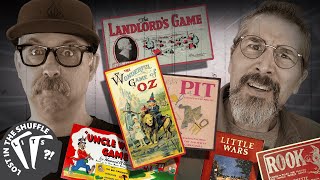
Pit is an open-outcry commodity trading game. The first edition in 1903 had a deck of 63 cards, 9 each of 7 commodities, each with a value (ranging from 40 for Flax to 100 for Wheat). Players offer trades by crying out the number of cards they want to swap (“One! One! One!”, or “Three! Three! Three!”) but not their identity. The winner of the hand is the first to collect all of one commodity, declaring “Corner on Wheat!” or whatever commodity has been collected. The winner of the hand scores points equal to the value of the commodity, and the winner of the game is the first to 500 points.
The 1904 Edition of Pit added much fancier artwork and the famous Bull and Bear cards, which provide wild-card and penalty features. The early editions allowed a maximum of 7 players, but later versions supported 8 and in at least one case up to 10.
Pit’s designer, noted psychic Edgar Cayce, is often accused of having stolen the idea from the game Gavitt’s Stock Exchange (G-S-E) invented by Harry Gavitt. While G-S-E claimed patents dating as early as 1896, it involved trading railway shares, and was only copyrighted and published in 1903, the same year as Pit. In addition, the only related patent assigned to Gavitt is US746492 A, filed October 7, 1903, and granted December 8, 1903. Also hitting the market in 1903 was Bourse', a remarkably similar open-outcry commodity trading game from Flinch Card Co., using an 80-card deck with 10 each of 8 commodities, and Panic, using a 65 card deck with 8 each of 8 commodities and a Panic card, roughly equivalent to the Bull. Pit, however, seems to have cornered the market on open-outcry games, as neither of its competitors were seen again after 1904.

Pit: My Favourite Card
Images



- accessible light card game with interaction
- not yet fully explored in playthroughs; upcoming impressions vlog
- set collection with inter-player stealing and point transfer
- resource/political style card game
Mechanics (from transcript analysis)
- set collection / resource theft — steal resources and give points back to neighbors
Video topics + discussion points
Quotes (from this video)
- Dimension was the one that I ended up keeping
- I'm booked up until January of 2020 because I need to make sure that I have you know my mental health at the forefront of things
- it's a pretty lightweight card game as you're trying to do a little bit of tableau building in front of yourself
References (from this video)
- political struggle between royalists and parliamentarians
- historical England; First English Civil War
Mechanics (from transcript analysis)
- Trick-taking with tug-of-war elements — Card-based actions representing political and military maneuvers
Video topics + discussion points
Quotes (from this video)
- space bees anyone
- gosh I I love board games
- this game looks pretty beautiful
References (from this video)
- overhauled and accentuated board elements compared to Gensis
- speaker liked Gensis but wanted more from the board elements
- speaker is excited about the changes and the potential for a more integrated board experience
- speaker made a sponsored video for Gensis and will be biased
- speaker did not love the board elements in Gensis
- campaign game
- Gensis
Mechanics (from transcript analysis)
- Area Control — move figures onto a spot and then once there's enough there you can turn them into a city
- Resource Management — card based game where you're spending time as a resource and doing a variety of other things
- Tableau Building — build out a kind of Tableau that is in front of you
Video topics + discussion points
Quotes (from this video)
- Tiny Epic Game of Thrones it's a 2024 game it says assume the role of a mighty House of the Seven Kingdoms
- players utilize an Innovative limited action dice mechanism M to strategically choose cards such as plot whisper event March and sail with the options to follow other players actions
- players will yield an immense amount of Power with their respective houses through a versatile hand of multi-use cards that allow players to plot against the influential houses of Westeros orchestrate grandio events and partake in exhilarating battles
- Worms span I'm being factious this is like one of the most talked about games over the last few weeks this is a reimplementation of wingspan all about dragons
- Build a cavernous Sanctuary for Dragons of all shapes and sizes
- your player board starts out small they're caves and at the beginning of the game your cave is Tiny I think there's only room for one Dragon but as you play through the game you can dig out your cave allowing you to put more dragons in there
- Wormspan looks cool I like dragons I think they're cool I think the artwork looks neat
- I'm intrigued like wingspan is one of the more popular games to come out in the last seven years and here is a follow-up game with a new theme and some new mechanics I want to see how this one goes
References (from this video)

- basketball/sacrifice ritual
- Mesoamerican
- abstract
Mechanics (from transcript analysis)
Video topics + discussion points
Quotes (from this video)
- "Mega XP is a board game convention unsurprisingly in Mexico City"
- "it's the biggest convention in Latin America"
- "I demoed so many Mexican games there"
- "pits which is based off the Mesoamerican basketball sacrifice ritual game ... that game was absolutely fantastic"
- "I still love Ticket to Ride"
References (from this video)
- Described as a fantastic loud, shouting game
Mechanics (from transcript analysis)
Video topics + discussion points
Quotes (from this video)
- The most expensive game that I own is frankly a huge anomaly in my board game collection because that's Foundations of Rome.
- It's a showstopping game. It does something fantastic, which is it's a huge box, but it doesn't make the setup any longer to be bloodily long to set up.
- To me, that one game was an investment that I'll have probably for the rest of my life and I'll be able to play and enjoy.
- Is $200 worth of components and value and craft in this game? Maybe.
- The price per evening at that point gets lower and lower until you're thinking, 'Wow, this game gave me a month's worth of Nights Out, but spent in playing the game for $5 a pop.'
- Foundations of Rome is in my top 10 games of all time.
References (from this video)
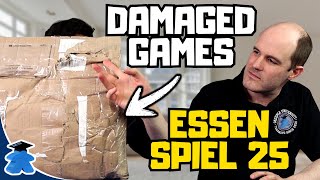
- hoping this is going to be a fun two-play game
Mechanics (from transcript analysis)
Video topics + discussion points
Quotes (from this video)
- Yes, maybe we knew there were still some games in transit.
- It's like 300 plus 150. I can't remember how much I pay about that much. 450 €450 something like it's about 500 Australian dollars.
- Sadly, they didn't survive the post.
- It's probably because actually no not the Pacific Ocean cuz that's the least direct ocean to get to Australia.
- So some people who really likes to care of their board games, please do not yell to anyone.
- It's still playable, although it's like bitten up like really bad, especially on the side.
- So, this is uh this is Space Cowboys. Sorry, Space Cowboys. We haven't been able to display a perfectly square box, but rest assured you at home, if you purchase from your friendly local game store, it will be square.
- This is by the people who did Ghost Lift who we uh which we shown last time.
- I am excited to play Recall.
- So, there are more that or three more actually games.
- If you have heard of Startups, please let us know if you enjoy it or if you don't like it.
- Um, this is Fman Frey's game called Floss, which is Fearless.
- I think I'm okay with this. Like, looks like everything is intact.
- I like this art here. I like this angular very stark angular uh geometric shape.
- So, this is like um a draft.
- This is very sad. This is uh I can't really give these toys to Teran.
- So, this is Limit. It's about environmental and this is the last games I think.
- Um, yeah, maybe it is rare. Maybe it's going to worth a lot in the chart, but it's dented a little bit.
- So, this is um yeah, maybe it is rare. Maybe it's going to worth a lot in the chart, but it's dented a little bit. Right.
- And this one I remember the preview from last year's Essen. So I remember being quite interested in this one.
- So, this is um yeah, maybe it is rare. Maybe it's going to worth a lot in the chart, but it's dented a little bit.
- This is a two-player game kind of like push and pull by uh Korea board Korea board games.
- So, this is the only one that I got from Korea Board Games and hoping this is going to be a fun two-play game that we got we can bring to Bali in our family visit soon.
- So, those are these are um little wooden potatoes.
- What do you call it? The laser cut.
- Laser rocks. Laser.
- Is it laser rocks or just general? No, just general general laser cut.
- Yeah, laser cut. And including the potatoes. It's very good.
- Caution signs is one of the one that we got from Essen.
- This is again, this is not new, but this is a good party game plays a lot of people, which is what is it now? Nine players up to nine players where one person is a guesser, the other one is drawer. You have 20 seconds to draw a combination of stuff and the guess I will need to and the cards would get mixed.
- You will get an adjective and a noun and draw them together.
- Very good there.
- Yes. And then it's kind of so clovery you have to or a guesser has to align them correctly. Yes.
- Good fun. So this is uh we've got three things from Delicious Games this year.
- One you've seen last time which is the underwater city expansion. Second one is Aquaria. This is a Thomas Hollik game.
- Yes. So obviously he had the very also slightly broken on the corner. He had the very big show last year with Seti Galileo and uh the tea.
- Yeah. I heard good things about this one as well. Yeah.
- And his release this year. Yes. So, and then the second one from delicious games is Aperna. This is Vladimir Sushi. The only Vladimir Sushi's game. Suhei. Vladimir Sui's game.
- That's what I've been singing in my head. Now you've got it.
- Yeah. Yeah. So, this is um our only Vladimir Suhi's game. And this is a smaller box. So, yeah. Nice little cute box.
- We've been enjoying these games including last year's release for Safa. Oh yes, he's he's had uh many classic releases over a long time. So many. So many.
- So before we move on to the next games, these magazine I got handed over magazine which is called Joy.
- Fort is it for depends what language it is. Yes. So there's not a lot of magazines around these days, but this is one of them. Um, why the first RPG season is the most important, challenging, and satisfying. Part two.
- So, a mix of things there and then a bag. I don't know if you know that I collect bags. So, on my birthday, please give me bags. Backs.
- Yes, Hobby tote bag. Yes, tote bag. And it's got two handles.
- Um, over there is a And it's got two handles.
- Yeah. It's actually a thoughtful review of the bag.
- Yes. There's the Soros. This is from Super Mele. Now, Super Meles distribute lots of games and this is one of their release games. It's actually sold out at Essentville. So, yes, it was one of the bigger games. Yeah. Shri Mill. Yes.
- So, it's looks beautiful. Look at that.
- And it has these dingies.
- I think somebody mentioned this game as well to me. Pretty sure it is like in my shopping list somewhere.
- Yes, it was pretty uh pretty well hyped going into the show.
- Very heavy. Lots of things in here. H they are okay the box the bit day if you want to please grab it first. So this is by Brett Spiel podcast. So look at this. It's cute right? It made it home.
- nice little 3D printed bit.
- Which clicks together.
- Clicks together. Hooray. Uh two more games. Well two more games that we can show. Oh yeah. I forgot about this. Whoops. There's a space lab. You would have seen the slideshow photo. Maybe you're not in the first part of essence build game. This is engine building game and it's very pretty. Like you want to Okay, it's shiny as well.
- Happy.
- Not as shiny as the other one.
- Well, the in the inside's also shiny, Taran. Well, you can play a bit um a bit later if you like. Look. Shiny.
- That is shiny.
- Yeah, shiny. Anyways, trust me, it's shiny. So, this is by Studio H. And this is a kind of like yeah as I say uh engine not engine building but tile placement you're trying to meet objective in a different way and this is my fault chemist lookout games
- now if you look back at the fortunes of scandal way it is a euro game but a euro game but looks like a marit
- very uh very thematic looking art. Yes, that this one is um well, look at Games brought out things like Oh, we've got the Forest Shovel one as well, the D Mall, the new version, but I didn't get it from Essence Spiel. I got it from Gen Con. Uh and this one is the lookout games one. So, would be interesting um to to play like this looks like not a Euro game, right?
- No, it looks like a battle card type of game. It's what I would generally imagine. I mean, it is to play two players.
- So, and so the Marvel characters we have here, it's I don't recognize many of them. That's Iron Man. That's the Hulk.
- That's all you know about Marvel. I'm the big fan of Marvel bigger.
- I'm more of an I'm more of an X-Men.
- That's actually true.
- So, I would recognize X-Men of which those I'm not
- which I will need to give you quiz. This is Hercules and the 12 labors. So this this is a solo game. This is uh the the publishers just got a few copies. So I got this from Essen
- and that is Envy Born Games.
- Yeah, it seems like a really fun uh solo game with with dice to dice to allocate to the cards.
- There's not really a lot of explanations there. Sorry. This is Punikica which we talked about in the previous vlog which is a two-player battle game with card play.
- Yes, Punic War game from Felank.
- And over there we have Children of Coloss. This might have the most heft to it. This is Yes, it is quite heavy. Children of the Colossi which I also show in photos um that it's kind of like a there's a area control but also there's uh you want to send your work in here for your control. want to send it up there in the mountains to give you more powers. So that difficult decision.
- Um they've got lots and lots of them but and by the end of essence spill I see that they almost none. So I don't know maybe they sold out as well.
- And this is not new. I don't know if this is this year's release. I'm pretty sure this was kickstarted.
- So they're very big this year though. Jaggi. Yes.
- Yeah. And we also had a alternative rule to some of using some of the components for
- It needs more love.
- I'd rather it be damaged than not arrive at all.
References (from this video)
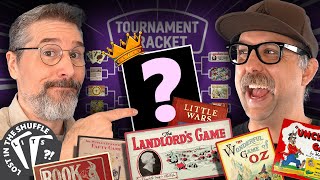
- Still relevant
- Stuck around for over a hundred years
- Comes with a bell
- Played within the last decade
- Little Shoppers
Mechanics (from transcript analysis)
- Set Collection — Players aim to collect sets of commodities.
- Trading — The game involves yelling to get people to buy commodities and trade.
Video topics + discussion points
Quotes (from this video)
- And which one of these are going to get lost in the shuffle.
- We'll vote secretly on our candidate and if we are unanimous in our decision, that game will move forward.
- And the Landlord's Game was created 30 years earlier and then stolen from the designer of the game.
- I think The Landlord's Game is what became Monopoly.
- Which of these two antique board games will be now crowned number one?
- So, congratulations, Jyn Rummy. You are the best antique board game out there. Even though you're a card game, but you know, still.
References (from this video)
- innovative real-time and negotiation mechanics
- energetic gameplay
- simple to learn
- can be very loud and chaotic
- commodity trading
- stock exchange
- real-time
- Milbourne
- Sid Sackson games
Mechanics (from transcript analysis)
- Card game — No, it is it is a card game.
- Negotiation — negotiation, trading.
- Real-Time — REAL TIME. negotiation, trading.
- Trading — negotiation, trading.
Video topics + discussion points
Quotes (from this video)
- It's all about the narration, the story, the the you know, and that's I still get caught up in this map.
- It was called Remote Possibilities.
- Scotland Yard, it just it's one of those games that's way ahead of its time.
- Sid Sackson was Way ahead of his time.
- This game almost just This started a genre, but then didn't.
- Cosmic Encounter is the or one of the original asymmetric games.
- Also introduced the traitor mechanism, which was a really cool concept that again didn't really become a thing till years later.
References (from this video)
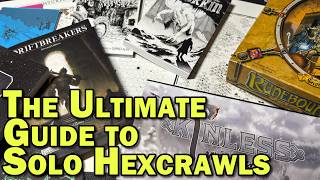
- Very, very small hex crawl.
- Single page with a trifold pamphlet for rules.
- Great for something really small.
- coffee break game
Mechanics (from transcript analysis)
- Hex Crawling — A single-page hex crawl with accompanying rules.
Video topics + discussion points
Quotes (from this video)
- This is one of the best tools for hex crawling that I know of.
- It just works so effortlessly.
- This little snap box here has everything that you would need to have a little solo hex crawl.
- So just a really really neat little pocket uh hex crawl.
- This isn't a game in and of itself. You will need a game. You will need a system.
- This is one of my favorite subgenres of the tabletop hobby.
References (from this video)
- I like Pit a lot in the right circumstances
- Stock Exchange
- Happy Salmon
Mechanics (from transcript analysis)
- shedding — Implied by the comparison to 'getting rid of cards as fast as you can'.
- Trading — Implied by the stock exchange theme and the nature of the game Pit.
Video topics + discussion points
Quotes (from this video)
- Hey everybody, I'm Tom Vasel and welcome to look back, a series where I go through and take a look at the reviews that I did last year this time and 5 years ago and 10 years ago and 20 years ago and tell you what I think about them now.
- So those are the reviews I did 1, 5, 10, and 20 years ago.
- Thanks for watching. I'm Tom Vasel. We'll see you next time.
- Hey. Uh thanks for watching another video here on The Dice Tower. Uh we really appreciate you stopping by and checking our things out.
- And hey, if you really like what we're doing here at The Dice Tower, then there are different ways to support The Dice Tower. One of those ways is through Patreon.
References (from this video)
- tight set-collection feel with tense pact interactions
- depth and variability in the expert variant
- tension from leveraging opponents' goblins
- rules can be lengthy and complex, especially at higher player counts
- overall point total is relatively low (20s), limiting takedown feel
- a rule was missed on first play, slightly lengthening the game
- goblin clan rivalries using pact cards to leverage opponents' resources
- Pandora-related goblin factions negotiating to claim territory; tie-in concept
Mechanics (from transcript analysis)
- expert variant — special goblins, a dynamite track, and other bonuses add depth when using the expert variant
- hidden goals and variability — hidden goals can yield extra points or penalties; completing pacts with others may grant bonus cards
- pact mechanic — you can use goblins from the player to your left or right to complete tasks; at least one of your goblins must be used
- task completion and scoring — complete tasks by discarding goblins; points reflect the number of packs and pact outcomes
- two-step goblin deployment — draw or play goblins into your tableau, then cash them in to complete tasks
Video topics + discussion points
Quotes (from this video)
- this is a game full of rules; the rulebook is a pretty substantial overall
- it's one of the more fascinating games I've played in a long time
- I would certainly play it again
References (from this video)

- The bear card's design is a clever commentary on how players try to offload bad cards.
- The game simulates the chaos and yelling of old stock market days.
- The bear card causes players to lose points at the end of a round.
- Stock market simulation where players try to corner the market on goods.
Mechanics (from transcript analysis)
- card drafting (implicit) — Players receive cards and trade to improve their hand, aiming to get rid of undesirable cards like the bear.
- Set Collection — Players aim to collect a full set of a single commodity card to 'corner the market'.
- Trading — Players yell out quantities and commodities they want to trade, then negotiate with others to exchange cards.
Video topics + discussion points
Quotes (from this video)
- The game is Pit, and this is My Favourite Card.
- So you smash this bell, and then everybody starts yelling, just like in the stock market days of yore.
- So you want to get rid of it.
- And this is, this is how you end up with a completely messed up, scuffed bear!
- Pit. That's my favourite card in the game.
References (from this video)
- classic, accessible for families
- rules interpretation can vary by group
- King's Corner
- Go Fish
Mechanics (from transcript analysis)
- Trick-Taking — Cards are played to win tricks and score through combinations; timing and strategy with a partner or opponents matters.
- trick-taking/collection — Cards are played to win tricks and score through combinations; timing and strategy with a partner or opponents matters.
Video topics + discussion points
Quotes (from this video)
- I love playing cards card games I feel like are what got me into modern board gaming
- there are so many different games that you can play with just a simple deck of cards
- get your cards out get some games played
- there were so many different variants of rules I got really confused
- this is board game Brody I hope you enjoyed this video
References (from this video)
- high-energy social interaction
- iconic components (bell) add flavor
- loud, potentially chaotic experience and hearing-damage humor
- no-holds-barred trading and shouting
- auction/commodity market frenzy
- energetic and chaotic
- Spoons
Mechanics (from transcript analysis)
- Auction / Bidding — Players bid and trade commodities in a lively, noisy auction environment.
- live-action auction — Players bid and trade commodities in a lively, noisy auction environment.
Video topics + discussion points
Quotes (from this video)
- Bridge is a lifestyle game. That's all we play is bridge and if you don't know bridge, you cannot be my partner.
- we discovered a game of Bunko and we're pretty sure it was haunted.
- This is a specific complete edition of Tiddly Winks.
- What does a good boy do when he accompanies grandmother to church?
- Do you always feel like you don't have enough time?
- I will say this is a game I still play.
- Hickey Pickity. Boy, is that fun to say.
- The landlord's game is a precursor to Monopoly
- this is thematically you are going on a shopping spree.
- Little Wars is seen by many as being the first modern war game.
- the box is like with a bell.
- Pogs is making a comeback even now 100 years later.
- Rook came out 20 years before Bridge.
References (from this video)

- Fresh, unusual take for a party game
- Engages conversation and debate
- Short playtime supports replayability
- Casual players may need guidance to grasp pattern logic quickly
- pattern recognition and matching
- party/social setting, casual home play
- light, party-driven social deduction-like interaction
Mechanics (from transcript analysis)
- Compound Scoring — Points awarded based on alignment with others' choices in a social pattern exercise
- Pattern Recognition — Players lay out cards and guess patterns; scoring when patterns match others
- pattern-based scoring — Points awarded based on alignment with others' choices in a social pattern exercise
Video topics + discussion points
Quotes (from this video)
- It's a funny little party game from Oink Games Picut.
- There are a whole lot of cards and they will have dog, cat or bird.
- It's very unusual, very different vibe, but extremely fun. Highly recommend.
- The interaction is really high where you can try to hitchhike other people's trains.
- Engine building galore.
References (from this video)

- Crunchy puzzle
- Strong interaction with co-present players
- Steep learning curve for unfamiliar players
- abstract strategy puzzle
- Mayan ball game
- crunchy, chess-like movement with asymmetric options
Mechanics (from transcript analysis)
- abstract strategy — puzzle-like scoring and positioning decisions
- asymmetric movement — different pieces move in distinct ways to score
Video topics + discussion points
Quotes (from this video)
- it's the largest gaming convention in Latin America
- Mega XP is really really fun
- I feel like it's such a valid place to go
- the energy of the Mexican designers and publishers feels so fresh
- I would love to come again
References (from this video)
- Atmospheric and interpretive exploration
- Lack of clear objectives may frustrate players seeking structure
- Atmospheric exploration with a focus on personal interpretation of progress rather than explicit goals.
- Tales of Arabian Nights
Mechanics (from transcript analysis)
- exploration_based_progress — Players explore with minimal direction, constructing their own path and sense of progress.
Video topics + discussion points
Quotes (from this video)
- Journey before destination.
- Destination before journey. I need at least know where I'm going.
- Some people look to just explore and just have a fun time exploring the game.
- Other people are going to look for an objective in a game.
References (from this video)
Mechanics (from transcript analysis)
Video topics + discussion points
Quotes (from this video)
- Our mission statement is about to create a diverse and supportive Gaming Community dedicated to playing discussing designing and promoting historically based board games.
- We're not here to make money. We're here because we love this hobby and we want to help people doing something that we love.
- SD Hiscon is an incubator—a place where designers meet, learn, and iterate, and where new voices can grow within a passionate community.
References (from this video)
- Silly
- Fast
- Noisy
- Feels like it's down to luck
- Trading
- Chaotic real-time trading
Mechanics (from transcript analysis)
Video topics + discussion points
Quotes (from this video)
- Life's too short
- I want designers to try new things
- I want someone to come along and invent the next deck building