/pic3487954.jpg)
Plague Inc: The Board Game is a strategic game of infection, evolution and extinction for 1-5* people - based on the smash-hit digital game with over 85 million players. Can you infect the world?
Each player is a deadly disease and they must battle against each other to spread their plagues, develop new symptoms and ultimately wipe out humanity.
Starting with Patient Zero, you spread your infection across the world by placing tokens in cities - earning DNA points and preventing other players from becoming dominant. Players choose which countries are placed on the board but you must be both climate resistant and connected to a country before you can infect it. Eventually, as countries become fully infected - you try to kill them using the Death Dice.
Each player’s unique pathogen can be upgraded by evolving trait cards onto an evolution slide (with DNA points). At the start, your disease is weak and unspecialised, so you will need to add new symptoms to make it stronger. Choose carefully and plan ahead in order to react to the changing world and exploit opportunities created by other player’s actions.
A simple nosebleed could accelerate things early on, whilst diarrhea will help you thrive in hot countries. Sneezing can infect new continents by air but Total Organ Failure would allow you wipe out multiple countries each turn.
As countries start to fall, use powerful event cards to alter the balance of power. You might try to eradicate a dominant player by bombing their diseased cities, or hold the Olympics to cause huge numbers of infected people to travel to a healthy continent.
When the world collapses, who will be the ultimate plague?
*5 players with 5th player expansion
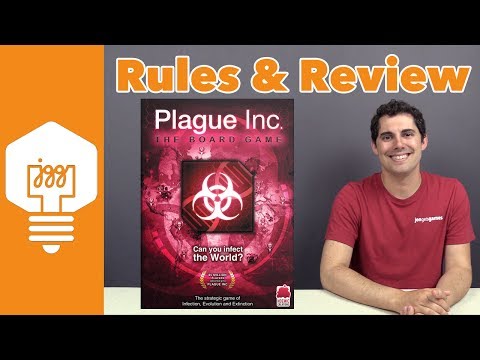

Plague Inc. Full Playthrough - JonGetsGames
- Spreading disease tokens and map control creates meaningful decisions
- Great sense of thematic escalation with mutations and engine building
- Event deck adds thematic variety and disruptive moments
- Death die provides tension and thematic alignment
- Mutation deck is homogeneous and lacks variety; desire for more unique cards
- Variability considered below average except mutation deck
- Five-player games cause long downtime; three players recommended
- competition to eradicate humanity through disease
- Global pandemic/worldwide disease spread
- engine-building with mutations and event-driven progression
Mechanics (from transcript analysis)
- Air Transmission / Waterborne movement — traits that allow moving to other countries by plane or sea; enable jumping between continents
- Area Majority — to control a country you must have the most or tied for most disease tokens in that country
- continent placement — placing a new country into its matching continent on the map
- country control majority — to control a country you must have the most or tied for most disease tokens in that country
- death phase / death die — roll a die for each fully infected country to determine lethality; may kill countries and grant DNA to players on those countries
- DNA track — DNA track around the board acts as victory points and currency; starting DNA is zero; points determine victory
- End Game Bonuses — deck exhaustion triggers sudden death; final scoring with endgame bonuses
- endgame / sudden death — deck exhaustion triggers sudden death; final scoring with endgame bonuses
- Event deck — draw event cards that affect the board; can cause borders to close, disasters, etc
- Events — draw event cards that affect the board; can cause borders to close, disasters, etc
- evolution phase / mutation cards — pay DNA to play trade cards onto the disease; cards provide various abilities such as Air Transmission and Cold Resistance
- Infection Phase — increase infectivity and place tokens onto connected countries according to infection pool
- mutation deck (cards) — deck of mutation cards that escalate the disease; cards can share similar effects (infection, lethality, etc) and add randomness
- virus vs bacteria side (variant) — board has two sides; bacteria side provides certain bonuses; virus side gains mutations and genetic switch instead
Video topics + discussion points
Quotes (from this video)
- this game is competitive so your each diseases trying to out kill and you are also going to be modifying and mutating as the game goes on with a bit of engine building mixed in
- the DNA track which counts as victory points you win the game if you have the most of those
- it's a interesting dynamic engine that you are constructing as you're playing the game
- this is a potentially mean game there is a lot of direct conflict that's going to be happening between players when it comes to those uh event cards
- I think three is best
- From a thematic perspective I think that it's actually relatively strong when it comes to actually spreading the diseases
References (from this video)

- evolving diseases trying to infect and wipe out populations
- global pandemic spread across a world map
- playthrough commentary
Mechanics (from transcript analysis)
- country phase and card deck — On a turn, players choose a country to place or discard, expanding into new areas.
- death die and death phase — If countries are full, a death die is rolled to kill countries; lethality affects chances.
- DNA points as currency and victory points — DNA points are spent to evolve traits and also count toward end-game scoring as victory points.
- End Game Bonuses — Endgame scoring includes continent bonuses, rare events, and large country bonuses.
- endgame bonuses and final scoring — Endgame scoring includes continent bonuses, rare events, and large country bonuses.
- Events — Outbreak allows relocation of tokens; Event cards can influence moves or provide bonuses.
- Hidden Victory Points — DNA points are spent to evolve traits and also count toward end-game scoring as victory points.
- infection tokens and continent control — Players place infection tokens; having the most tokens in a country yields DNA and control impacts score.
- outbreak and event cards — Outbreak allows relocation of tokens; Event cards can influence moves or provide bonuses.
- random event interactions — Various event cards (e.g., CDC Alert, Bird Migration, Nuclear Strike) can block placements or remove countries.
- sudden death — After the last country card is placed, the game enters sudden death with specific end conditions.
- Trait cards and evolution — Trait cards modify bacteria; players discard and draw cards; evolution costs DNA and upgrades infectivity or transmission.
- transmission modes and climate constraints — Airborne, Waterborne, Heat/Cold resistance affect where infections can spread.
Video topics + discussion points
Quotes (from this video)
- this is a pretty good example of how the game plays
- I hope you enjoyed this playthrough
References (from this video)

- thematic and engaging concept
- asymmetric player experience with interaction
- interesting mutation/spread decisions
- downtime at higher player counts (five players)
- dice randomness can feel punitive
- asymmetric tabletop adaptation of a disease-plague scenario
Mechanics (from transcript analysis)
- DNA points / mutation — Players accumulate DNA points to mutate the disease and spread across the world.
- multi-player interaction with events — Event cards gained when present in affected countries add twists and strategic considerations.
- rolling for spread / lethality — Infection spread and country lethality are influenced by dice rolls, disease mutations, and event cards.
Video topics + discussion points
Quotes (from this video)
- the hype was real on this one
- the first two weeks of December are crazy because every single company in San Francisco all these startups they're all doing holiday parties
- I spent two and a half hours talking about the games in front of me
- it's a very cool thing that and it means that next year in 2017 I'm hoping to take four separate weeks off for all these conventions