/pic7375352.jpg)
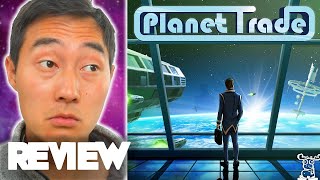
In the far away future, the population of Earth has increased drastically, and more resources are needed for the everlasting demands. The only logical solution was to search for additional resources on other planets, and expedition teams was therefore sent into the vast space to search for planets with an atmosphere suitable for humans, so they can live there and establish farms, mines, and production facilities on them.
In this new reality large companies seek to dominate the transport market in space.
You are a CEO of your own company with your own fleet of spaceships. Discover planets and exploit these to sell resources, build factories, expand your company, and tax your citizens to achieve power and wealth. But be aware of your competitors because they have the same goals and will have the opportunity to attack you throughout the game. Who will have the best strategy?
The Players acquire different cards by drawing them and paying their cost to improve their company or the demand marked of resources. Even to irritate your competition doing the game.
Your income is based on the resources you bring back to earth and how you evolved the newly found planets in the Galaxy
To win the game, you must collect the most points through shares, ownership, and secret missions for you to call yourself the greatest trader in the galaxy.
—description from the publisher

- Endearing ships and cube-loading mechanic; satisfying physical interaction
- Money tokens and solid visual money components
- Flavor text across many cards and flavor text on global events enhances theme
- Resource symbols are intuitive and legible
- Deep card play with multiple strategic avenues for upgrading, financing, or influencing events
- Interactive attack/defense dynamic adds tension and strategic depth
- Reasonable playtime for a mid-weight Euro (roughly 2–4 hours)
- Rulebook translation quality can be confusing; English phrasing and clarity issues
- Visual differentiation between keep and event cards could be improved
- Attack cards are relatively expensive to play; incentive to attack is not consistently strong
- Balance concerns around certain cards and the War global event; some interactions feel over/underpowered
- Gold keep cards have limited utility; overall engine balance can feel uneven
- Game can feel lengthy and fiddly (lots of cubes, counting income, etc.) for some groups
- corporate expansion, resource scarcity, economic competition
- Earth in a near-future interplanetary trade scenario where corporate CEOs manage planets and resources
- card-driven, with evolving events and a focus on direct player interaction
- Terraforming Mars
Mechanics (from transcript analysis)
- Attack / defense cards — attack cards target opponents and can be defended against with defense cards; affects cash and momentum.
- Building on planets — buildings on planets increase production; one building type per planet; unlocks milestones and income effects.
- Combat: Deck/Hand — attack cards target opponents and can be defended against with defense cards; affects cash and momentum.
- Events — round-based global events influence the round, shifting incentives and strategies.
- Freighters and cube loading — load cubes onto freighters, ship to planets, and sell cubes for income; ships and planets interact to drive economy.
- Global Events — round-based global events influence the round, shifting incentives and strategies.
- Hand Management — players hold and play cards that provide permanent or temporary effects; discard for money; some cards upgrade economy or enable other actions.
- Hand management / keep cards — players hold and play cards that provide permanent or temporary effects; discard for money; some cards upgrade economy or enable other actions.
- Pick-Up and Deliver — load cubes onto freighters, ship to planets, and sell cubes for income; ships and planets interact to drive economy.
- Resource / demand tracking — a demand track for goods fluctuates round to round, changing the value of cubes and strategic decisions.
- Resource Management — a demand track for goods fluctuates round to round, changing the value of cubes and strategic decisions.
- Stock / corporate points — buy stock to gain points and income; strategy involves balancing growth versus economy.
- Stock Holding — buy stock to gain points and income; strategy involves balancing growth versus economy.
Video topics + discussion points
Quotes (from this video)
- Planet trade could be right up your alley for a medium weight interactive Euro to constantly survey how to play those Attack cards
- these ships are really quite endearing in letting you put the cube inside of them
- the whole attacking and defending Dynamic really does twist the economic play
- Load them up with cubes and sell each Cube you'll get money for how much that Cube or good is currently worth
- you can only buy each building once around
- war makes the round more intense and attack cards become cheaper to play with the war
- Planet Trade is going through recalls but the core idea is solid