

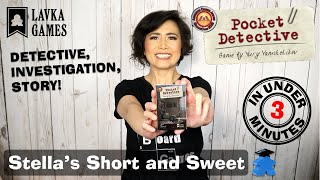


Pocket Detective Deep Dive
What the Community Thinks About Pocket Detective
Reviewers describe Pocket Detective as a compact, card-driven investigation game in which players read a story, flip cards to gather clues, question suspects, and decide when they have enough evidence to make an arrest. Stella of Meeple University frames it as a cooperative murder mystery and places it alongside Chronicles of Crime, while noting that it is smaller, with cards close to the size of playing cards and no app or scanning option.
The most enthusiastic voice comes from Brody of Meeple Mountain. Brody explains that the group usually struggles with deduction games because they keep pointing toward several suspects at once. In Pocket Detective that problem did not arise, and the game was more enjoyable because it was quicker and easier to follow. Brody is careful to say that the same ease may not suit every table.
Johannes of Board Gaming Ramblings is more measured. Johannes called the game good and said they could recommend the series to anyone who enjoys shorter detective style games. Johannes did, however, prefer Chronicles of Crime to this entry, and noted that the copy played was a self-published release from a small publisher.
Core Mechanics That Define Pocket Detective
Deduction
Deduction drives the game. Players work from the story and from each card they flip, building a picture of who is responsible and why. Brody notes that the game makes almost every character seem guilty at first, so the group has to connect the odd details it uncovers and decide which lines of questioning are worth pursuing. When a suspect's behavior has a satisfying explanation, the group can move on; when it does not, the group keeps digging until the answer either holds up or falls apart.
Timed Scoring and Turn Efficiency
The second mechanic is the scoring system, which turns investigation into a race against the clock. Stella explains that the final score reflects how many time actions and tension actions the group used, and that fewer of both is better. Brody adds that cards carrying a clock symbol subtract points, and that some flipped cards show penalty icons that can hurt the score even when they point toward the truth. The result is a central trade-off: the fewer cards the group uses, the better the score, but with less information the group is more likely to answer the closing questions wrong. Brody concludes that players need to find a balance between the two.
The Pocket Detective Experience
Approachable, Story-Led Puzzling
Reviewers consistently describe the game as an approachable puzzle that rewards attention to the story rather than card-by-card reading. Brody says the group enjoyed piecing the story together more than similar games, and that they felt they reached the correct answer without reading every single card. That matters because the case is meant to be relatively quick. Stella likewise describes the game as one in which players read the story and investigate the crime together, which gives the table a social feel rather than a dense simulation.
Tension Between Speed and Thoroughness
The other prominent feeling is a steady pull between thoroughness and efficiency. Because the score falls with each clue collected, players keep asking whether one more card is worth its cost. Stella points out that players may guess and solve the mystery whenever they choose, which adds a sense of risk. Brody describes how a wrong accusation sends the group back to rethink its theory and damages the score, and how a card may reveal more or fewer icons than the players expected. Every flip carries a decision, and the group feels that weight throughout the investigation.
What Makes Pocket Detective Stand Out
Scenarios That Change the Rules
Brody highlights that Season One contains three scenarios, each with its own deck, and that the decks change how the game plays. In one scenario the players are sneaking around and trying not to get caught by the police, while in another they take the role of detective with the help of the other officers. Johannes praises the same design, saying that each deck changes how the cards work, how information is found, and how players interact with the characters. That variety gives each case a distinct feel within the same series.
Small, Quick, and Easy to Start
The compact footprint comes up repeatedly. Stella notes that the cards are close to the size of playing cards and that there is no app or scanning feature, which keeps attention on the table. Brody calls the game quick and easy to follow, and Johannes describes it as a shorter detective style game. Because players read the instructions from the start of the case and follow what they say, new groups can begin investigating without a long setup.
Potential Drawbacks
It Can Feel Too Easy for Experienced Players
Brody openly acknowledges that the ease that suited Brody's group may not satisfy everyone. Brody says the game was easier than other deduction titles the group had played, and warns that some players may find it too easy and therefore less enjoyable. The concern is one of depth rather than quality, and Brody frames it as a matter of taste.
Familiar Ground Next to Chronicles of Crime
Several reviewers place the game close to Chronicles of Crime rather than clearly beyond it. Stella says it shares a similar field, with players investigating a crime, questioning suspects, and working with timing mechanics. Johannes says they prefer Chronicles of Crime, and points out that the version played was a self-published release, with a larger boxed edition available later. Players who already own Chronicles of Crime should expect a good deal of overlap in the investigation style.
If You Enjoy Pocket Detective
Stella recommends Pocket Detective to fans of Chronicles of Crime and of Sherlock Holmes style games generally, and suggests that players who want something more complex may find it especially appealing. Johannes also treats Chronicles of Crime as the natural point of comparison, so it is the most logical next step for players who enjoy the card-driven investigation format.
What Reviewers Are Saying
"The game consists of cards and you read the instruction from the start and follow what it says. The only grab and flip cards as you are told in the game, they are timing mechanics so you can try to investigate as many things as possible but most likely you won't get as good points if you are trying to find a lot of clues."
— Stella, Meeple University
"Well, let me say in this one we didn't have those same problems, and the game was more enjoyable to us because it was quicker and it was easier than the other. So that might not mean that it's a better game for you."
— Brody, Meeple Mountain
"There is like a bigger box now from looking at games like this is season one case one and there's like three cases but somebody said this is the best but I think now you can get it like in a box because this is like self-published from a small publisher."
— Johannes, Board Gaming Ramblings