


Princess Jing Deep Dive
What the Community Thinks About Princess Jing
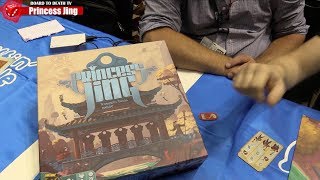
Princess Jing is a two-player bluffing game designed by Roberto Fraga, and the two reviews in this set are early impressions rather than final verdicts. Board to Death TV covered it from Gen Con, where the reviewers focused on the production and what the game was trying to do. Getting Games played it with early access copies and came away enjoying the experience while being clear that it is not a game they plan to seek out for their own collection. Both reviewers treated it as an intriguing hidden-information design that rewards sneakiness, with the main reservation being how the longer variant plays out.
Core Mechanics That Define Princess Jing
Hidden Movement Through Swapping
Each player controls a princess, a handmaiden, and a mirror holder, all represented by tall cardboard figures. On a turn, a player swaps a piece with an adjacent figure on the board, orthogonally or diagonally. Getting Games described the goal as moving your princess to the far middle row, and the constant swapping is what keeps the opponent guessing where the real princess is. Because each figure can be shuffled around, the board state is always partly concealed, and the reviewer noted that the rhythm of play comes from trying to read those hidden swaps rather than from any single big move.
Mirror-Based Deduction and Bluffing
The princess and the handmaiden look identical from the waist down, and the only visible difference is the hooded cowl on the handmaiden's head. Each figure has a small mirror attached to its mirror holder, so a player can look through the mirror to glimpse the hidden figure. Getting Games pointed out that the geometry makes this awkward: from a normal seated position you mostly see legs, so you have to lean back and look down to read the head. That physical act is the bluffing layer, because a player who obviously leans in to check a figure has given away that they care about it. The reviewer explained that a player who catches the princess can pull her back to the far end of the board to conceal the discovery, which turns the mirror peeks into a live negotiation of information.
The Princess Jing Experience
Tense, Sneaky Table Play
Getting Games framed the feel of the game around discretion. Players try to get glances at the other side's figures while avoiding any tell that they know where the princess is, which the reviewer described as a constant balancing act between watching and not being seen watching. The reviewer compared the overall tension to a lighter version of Stratego, where the fun comes from reading a silent opponent and trying not to reveal your own hand.
A Guessing Game at Its Heart
The basic game leaves players with a sense of partial information that stays with them throughout. Getting Games noted that the swaps and peeks give you only slight clues about what has moved where, so every decision is a guess informed by fragments. That makes the basic game feel focused and quick to absorb, while the reviewer found the advanced version pushed the guessing much further than they expected.
What Makes Princess Jing Stand Out
Physical Components
Board to Death TV singled out the production quality, and its host praised the publisher's track record directly: "You guys have always done amazing components, amazing artwork, and this is definitely on par with that standard." The reviewer also noted that the artwork came from the artist behind Seasons, which set expectations for the look of the game. Getting Games echoed the praise for the components, calling the figures well put together and highlighting the way the pieces let players look at the back side of each figure.
Hidden Information Built Into the Pieces
What makes Princess Jing distinctive is that the hidden information is physical rather than printed on a card or hidden behind a screen. The mirror on each holder and the small gap in each figure turn the components themselves into the mechanism for deduction. Getting Games described the mirror peeks as the core of the bluffing, which means the game's identity lives in the way the figures are built rather than in a long list of rules.
Potential Drawbacks
The Expert Variant Drags
The advanced version adds magical forest creatures such as a fox and an owl, along with an extra mirror holder, and it is meant to give experienced players more deduction to work with. Getting Games and its group never finished it. The reviewer said that after 25 minutes it had started to feel like a guessing game, and while they suspected the variant might be great for players who are truly expert at the base game, their group did not enjoy the added complication. For players who are not already fluent in the basic rules, the longer version is the main reason to hesitate.
Two Players Only and Preview Copies
Princess Jing is strictly a two-player game, which Getting Games noted without treating it as a flaw in itself. The bigger caveat came from Board to Death TV, where the reviewer stressed that the copy they saw was not a definitive product and that the game was still being finalized, with sales planned for early the following year. Because both reviews rely on pre-release play, the final components and rules may differ from what the reviewers handled.
If You Enjoy Princess Jing
If you like the quick-thinking bluffing of Stratego and enjoy games where the board itself hides information, Princess Jing is a natural fit. Getting Games described it as a lighter version of Stratego, which suggests it will appeal to players who want that same hidden-identity tension in a shorter, two-player format. Players who enjoy reading opponents and deciding how much to reveal will find the leaning, peeking, and discreet glances part of the fun. If you prefer games with large amounts of open information or long strategic planning, the reviewers suggest you may find the guessing too unsettling, and the expert variant is worth approaching carefully rather than diving straight in.
What Reviewers Are Saying
"We were like 25 plus minutes in, and it felt like a guessing game at that point. It truly felt like it is probably great if you are actually an expert at the game, not just very familiar with board games in general."
— Getting Games
"It was kind of like a lighter version of Stratego, and also just from a component quality perspective it was really cool, having actual beard pieces that let you kind of take a look at the behind the back side of these various pieces. It was very well put together."
— Getting Games
"You guys have always, always, always done amazing components, amazing artwork, and this is definitely on part to that standard."
— Board to Death TV