




Prussian Rails Deep Dive
What the Community Thinks About Prussian Rails
Reviewers who cover Prussian Rails tend to describe it as a game for a specific taste rather than a universal crowd pleaser. Jonathan Cox of Jong Gets Games calls it a polarizing design that will turn many players off, while noting that the people who like it become genuinely devoted to it. Cox's tutorial on Jong Gets Games walks through a four-player game in which every auction and track placement visibly changes the other players' plans. Kimberly of Tabletop Tolson is enthusiastic about the game as a classic train game, having received a copy through a Rio Grande library promotion at Origins, and points to its hexes and familiar railroad look. Tom Vasel of The Dice Tower takes the opposite view in a roundup of mid-ranked games, dismissing the title as simply not their style. The overall picture is a train game with a committed following among players who enjoy shifting alliances and volatile turn order, and a clear warning that its rules-heavy design will not suit everyone.
Core Mechanics That Define Prussian Rails
Stock Auctions and Capitalization
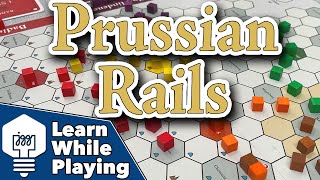
Prussian Rails opens with an initial auction in which players bid for the first share of each of the eight railroad companies, and the same bidding system returns during play. A player who chooses the capitalize action puts a fresh share up for auction. Bidding proceeds clockwise, and a player who passes is out for the rest of that auction. Winning money goes straight into the treasury of the railroad whose share was sold, so a bid is both a purchase and a financial boost for a company the buyer may depend on. The Jong Gets Games tutorial notes that a company's third share cannot be capitalized until the second share of all eight companies has been sold, which shapes the pacing of bidding across the whole game. Players also use auctions as a tool for shaping the table. In one round of the tutorial, a player bids up a rival's share so that the rival has to pay more to win it.
Income-Weighted Turn Order
Each round begins with action tokens dropped into a cup. Players with lower income contribute more tokens, and a random draw equal to the player count decides who acts and in what sequence. As a result, a player may get no turns in a round, while a trailing player may take several in a row. The December 2023 Jong Gets Games update vlog explains that Prussian Rails has more randomness than most cube rail games, because turn count and turn order are shaped by how well each player is doing rather than by a fixed sequence. Turn order is only one half of the economy. Each player's personal income rises with the income of the railroads they hold shares in, and every cube laid on the map costs $2, $3 or $4 depending on the terrain, with an extra charge for building into a city another railroad already occupies.
The Prussian Rails Experience
Interactive and Dynamic Play
The tutorial repeatedly returns to how much other players' moves affect one another's plans. The host describes the game as very much a shared incentives design, in which expanding a railroad you hold can help rivals as much as yourself, so the real question becomes who you are targeting. Building Brown track toward a neighboring company, for example, raises the income of every player holding Brown shares, and a single well-timed connection can trigger dividends that reward several players at once. When the other players begin cooperating or competing for the same stock, the picture changes quickly, and the host observes that the target can change rapidly as the game goes on.
Intense Decision Making
Prussian Rails asks players to weigh each action carefully. The tutorial host spends visible time deliberating over whether to strengthen a leader or hold back, and describes taking three turns in a row as giving honestly a ton of control, which also means choosing which rival benefits from the expansion. The August and July 2024 Jong Gets Games update vlog describes a playthrough in which a single favorable auction let the reviewer nearly double the score of the next player. That account shows how a few well-timed decisions can swing the standings, which rewards close attention at every turn.
What Makes Prussian Rails Stand Out
Railroad-Specific Special Rules
Each of the eight companies operates under its own special rule, and reviewers treat these asymmetries as central to the design. The tutorial lists several: the black company may lay four track in an expansion, the orange company only two, the blue company receives a discount on track, the purple company can never spend more than five money on track, and the brown company pays no penalty for building into a city that another company already occupies. Each effect applies for the whole game, and starting positions are unequal as well. The August 2024 reviewer describes Prussian Rails as a crazy, kooky quick rail game and says they vastly prefer weird quick rail designs over pristine train games. For players who appreciate that kind of zaniness, the company rules give each railroad a distinct personality on the table.
Dividends That Reward Connection Building
Dividends are triggered whenever a railroad makes its first connection with another railroad, and the payout structure gives every player a reason to watch the map. Each player receives money equal to their current income, and players who hold shares in the railroad that made the connection receive double income from those shares. In the tutorial, the connecting railroad's own income is also doubled for that dividend. The host notes that dividends ramp up as more cubes are placed near other companies, so the map and the economy stay tightly linked from the first round onward. Because connections cannot be undone once made, the dividend system rewards planning and patience as much as bold expansion.
Potential Drawbacks
Randomness and Comeback Dynamics in Turn Order
Turn order is the most frequent point of friction. The December 2023 reviewer notes that the random cup draw makes Prussian Rails less predictable than most cube rail games. The August 2024 reviewer describes the rule that the worse a player is doing in score, the more action tokens they put into the bag, so turn order rubber bands in favor of trailing players. That same reviewer warns that a player may go several rounds without a turn because their tokens never come out of the bag, and says players have to buy into that concept before they sit down. Players who want tight control over every turn may find this frustrating, while players who enjoy comeback mechanics may see it as a feature.
An Auction-Centered Design
Auctions are the second recurring concern. The August 2024 reviewer explains that auctions are tolerable in train games when they are a secondary feature, but that the game needs to do much more to win over a player when an auction is a central pillar of play. Because Prussian Rails uses auctions for the initial stock distribution, for every capitalization, and as a way to raise money for expansion, the design asks players to accept that structure at every turn. On The Dice Tower, Tom Vasel offered a brief dismissal, calling the game not their style. That verdict reflects personal taste rather than a specific rules problem. Players who enjoy bidding will likely see the auction phase as a strength, while players who prefer fewer auctions may find it a barrier to entry.
If You Enjoy Prussian Rails
Players who enjoy a central auction structure should consider Wabash Cannonball, the Rio Grande version of Chicago Express. The August 2024 reviewer notes that it shares that same bidding-driven core with Prussian Rails, making it a natural next stop for players drawn to the capitalization auctions.
Players who want to explore the broader 18xx train genre with others learning alongside them should look at Railways of the Lost Atlas, which the same reviewer played extensively with friends. Players who want to reduce the amount of bidding may instead prefer Dual Gauge or Mini Rails, which the December 2023 reviewer describes as having very few or no auctions. Players who value negotiation, shared incentives, and unpredictable turn order will find the most common ground with Prussian Rails itself.
What Reviewers Are Saying
"It's definitely a polarizing game and I'm really happy I got to make a video for it because I think more people should know that it exists. I think again it's going to turn a lot of people off big time but the people who like it love this game."
— Jonathan Cox, Jong Gets Games
"I got me a nice train game. I love a good train game. I mean, this is great."
— Kimberly, Tabletop Tolson
"Prussian Rails, this is one of these railroad games from Queen, Rio Grande, Winsome Games. I... yeah, it's just not my style."
— Tom Vasel, The Dice Tower