/pic3488229.jpg)


















Quarto Deep Dive
What the Community Thinks About Quarto
Quarto has earned a devoted following among board gamers who appreciate elegant abstract strategy. Reviewers consistently praise its deceptive simplicity, outstanding production quality, and the strategic depth hidden within its wooden pieces. The game inspires strong reactions from players encountering it for the first time, who find themselves astounded at how much mental engagement emerges from such a straightforward premise. Quarto occupies a rare position in the hobby: a game simple enough to teach in minutes, beautiful enough to display on a coffee table, yet challenging enough to reward serious study and competitive play.
Core Mechanics That Define Quarto
The Four-in-a-Row Objective with Multiple Win Conditions
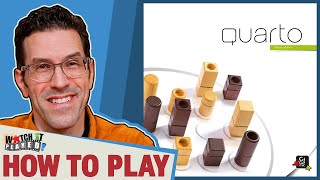
At its heart, Quarto plays like a variant of tic-tac-toe or Connect Four. Players work to create four pieces in a row, but with a crucial twist: those four pieces need not belong to the same player. Instead, victory comes when any four pieces in a line share a single common characteristic. This characteristic might be color (light or dark), shape (round or square), height (tall or short), or construction (solid or hollow). A player could win with four pieces that are all dark, or all solid, or all round. This multiplicity of win conditions transforms what could be a simple spatial puzzle into a layered strategic challenge where players must constantly monitor numerous potential patterns simultaneously.
The Opponent-Selection Mechanic
The mechanism that makes Quarto revolutionary and memorable is deceptively simple but profoundly disruptive to normal board game expectations. On your turn, you do not choose the piece you will place. Instead, your opponent selects which wooden piece you must play. You retain full control over where on the board you place that piece, but the piece itself is completely out of your hands. This reversal of control creates constant psychological tension and forces players into adversarial territory-building. If your opponent hands you a piece that could complete a winning row for them, you must still place it, and you must be careful not to give them the final piece they need. The twist compels constant vigilance and makes each placement decision a negotiation between threat prevention and position building.
The Quarto Experience
A Thinky, Brain-Burning Puzzle
Players who sit down to Quarto often find themselves stunned by how intensely the game engages their minds. Despite playing with just wooden pieces on a simple grid, reviewers describe the experience as requiring heavy strategic thinking. Matches tend to play quickly, usually finishing within 20 minutes, yet players report that their brains feel thoroughly taxed by the decision-making. The "thinky" nature of the game means both players remain locked in concentration until the final piece drops. Unlike games where players can coast through turns, Quarto demands engagement from both sides. The pressure comes not from complex rules but from the constant need to evaluate multiple overlapping patterns and anticipate your opponent's pieces in coming turns.
An Immediately Engaging First Play
Quarto creates memorable first impressions. Reviewers report being blown away on initial plays, often wanting to shuffle the pieces and play again immediately. The game's hook works immediately because the central mechanic is so counterintuitive and clever that players want to explore it further. That first play serves as an invitation rather than a complete experience. The opponent-selection system feels almost magical in how it transforms a standard grid-placement game into something that feels wholly new. Players recognize the familiar territory of abstract strategy games, but the twist makes them want to dive back in to master it.
What Makes Quarto Stand Out
Exquisite Physical Production
Quarto's wooden pieces and elegant board make it a game worth leaving on display. The pieces feel substantial and satisfying to handle, and their four different characteristics are visually distinct and easy to parse at a glance. The game's production communicates sophistication. It sits comfortably on a coffee table as a decorative object, looking like a refined chess variant rather than a mass-market game. This visual elegance attracts players and gives the game permission to occupy space in the home as something beautiful, not just functional.
A Completely Fair Playing Field
Quarto eliminates luck from the equation entirely. There are no dice rolls, no random card draws, no shuffle-dependent surprises. The most skillful player will win. This purity appeals to players who want their victories to feel earned through genuine strategic mastery rather than good fortune. The open information system means both players can see every piece on the board and every piece in the supply at all times. Players can calculate several moves ahead, planning sequences and trying to trap opponents. The game rewards deep analysis and punishes sloppy thinking.
Potential Drawbacks
Analysis Paralysis and Decision Weight
The strategic depth that makes Quarto rewarding can also slow it down. Because the placement decision carries enormous weight, some players find themselves locked in extended deliberation. Even experienced players often keep their finger on a piece for extended seconds, recalculating all possible outcomes before committing. The brevity of the game's playtime can stretch if players approach each move with serious analysis. Casual players looking for a quick social experience might find the atmosphere becomes tense rather than relaxed.
Limited Replayability Through Mastery
Quarto's fixed set of 16 pieces means the decision space, while large, is not infinite. With serious study, players can begin to master the most dangerous sequences and recognize optimal patterns. Some reviewers note that the game, while endlessly enjoyable for casual play, may eventually plateau for players seeking deep strategic growth across many sessions. The game is solvable in theory, and while practical play rarely reaches those depths, the knowledge that Quarto operates within defined boundaries may eventually feel limiting to players who live for abstract strategy.
If You Enjoy Quarto
Players drawn to Quarto likely enjoy other abstract strategy games and spatial puzzles. Connect Four shares the four-in-a-row objective and satisfying physicality, though without Quarto's characteristic twist. Othello offers a similar level of depth and clean rules, rewarding positional thinking and pattern recognition. Chess appeals to similar players who value pure strategy and the satisfaction of outthinking an opponent through calculation and planning.
What Reviewers Are Saying
"Quarto is like chess and Connect Four had a baby, and I can tell you all about it. The best twist is you give your opponent the piece to place right. You say okay, place this round one, and it's so good. We played it like three times and we played it like a few more times afterwards."
— Board Game Spotlight
"Quarto is one of the best games in that range. This is essentially you're connecting up four pieces and you might be connecting four of the same color or four pieces that are all round. No one owns any of these pieces, on your turn you play the piece that your opponent chooses for you. Just that twist is just amazing. It's a really clever, really simple game and very very satisfying."
— Adam in Wales
"The opponent-selection mechanism is one of the best hooks I've seen in modern tabletop games. It's extremely clever but most importantly it's really fun. It's one of the most underrated abstract strategy games around."
— Might I Suggest A Game