An introduction to Abstract Board Games.
Games in This Video
10 games are featured in this video — they unlock as you watch.




Transcript
upon discovering this hobby of modern board-gaming it took quite a long time before I investigated abstract games abstract strategy games as they're sometimes called the reason for this is because suddenly I was looking at all these exciting pretty sort of games with nice themes and it was all very exciting and new whereas abstract strategy games felt like something from my past whether we're talking about chess or drafts checkers or even something as simple as noughts and crosses or connect four and that felt like something that had been around forever and I've pretty much ignored it all my life so why would I pick it up now but as I've delved more and more into playing games and designing games I've realized that the simplicity of the mechanisms in these abstract games is it's fascinating not all the games i'm going to show you in this video can genuinely be called modern board games some of them have been around for quite a long time but but there's still a place for them in the modern world and you can't really the simplicity of them can't really be criticized you know in comparison to these other games with their with their complex rules and their convoluted mechanics these are games that can largely be taught in a minute or two minutes they can be learnt practically you know straight away and and yet they can take a long time to really get very very good at they can be played
extremely competitively but often they can be played very quickly often they play very well with two players and sometimes they can be extremely attractive the first games that we're going to look at our games which include travel so we're playing pieces are moving from one location to another an example of a game which uses travel would be let's have a look at corridor so the corridor is a classic game from gigantic this is it's by no means an old game you know we're not talking 30 40 50 years but we're talking 20 years at least and it's become a massive seller and and a fairly mainstream sort of game in corridor a player is aiming to get their pawn to the opponents line at the end of the grid here and on their turn they can do one of two things they can either move one step forward or one step sideways or they could choose to place a wall so it goes somewhere usually blocking their opponent in some way so this player might move here this player might place another wall and then this player goes here and then the player starts his advance this player does the same and so we move on and then he thinks right he's going to block him a little bit but he sidesteps it so he
places another one these side steps again and then the white continues his movement and so you can see how this grid will fill up with walls and a maze will start to be created as the player tries to get to the end or as the red player tries to get to this end another travel game is this game the climbers or the Alf's tiger this company I've seen his recently stopped trading so it's hard to get hold of copies of this but this is an example of how beautiful these games can really be and this game plays best with multiple players not just with two in the climbers or dr schlager each each player will who will help in setting up this tower that's randomly determined with these blocks and then these little pawns are going to try and climb up the tower to get towards the top of the tower and they want to get to a point where they're higher than everybody else and nobody else can get any higher so gradually this tower is going to change and they can only move on two blocks of their own color so the pink player here can only move onto blocks that have a pink surface or blocks that have one of this and pale gray surface which is a neutral color that anyone can move on to once per game they can use one of these large ladders to climb up a distance which they couldn't normally manage it can also once per game use one of these small ladders to climb up a slightly smaller they also have a little blocking porn here which once per game they can place which means that another player would not be able to go on that space so have
a little look at how the game runs the next type of abstract strategy game we're going to look at is games where you capture the opponent's pieces I mean if we think of chess where the goal is to take the king in high the goal is to capture the queen bee of your opponent's hive in hive each player has 13 pieces which represent different insects each of these insects is on absorb bakelite tile and these there's no board in this game so these pieces are going to make up the board as we place them together at the start of the game each player is going to place one of their pieces and they're going to go right next to each other like this throughout the rest of the game the players are going to either add additional pieces to this this hive here or move pieces and each individual type of piece moves differently depending on the insect that's portrayed on it the queen bee can only move one space at a time so it could move here it could move here it could move over over
here or it could move up here the beetle can also only move one space but the beetle as well as being able to move like this it can also move on to the top of other pieces and then move about on top of pieces there by stopping them from being able to move in their own turf grasshopper can jump as far as it likes in a straight line landing in the next available space so for example this grasshopper could jump up to here it could jump down to here or it could jump along here and and in the space there a spider is able to move 3 spaces so it could move 1 2 3 or it could move 1 2 3 or it could move um 1 2 3 the soldier ant can use a single move to move all the way around the outside of the hive so this ant could move as far as it likes continuing around and stopping where it wants to around the outside of the hive it's important to remember that at no time canopy Smoove in such a way that it separates the hive and the game ends when one player's Queen Bee has been completely surrounded either by the opponent's pieces or pieces of their own color in this case the black player has lost because their queen bee has been captured of course some games cross multiple genres and certainly there are
games which include that element of travel that we've already discussed along with capturing a recent example in a very good example would be the game on at armor in a game of Honor tarma each player has five pawns one of these being the master the aim of the game is to get the master into the opposing players temple space or four want to capture your opponent's master with one of your pawns and the way you move is by using these movement cards that sit in front of you this indicates where the piece currently is and this indicates where it could go to so if this player chose to use the crab he could move this piece forward and then on later terms he could potentially use it sideways if you uses the crab again but once the card has been played the card is placed over here and the person takes the new card his opponent will then go and use their own card in order to move a piece and then that card will be placed in the middle and then you will retain the other one and so the capabilities of these cards cycle and the players get the different abilities ultimately a player wants to be in a position where they can capture their opponent's pieces and best of all if they can capture the opponent's master win the game the other way to win the game is if the master gets onto the temple space belonging to their opponent and then the game would end the game has multiple cards with different movement types and many of them aren't used in
each game so there's always lots of variety no two games are ever the same because you only ever have five of these cards in any one game another game which includes capture and travel would be a classic from my childhood in fact I believe from my father's childhood I don't know whether you can still get this imprint but if you can find a copy even in a charity shop or thrift store then then it's well worth getting hold of a copy of care alot a great classic 2 player abstract strategy game in Camelot each player has a series of pieces which are made up of men and of knights on horseback the aim of the game is to get your colored pieces into the opponent's two starts faces down at their side of the board if you achieve that if you have both spaces filled then you win the game on your turn you can do one of three things so the main thing that you'll be doing is moving either forward or in a diagonally diagonal and or sideways direction that the other thing that you can do is is jump over your opponent's pieces so for example a my turn I could jump over here taking this piece I can then jump over here taking this place and so you can make a chain of these jumps the other option available to the player is to canter now this means jumping over their own piece and again these moves can be chained so a player might jump over one piece then
can't I mean canter over one piece then canter over another piece and that way they can move great distances the difference between a night and a man is that the night can combine a jump and a canter they have to initially do a candidate and then a jump so this night for example could canter over this man canter over this man and then jump over his opponent capturing him jump over another capturing him and continued his jump in this way and capture multiple pieces as you can see the game ends when one player has two pieces on the starred squares at the edge of their board regardless of the weather there a man or whether they're a night the next group of games that I wanted to mention a games where where we gain territory and we we we collect tokens and we place tokens around the board in order to claim areas of territory so now we're moving into the area away from the sort of chess like games and more towards that classic game of go so a very simple example would be something like hey that's my fish by Fantasy Flight Games but my favorite in this particular genre is battle sheep by blue orange games in battle sheep each player places pastures which build up the board to the boards different for every game they also have a stack of sheep and which sheep of their own colors on these these thick plastic chips turns are simple the player can move all of his stack or just
part of his step but he must leave at least one disk behind and they move as far as they can go in a straight line so this player for example might choose to ship to shift his stack over here and leave these ones behind the player here might choose to move a large portion of his stack over here and then the blue player moves his in a straight line to here and so it continues with each player moving as far as they can and trying to block off portions of the board as they do so and so it continues and as we see each player is now claiming territory on the board and trying to get in the way of what their opponents are doing and once the game is over these sheep will be spread all over the map you then see how many of your sheep you've managed to get onto the separate spaces you count those up in the play who's got the most wins very closely related to the territory control and that travel idea of moving one location to another and the games where you connect one portion of the board to another portion of the board with a string of pieces so the example i'm going to show you on those lines as the game punked from the gift series of games now gip was a project which had six or seven different games in it all of them abstract all of them by Chris Byrne and these games and they had a very similar aesthetic but slightly
different gameplay and there was a mechanism whereby you could if you won one game it would give you another play in peace you could use in another game so you could have this sort of grand meta game going on while breaking off into little mini games of the of the other games I don't know how often people actually did that but the games in themselves are very good so let's have a look at punked in poked each player has a selection of different pieces like this one player has white and one player has all the black pieces and these pieces are going to be placed onto this board slotting into little holes here and the idea is to try and make a chain connecting one side of the board to the opposing side so here to here or here to here and so on and both the players are trying to do that so they would take it in turns to place one of their pieces on the board and their choice on the turn is either to place a piece or to move a piece now if a player chose to move a piece they need to be able to move on to a piece which is already on the board and it's a piece of their color so for example this piece here can move in a straight line from the central dark space here and it must land on a piece of its own color so currently there is no where really for this piece to go but supposing there was a piece a black piece here and a white piece here then you could have a
situation where this piece would let's put one more piece down here this piece would move and it lands on a piece of its own color and then it may rotate so the pieces can stack up like this and gradually the players are trying to create a chain of their own color across the board and block off the other player from do same as they go across the board in the other direction the final example and perhaps the most common I think example of these abstract games is games where we connect a series of like pieces like we mentioned connect for where we're trying to connect up a bunch of pieces and make a line or a row so a great example of that would be the again gigantic who make these lovely wooden games this game quarto in quarto these wooden pieces do not belong to any particular player both players will be sharing them and the pieces have four different qualities to them firstly they're obviously either brown or
they're this pale sort of color this white color I suppose then the second quality is there either round or they're square third quality is there either short or they're tall and then they're either hollow or they're solid so those are the four different categories not a player's turn they're going to have the piece that they place dictated by the opposing player so player 1 will choose which piece player 2 places so player one might say you're going to be placing this piece and player 2 will place it on the board somewhere what player 2 is trying to achieve is to make a line of four pieces which have matching characteristics so for example this would be a line of four with matching characteristics because they're all white equally this would be a line of four with matching characteristics because they're all round or we could say this would be a line of matching characteristics because they're all short so players are going to take it in turns after one has has given player to a place to place then player 2 will give player 1 at peace and they're trying to select one so that that player cannot make a line of force so they might give them this one for example because there is no way of placing this to give them a matching row of four they're not all square they're not all round they're not all solid they're not all Hollow they're not a little short they're not all tall but not all brown they're not all white so players have to think very carefully
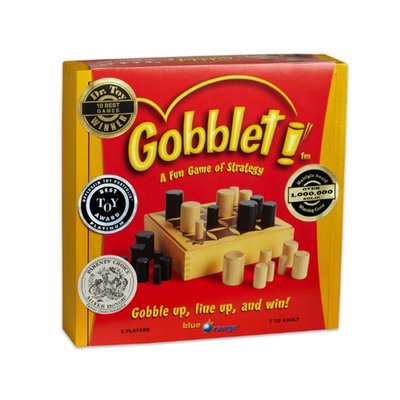
just one or two steps ahead if I give the player this piece is that going to give them the opportunity to make a line of four in the more advanced version of the game you can even win by making a square for another example very similar to what we've just seen is again blue oranges game and this one is goblet which was blue oranges first game and did very very well for them goblet is very similar in feel to corto but it plays a little differently again players are trying to make a row of four but they're trying to do it in their own color on a player's turn they will take one of their pieces and place it somewhere on the board you'll see that they've now revealed a smaller piece and again this goes down a bit like those old Russian dolls so things get smaller and smaller the next player will then do the same and then this player might go here and then this plane now has the opportunity to place on the board here and then but the alternative to that would be to move one of their existing pieces on the board and place it over the top now of course this opens up the possibility that players might forget where the pieces are as more and more pieces go around the board and more things get covered up eventually somebody might accidentally move a piece and uncover one of their opponent's pieces if at any point there's a line of four matching colors then that player wins the game I mentioned earlier some of these games are very very beautiful to look at none of them that I've ever seen been quite as beautiful as the game
Hollywood shaban particularly because I've got this lovely first edition in inwood but it but the board the board version a cardboard version is still very very pretty this is a Bruno khattala abstract game from a couple of years ago halle with Japan in Haru Ichiban each player has a pile of lily flowers which each have a number between one and eight on them so they have numbers one to eight in each player's stack and the players are trying to make a pattern on the board of their flowers so if they can get four in a cube like this and ask where they'll get one point four in a row will be two points for in a diagonal row three points and five in a row is five points if diagonal this and these points are added up between different rounds and once a player reaches five then they win the game so in this instance this would be an automatic victory if they could get five in a diagonal row the way that the game actually works is that the players will select from three randomly drawn flowers and they will place them face down to face off against their opponent they then reveal which flower they have picked so yellow here's picked a five red has picked a seven yellow has the lower so yellow becomes the smaller gardener now what that means is that yellows flower is placed onto the dark colored lily pad over here at this point the the the bigger garden at the person
who played the bigger score gets to place this on any lily pad on the pond so they could place it here for example at this point the small gardener can now push lily pads and
so they can choose any selection of these tiles and move them so for example the player could push these three in this direction using what's called the spring wind the large player then turns one more lily pad over to the dark side they might choose to turn over to here and then we draw another tile each and place it into our little selection here and each player will choose their next placement so for example you know chooses this green red juice is this they reveal now yellow is the lower value with a six so that gets placed on here red can place their tile anywhere which is here yellow then gets to push a row so they'll push them along here and now red gets to choose another tile to turn over to the darker side and so the game continues until somebody has completed one of those patterns over multiple rounds the game ends when somebody scored five points total now we've talked about several games that involve connecting for or connecting five pieces in a row or in a diagonal these games have all been fairly simple but when you come to a game like inch this is another game from the gift project of games now this one is just sublime it looks stark but lovely the pieces are nice of weighty and tactile pieces of bacon aight sort of and you
know pieces that click together and the game is not complex to teach but the strategy is really very clever and it's got a wonderful capture mechanic so let's have a look at yenc in the inch one player is black and has these black rings on the board the other player is white and has these white rings on the board the players are trying to place these other markers onto the board which are black on one side and white on the other and once they complete a row of five of these markers in in a line then they win one point and once three points have been won the game is over the way that a turn goes is that say the white player was to go they would place a white market inside one of their rings and then move their ring across a little the black player would then go he could place one in here and move over here now the white player might go and he would move here and the black player then goes to here and now the white player might go here and move down here now the black player has a attack move that they can do now where they place a room here and they can jump over this turning it to black and the white player likewise could put a white piece in here jump over all of these and flips into their opposite side that may not be a good move but ultimately this is what we're doing until eventually there is a row of five of one color at that point those tokens would all be taken off if
there were five of them along with one ring of the player who who scored that point so that they're now playing with fewer rings on the board and so the other player has a chance to catch up once one player has taken three of their own rings off the board then they have won the game so there's a very brief look at a bunch of different abstract games and the lovely thing about a video like this is that with abstract I can really teach you the rules within a minute or 30 seconds so I don't have to do this sort of very brief overview that I would do with a euro game I can actually get into the meat of the game in very little time and these games are not going to be for everybody but if you're drawn in by the beauty of the Euro games and the emeritus onerous just going to urge you not to completely overlook the abstract games because there's still a lot to explore in there and a lot of pleasure to be had in a short frame of time and particularly if you're playing is as two people and and in a short sort of time frame you these are great couples games great games to play with family because they're so simple and great games to play with people who aren't familiar with this modern sort of world of board gaming so there's my brief introduction to abstract strategy games