



Railroad Ink Challenge Deep Dive
What the Community Thinks About Railroad Ink Challenge
Railroad Ink Challenge has earned consistent praise from the board game community as one of the strongest roll-and-write games available. Reviewers across different channels and formats describe it as genuinely fun and engaging, with a system flexible enough to support multiple versions and expansions without losing its core appeal. The game sits in a rare category where accessibility and strategic depth coexist, making it compelling for both casual players discovering roll-and-write mechanics for the first time and experienced gamers seeking another layer of decision-making through challenge cards and optional expansions.
Core Mechanics That Define Railroad Ink Challenge
Network and Route Building
At its heart, Railroad Ink Challenge is about constructing an efficient network on your personal board. Each round, players roll dice showing different route types (railroads, highways, overpasses, and stations) and must draw these routes directly onto their dry-erase boards. The critical constraint is that every new route must connect to an existing route of the same type; you cannot build from empty space. This forces careful planning from the very first round. Routes that connect the exits along the board's borders earn victory points based on how many connections you establish, creating a compelling tension between immediate scoring opportunities and long-term network efficiency.
Compound Scoring System
Scoring in Railroad Ink Challenge draws from multiple independent sources that combine into your final score. Connected exits form your primary scoring avenue, but the game rewards other accomplishments too: the longest unbroken railroad and highway segments earn points, completed buildings such as villages and universities contribute bonuses, and successfully tackling optional challenge cards grant additional rewards. However, the game penalizes incomplete routes: any route that ends in the middle of your board without connecting to another route of its type costs you a point. This multi-layered scoring system means players must balance competing objectives, planning networks that satisfy several goals simultaneously rather than optimizing for a single metric.
The Railroad Ink Challenge Experience
Strategic Planning Under Constraint
Playing Railroad Ink Challenge feels like solving a puzzle where the pieces arrive in a predetermined sequence and you must integrate them smoothly. Since all players use the same dice rolls in each round, there is no direct player interaction during placement: you compete by optimizing your personal board more cleverly than others. Yet the game maintains tension through its decisions. Do you prioritize connecting high-value exits now, or do you preserve your board's flexibility for future rounds? Which challenge card should you chase, knowing a neighbor might claim it first? The experience oscillates between calm concentration on your own board and moments of pressure when the board state crystallizes into clearer win conditions.
Accessibility Through Clarity
Despite its strategic depth, Railroad Ink Challenge invites newcomers with transparent rules and immediate comprehension of the core loop: roll, draw, score. New players grasp the fundamental objective (build networks to earn points) within minutes and can start making meaningful decisions immediately. The game does not hide its mechanics behind thematic abstraction or teach through failure. This clarity makes it a gateway title for players exploring roll-and-write games, while the suite of expansions and variants ensures experienced players never exhaust its strategic possibilities.
What Makes Railroad Ink Challenge Stand Out
A Remarkably Flexible System
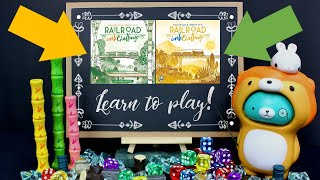
Railroad Ink Challenge comes in multiple base editions (including versions called Lush Green and Shining Yellow) each bundling different mini-expansions that introduce fresh rule modules. The original editions added buildings and goal cards that layer onto the base system. Beyond that, Horrible Guild has released expansion packs introducing mechanics ranging from electricity and street lamps to alien farmers and weather systems. What makes this expansion ecosystem remarkable is that none of these additions feels mandatory or bloated; reviewers describe the core game as already satisfying, and expansions serve as optional flavor rather than necessary patches. This design allows players to scale complexity and variety on their own schedule.
The Digital Parallel and Asynchronous Play
Railroad Ink Challenge exists simultaneously as a physical board game and as a fully-featured digital adaptation featuring asynchronous multiplayer. Players can complete a game on their own time, then post their score so others can play using the exact same dice rolls and goals to compete against their results. An online leaderboard tracks performance across different time horizons (daily, monthly, all-time) and functions cross-platform seamlessly. This digital version is not merely a port; it brings the same design philosophy of accessible strategic depth to screens and has attracted players who prefer digital interfaces or asynchronous scheduling. The fact that both versions thrive in parallel demonstrates how robustly the core system functions.
Potential Drawbacks
Limited Player Interaction in the Base Game
The original Railroad Ink, before the Challenge edition added cards, allowed unlimited players to enjoy a single round simultaneously with zero interaction: two people could play alongside two thousand others using identical dice rolls. While some prefer this solitaire-like experience, others find the competitive void unsatisfying. The Challenge edition addresses this by introducing challenge cards that reward the first player to achieve specific objectives, adding a race dynamic. However, for players seeking negotiation, blocking, or meaningful interaction between opponents, even the Challenge version offers only light interaction compared to other competitive games.
The Anxiety of Finite Space
Your board is fixed in size, and dry-erase boards get crowded fast. Reviewers sometimes experience frustration when their routing plans clash with the physical reality of limited squares, forcing compromises they did not anticipate. This is not a flaw so much as an inherent design consequence (the board constraint IS the puzzle) but players seeking games where spatial planning is secondary rather than primary may find the pressure of every square mattering to be oppressive rather than engaging.
If You Enjoy Railroad Ink Challenge
Players drawn to Railroad Ink Challenge's puzzle-like network-building often find deep satisfaction in Cartographers, a roll-and-write where you map kingdoms instead of railways, using terrain placement and object placement to score from multiple categories. The tight spatial puzzle and multi-layered scoring feel kindred, though the theme and specific mechanics differ.
Welcome To offers another complementary experience, trading dice rolls for card drafting but maintaining the core appeal of portfolio-building on a grid. If you enjoy the asynchronous, leaderboard-driven play of the digital Railroad Ink Challenge, Welcome To's public scoring and the ability to play at your own pace against globally published scores delivers similar social-competitive satisfaction.
For those seeking Railroad Ink Challenge's network-building spirit in a heavier euro format, Brass: Birmingham scales up the route-network concept to a full economic game across multiple eras, though it trades roll-and-write accessibility for deep strategic negotiation.
What Reviewers Are Saying
"From Horrible Guild, the online adaptation of the critically acclaimed roll and write game about building connections. Each round roll the dice and draw routes to connect the exits around your board to expand your network with railways, highways, and stations."
— Watch It Played
"These games are just a lot of fun and they're they're different enough that I will keep all of them and love all of them."
— kovray
"It's a very good system for a game, and I am not a completionist so I'm not going to be buying all of these expansions, but it's possible I might try to get one or two of them that seem to appeal to me."
— Getting Games