



Raising Robots: Friends Deep Dive
What the Community Thinks About Raising Robots: Friends
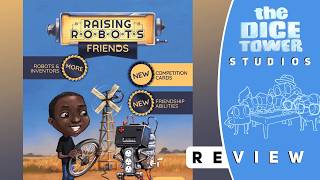
Raising Robots: Friends is the second expansion for the Raising Robots engine builder from Nauvoo Games, and the reviewers who covered it agree on its core identity: it is a denser, more interactive step up that rewards players who already know the base game well. The clearest voice is Z Garcia of The Dice Tower, who scored the expansion 7 out of 10 and called it a "power users expansion" that is good on its own terms. The Dice Tower's weekly roundup, hosted by Zee Garcia, repeats that position and advises that newcomers should hold off until they are truly ready for something that pulls focus away from the center of the game.
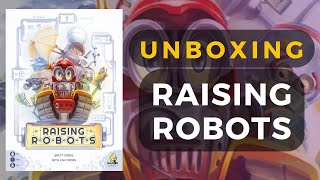
DaniCha unboxed their Kickstarter package with obvious affection for the base game, praising the upgraded wooden tokens and the artwork. Their video is an unboxing rather than a critical review. Garcia's review is more analytical, and Garcia is comfortable with the expansion's demands for experienced tables. The reviewers align on the idea that the expansion's power comes with a learning cost, and they differ mainly in emphasis: DaniCha is drawn to the components, while Garcia weighs how much complexity the expansion adds.
Core Mechanics That Define Raising Robots: Friends
Deck Building
The robot deck is the engine of the expansion, and Friends changes how players acquire cards from it. Robots in this expansion carry a new search symbol. When a player activates it, they name a row and a value or range of values, then flip and discard from the robot deck until a matching robot appears, which goes into their hand. Garcia demonstrates the process by asking for a purple robot triggering between one and four energy, then tightening the request until a match appears. A robot marked with the symbol that counts as every color widens the range of hits. The search has a firm stopping rule: once the bottom of the deck is reached, the last revealed card is kept, and the deck is reshuffled into a new one. The player does not keep digging.
The search matters because the robot deck keeps growing, and Garcia notes that finding a specific robot gets harder as it does. For experienced players who know which robot they are chasing, this turns a loose draw into a planned acquisition.
Competitions and Friendships
The second major system is a competition module that connects players in the middle of the table. Four competition cards are chosen at random, each with a trigger condition, such as having nine of any one kind of resource, and a set of rewards. When a player achieves a trigger, they may pay one of the listed costs, such as giving up seven energy, and then take one of the benefits, such as victory points or drawing three friend cards and keeping one. Other players can claim the same competition later in the round. At the end of the round, any tokens on the competition are flipped back, so later claimers pay less but receive a weaker reward. The result is a race where the earliest player gets the strongest payoff.
Friendships work alongside this module. Players remove their chosen character's friend card from the deck during setup, then draw three friends, keep one, and discard the others. Each friend works like a smaller version of an inventor. Garcia gives the example of Steven, whose energy cards a player can use while playing Confucius. Because competition rewards include friend draws, the two halves of the module feed each other.
The Raising Robots: Friends Experience
A Heady, Thinky Table Experience
Reviewers consistently describe this expansion as cerebral. Garcia calls the game "thinky" and "heady," and says that Friends adds a layer of methodical play that requires care at every step. Some new robots can trigger a row, and some can trigger a neighbor, which means a sequence can loop back on itself. The rulebook devotes space to warning players about infinite loops, and Garcia notes that some cards let a player pause a trigger, resolve an entire line, and then return to where they were. The feeling at the table is one of careful sequencing, where every trigger needs to be checked before it is resolved. Garcia admits that this can slow play and that it asks for constant attention.
Modular Buddies and Personal Power
The most celebrated feeling in the reviews is the satisfaction of building a personal engine out of optional parts. Garcia says the friend module is their favorite part of the expansion. Each player already has a character with their own abilities, and the friend adds a companion they can use alongside it. Garcia describes the sensation as "having my own special character and now I have a buddy," and says that the feeling "feels tremendous." Because every module can be included or left out, players can shape the game to the group in front of them, which gives the experience a sense of personal ownership that the reviewers clearly enjoy.
What Makes Raising Robots: Friends Stand Out
Modularity That Lets Players Choose the Depth
Garcia emphasizes that the expansion is built from separate parts. Players can add the new inventors, the new robots, or the competitions and friendships in any combination, and Garcia notes that it is easy to add only the inventors and robots while leaving out the rest. This flexibility is a key reason Garcia recommends the expansion to experienced groups, since they can dial the complexity up gradually. Garcia says that the ability to decide what goes into the game is something they appreciate "a lot," and it helps explain why the expansion is positioned as an option for committed fans rather than a required upgrade.
Competition That Happens in the Middle of the Table
Garcia contrasts the expansion with the base game, which Garcia describes as multiplayer solitary in many ways. Competitions and friendships change that, because players race for the same rewards in the center of the table. Combined with endgame scoring, which Garcia says they like "quite a bit," the module gives players reasons to watch what others are doing and to time their claims carefully.
Potential Drawbacks
A Steep Learning Curve for Newer Players
The most consistent criticism is that the expansion is aimed at experts. Garcia argues that features useful to an expert become a burden for a newcomer. The robot search slows the game when a player does not yet know what they want, and the friend abilities and competition triggers can pull attention from the core loop, so a new player may forget a trigger or miss a competition they earned. Garcia concludes that the expansion "really really rewards" players who know the game well. The Dice Tower's weekly roundup makes the same point and recommends learning the base game first.
Infinite Loop Warnings and Less Charm Than Pets
Garcia has two reservations about combining the expansion with its sibling. Garcia is not a fan of mixing the two, because the risk of an infinite loop becomes real when both expansions are in play, and dislikes that the rules need two full pages of caution. Garcia also finds that the artwork, while fantastic, does not match the warmth of the Pets expansion, saying the cultural celebration in Friends is visually strong but does not feel as warm as the animal robots in Pets did. These points are not deal-breakers for the reviewers, but they shape how the expansion should be introduced to a table.
If You Enjoy Raising Robots: Friends
The most natural companion for this expansion is Raising Robots Pets, the sibling expansion that came before it. Garcia describes Pets as adding triggers based on the geometry of the player board, with effects tied to adjacency to the pads or the same column. Friends drops that adjacency focus in favor of endgame scoring and character-based companions. Pets suits players who want the animal robots and a more spatial style of play, while Friends suits players who want more to think about and more interaction. Garcia would recommend Friends first to anyone who loves the base game and owns neither expansion, and suggests introducing the two expansions one at a time.
What Reviewers Are Saying
"Raising Robots is always one of those games I worry is going to be misleading to people that just see this cover and go, 'Oh my gosh, that's adorable, cute little robots.' Or if they see the cards and then jump into it and don't realize what a thinky, heady, and complicated game this is. This game has a lot in it. It's an involved game. There's plenty to think about, lots to do."
— Z Garcia, The Dice Tower
"I love this game and just having the wooden bits are just makes the game a lot more enjoyable, you know."
— Danielle, DaniCha
"This is a great expansion with more contents, more things to think about, more interesting interactions if you are already a fan of Raising Robots. But if you are even just someone who hasn't really explored the game and you're looking to pick up an expansion, I would say hold off, really dig into the game because it has so much going on."
— Zee Garcia, The Dice Tower