







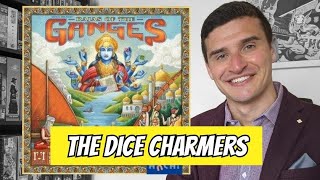


Rajas of the Ganges: The Dice Charmers Deep Dive
What the Community Thinks About Rajas of the Ganges: The Dice Charmers
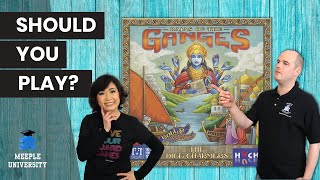
Reviewers present Rajas of the Ganges: The Dice Charmers as a roll and write distillation of the original Rajas of the Ganges, a worker placement board game that uses dice to drive nearly every action. The overall tone is warm. Chairman of the Board called it a top tier roll and write game and said it was among the best in the genre they had played. A later video from the same channel went further, describing it as one of the best roll and write games they have played and possibly their favorite. The praise centers on how much of the original survives in a shorter, single-sheet package. The core idea of racing two tracks to a meeting point is kept intact, and the game fits a 30 to 45 minute session.
Enthusiasm is not universal, and the reservations concern what the format gives up rather than the design itself. Chairman of the Board acknowledged that trading a big board and many components for a sheet and dice removes some tactility from the experience. Getting Games previewed the title ahead of release and was cautious, having already parted with a copy of the original because it had not held their interest. Getting Games was more interested in whether a 30 to 45 minute version could capture what the original did well. Jenna's Cozy Corner played a three-player game, enjoyed it, and said Jenna already owns many roll and writes and is selective about adding more. The Brothers Murph, during a fantasy designer draft, placed the game within the catalog of its design pair and called it a great game in passing.
Core Mechanics That Define Rajas of the Ganges: The Dice Charmers
Dice Drafting
The game opens with eight dice that every player draws from over the course of play. Each die has a color and a face, and the face determines what the die lets its owner do on the sheet. On a turn, a player takes one die and places it on a personal platform, which removes it from the pool for everyone else. Reviewers stress that this single choice drives the whole game. Chairman of the Board described the draft as "so pure," because each pick requires weighing what helps you against what might help or hinder the other players. Blocking is also part of the design. Dice can sit on a shared elephant space that makes them harder to reach, and karma points can be spent to reroll dice or regain access to a blocked die. Reviewers note that this creates a small amount of denial play, but the main interaction comes from competing for the same dice.
Flip/Roll and Write
Each player records results on a personal sheet, and the sheet is where the strategy takes shape. Drafted goods are circled on the sheet, then sold by drawing roads through tent buildings, which pays out coins on a track. Some dice draw straight, L-shaped, or half-row roads, and crossing complete columns unlocks bonuses. Reviewers consistently describe the sheet as well laid out. Chairman of the Board said the bonuses and triggers are easy to read, and that "when you start taking things off it does feel very satisfying." Because every player works from the same public dice pool, the strategy lies in how each person interprets the same shared result on their own sheet.
The Rajas of the Ganges: The Dice Charmers Experience
Chaotic
Reviewers do not describe the Dice Charmers as wild, but they do describe a game in constant reaction to a shrinking pool of dice. Chairman of the Board noted that despite the many options on the sheet, a player is always responding to what is left in the pool, so the same plan cannot be repeated turn after turn. That keeps the table in motion. Each pick can change the options available to everyone else, and the sense of unpredictability comes from the shared draft rather than from any single random event.
Push-Your-Luck
The tension in this game builds as the race goes on. Coins and prestige both have to reach the same point on their tracks, and scoring ramps up as players invest in buildings and goods. Chairman of the Board observed that the snowballing effect grows as the game develops, so players are scoring faster and faster, which adds to the tension about who will win. The most memorable moments come from long chains of actions. When a player strings several bonuses together into one turn, the result can feel like a domino effect, and the reviewer said pulling off such a turn makes you feel clever even when it was not the original intention.
What Makes Rajas of the Ganges: The Dice Charmers Stand Out
Chaining Actions Into Combos
The feature reviewers praise most is the potential to chain actions together. Taking a die that moves along the river might grant a bonus that lets a player take another action, which can trigger further bonuses on the same turn. Chairman of the Board said this is one of the best examples of that kind of design they have encountered, and that it is the aspect that most distinguishes the game from the original. Jenna's Cozy Corner summed up the core loop without needing much explanation, which suggests the chaining is easy to see once the sheet is in front of you.
A Faithful Core in a Smaller Package
Reviewers repeatedly return to the fact that the game preserves the original's central tension in a compact format. The dual-track win condition, where coins and prestige must cross, is kept from the board game. Chairman of the Board highlighted this, noting that the game keeps the original's scoring mechanism of overlapping victory points and coins. Setup is minimal, the rules are quick to teach, and the game fits on a shelf far more easily than the original. The designers also included two sheet variants, which reviewers credit with giving each play a different feel. Chairman of the Board argued that the reactive nature of the dice pool still keeps the game from repeating itself.
Potential Drawbacks
Limited Direct Interaction
The main reservation concerns how much players affect one another. Interaction flows almost entirely through the shared dice pool, through taking a die someone else wanted or occasionally taking one to deny an opponent. Chairman of the Board noted that this is a real decision but may matter less than the designers intended. The reviewer framed it as typical of roll and write games, which tend to feel like multiplayer solitaire with a layer of tension over the draft. Players who want close, direct confrontation may find the experience more parallel than competitive.
Tactility, Components, and Solo Play
Some reviewers accept a trade-off in physical presence. Chairman of the Board said that the loss of the original's tactility is real, although the core decisions remain. The elephant piece must be disassembled to fit back into the box, which the reviewer felt could make the box wear over time. The dice and sheets were praised for clarity, so the concern is mostly about the box rather than the play. For solo players, the picture is less favorable. Jenna's Cozy Corner noted that the game has no solo variant, so a player who wants to play alone would need a fan-made option or another title.
If You Enjoy Rajas of the Ganges: The Dice Charmers
Players who value this game's compact form and chained combos should consider the original Rajas of the Ganges, which is the source of its theme and win condition. Reviewers who enjoyed the Dice Charmers for its combos and its dual-track race would likely appreciate the original's broader worker placement and richer board, with the caveat that the original takes considerably longer. For players drawn to the track-crossing ending, Ark Nova offers a similar end-trigger in a much larger design, and Jenna's Cozy Corner made that comparison directly. Players who enjoy the feeling of choosing a shared die and watching its consequences ripple across a personal sheet may also want to explore Fleet, the dice game, which shares some of the same tension around drafting into a limited pool. Hadrian's Wall also appears alongside this title in community comparisons and may suit players looking for another strategic experience with a similar sense of planning.
What Reviewers Are Saying
"The one thing I took away from this game more than anything is the actual potential to combo different actions off each other, which is what you really come to these kind of games to experience. This probably is one of the best examples of that I think I've ever seen."
Chairman of the Board
"I enjoyed Rajas of the Ganges well enough. I did end up getting rid of my copy because it didn't quite grab me in the long run, and I'm quite interested to try a 30 to 45 minute version of that game, especially with you writing all this stuff down."
Getting Games
"It's kind of similar to Arc Nova, where the first person to get their two tracks to cross, which I believe there is a wealth track, a money track, as well as a popularity track or reputation track, and whenever that crosses, whoever does that triggers the end of the game."
Jenna, Jenna's Cozy Corner