



Restoration Deep Dive
What the Community Thinks About Restoration
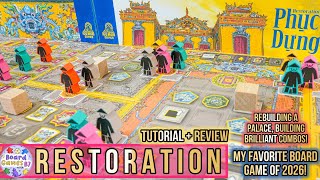
Restoration, the 2026 strategy game published by Ngự Hành Games, has drawn strong praise from the reviewer at Board Games With B7. The reviewer calls it a clever worker placement game with incredible combo potential and a thinky, tactile pace, and declares it their favorite game of the year so far. The enthusiasm centers on how many systems feed one another. Workers, the development track, reputation, construction tiles, and artisans all compete for the same limited turns, so each decision touches several parts of the board.
The criticisms are more measured. The same reviewer notes that the game runs longer than its listed playing time, that some turns slow down while players work out their best move, and that the wooden meeples are fragile. These points are presented as trade-offs rather than dealbreakers, and the reviewer says the length does not diminish their enjoyment. The overall tone is that of a hidden gem that deserves a wider international release, a wish the reviewer repeats near the end of both of their videos.
Core Mechanics That Define Restoration
Worker Placement
Worker placement drives every turn in Restoration, and the reviewer spends the most time on how it works across the shared workshop boards designed by Ton Nguyen and Manh Tran. Placing a worker on a circle in a workshop moves that workshop's production cube one step and triggers the action beneath it. If another worker already occupies the space, the newcomer pushes it out into one of the four spaces around the zone. Those displaced workers then take part in a collaborative action, which the reviewer identifies as the game's follow mechanic, letting each one either push a production cube or gain one reputation. Because every placement changes what opponents can do next, the reviewer treats choosing a spot as a question of which opportunities you hand to the other players. Cards that move or swap workers already on the board give players a way to adjust plans and avoid feeding opponents unnecessary follow actions.
Area Majority
The second pillar is area majority, which decides who gains artisans. Each workshop has zones whose yellow influence markers show how many points a placed worker contributes toward that board. The player with the most influence claims an artisan, and the player who wins the majority on the main workshop board also takes the start player token. A tie awards nothing, and a tie on the main board leaves the start player where they are. Artisans carry real costs, since each one requires a point of reputation to keep during the salary phase, but the reviewer recommends collecting many. Artisans prolong the action phase by adding workers, and each one is worth three points at the end of the game.
The Restoration Experience
The Thrill of a Combo Turn
The reviewer describes Restoration as a game where a well-timed turn feels like a puzzle coming together. The reviewer at Board Games With B7 says that a single worker placement can trigger a chain of actions, with some clever plays leading to satisfying combos. Completing an entire construction tile with one worker placement is rare, but the reviewer says it is "immensely satisfying" when it happens. That payoff comes from the way placement, production cube movement, development track bonuses, and card play interlock. Because such turns are occasional, players stay alert to combinations on the board, and the reviewer's enthusiasm for spotting them is clear throughout both videos.
A Balancing Act Under Pressure
The other recurring feeling is the strain of juggling many priorities at once. Reputation serves as the game's currency, paying for artisan salaries and for keeping workers on the board through the report phase. The reviewer says that managing resources and workforce while keeping everything else in check "can be quite the balancing act," and notes that reaching the top of the development track is a challenge when so much else is happening. Players must weigh immediate gains against long-term planning on every turn. The reviewer captures the result as a game that is tactile, thinky, and demanding, yet rewarding to play.
What Makes Restoration Stand Out
Interlocking Systems With Real Depth
The most emphasized quality is the way many scoring paths feed into one another. Completed construction tiles supply most of a player's points, while upgrade cubes placed on the player board add end game bonuses. Artisans, the first player token, manager cards held at the end, the development track, and reputation levels all contribute to the final total. The reviewer notes that the game has so many aspects to pay attention to, and that a large pool of manager cards plus event tiles that set special rules for each round keep the options changing from one game to the next. The combination makes it difficult for a single plan to dominate, which the reviewer finds especially rewarding.
Artwork That Evokes Kien Trung Palace
The illustrations receive consistent praise. The reviewer at Board Games With B7 calls the artwork gorgeous and says the illustrations across the components are mesmerizing, transporting the player to Kien Trung Palace. The theme and art complement each other, making the restoration project feel special. The game's link to the real palace adds weight to that presentation: the palace was destroyed during the war in 1947, its reconstruction began in 2019 and was completed in 2023, and it reopened to visitors in February 2024. The meeples are singled out as a highlight of the physical components.
Potential Drawbacks
Length and Downtime
The most consistent caveat concerns time. The reviewer notes that the listed playing time understates the experience, with games averaging around 25 minutes per player and a four-player game lasting roughly 90 minutes. Certain turns become very thinky as players work out the best sequence of placements, which can create downtime between turns. The reviewer says the length does not bother them, but players who prefer brisk turns should plan for a longer table commitment, particularly with four players.
Rulebook Density and Fragile Components
The second concern is the rulebook and the physical pieces. The reviewer describes the rulebook as long and a hard read, although the game itself proves easier to grasp once it is explained. On components, the reviewer calls them fairly standard and says the pieces are fragile, with some of their meeples losing a leg. The reviewer wishes the pieces were sturdier, a disappointment that stands out against the otherwise strong praise for the production.
If You Enjoy Restoration
Players who enjoy Restoration's area majority scoring will find related satisfaction in Glory Islands, a pirate-themed family game from Rio Grande Games. Board Games With B7 describes it as a game where players compete for area majorities on fully occupied islands, earning additional glory for each one they win, in the same hidden gems roundup that features Restoration. This pairing reflects shared mechanics rather than a comparison made by the reviewer.
Players who appreciate Restoration's worker placement, where every placement reshapes what opponents can do, may want to explore other worker placement designs built around shared action spaces. The link is based on the shared mechanic, not on a reviewer comparison.
What Reviewers Are Saying
"It's official. Restoration is my favorite game of the year so far, and the gameplay is absolutely brilliant and combo-tastic. This is a very thinky game with so many different aspects to pay attention to, and I absolutely love it."
— Board Games With B7
"Every time you place a worker, there are so many things to consider, and with some clever plays, you can pull off some really satisfying combos."
— Board Games With B7
"The artwork is absolutely gorgeous, and I've thoroughly enjoyed the illustrations across the various components. They're truly mesmerizing and do a wonderful job of transporting me to Kien Trung Palace."
— Board Games With B7