















































River of Gold Deep Dive
What the Community Thinks About River of Gold
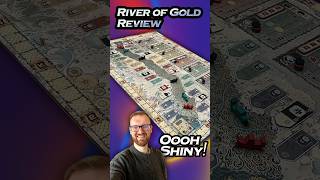
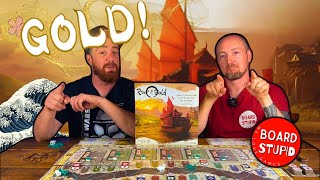
Reviewers who have actually sat down with River of Gold tend to agree on the big picture: this is a relaxed, gold-embossed mid-weight euro from designer Keith Pigot and publisher Office Dog Games, built around sailing a river, building along its banks, and delivering goods to customers. Board Stupid called it out as a straightforward relaxing euro where the choices are massive but never punishing, and The Broken Meeple awarded it a 9 out of 10, calling it one of the best games played that year. Foster the Meeple ranked it as its number two release of 2024, with one host insisting it belonged even higher on a co-host's list.
Where the channels diverge is on how much the game asks of its players and how far it pushes past its comfort zone. Board Stupid and The Broken Meeple both frame the low interaction and gentle rules as a feature for anyone burned out on heavier fare, while The Cardboard Herald's host pressed designer Keith Pigot directly on what he saw as an obvious gap: the lack of an official solo mode at launch. Paula Deming's group, playing across a long stream sponsored by Office Dog, loved the game enough to call it a personal favorite of the year, but also flagged real friction points in a single session, from a resource-starved building market to a game that wrapped up faster than the table expected. Good Time Society's preview, published ahead of general release, leaned into the game's freshness and unpredictability, praising how a new building setup keeps every session from playing the same way twice.
Core Mechanics That Define River of Gold
Rolling the Clan Die and Bending Fate with Divine Favor
Every turn in River of Gold hinges on a single die roll made at the end of the previous turn, and that roll dictates which of six river regions a player can act in next. Board Stupid summarized it plainly: your dice will determine which of the six regions down the river you get to act in, and everything else, building, sailing, or delivering, flows from that number. Before acting, players can spend Divine Favor to nudge the die value up or down, wrapping a six into a one if needed, a system Paula Deming's group likened to Castle of Burgundy in the way a single die result opens up multiple possible actions rather than locking a player into one path. Divine Favor itself is capped by a moon token on each player's board, so it has to be earned back through customers like monks rather than stockpiled freely.
Building, Sailing, and Delivering Down the River
On a turn, a player chooses to build a market tile into one of the six river regions to gain influence, sail one of two ships downriver to activate buildings along the way, or deliver a matching customer card using stockpiled trade goods. Board Stupid explained the sailing action's split reward structure: whoever sails into a building gets the benefit closest to the river, while the owner of that building collects the benefit further from the river, so every trip downriver hands out points to more than one player at once. Paula Deming's stream description matched this, noting the ultimate goal of delivering to elders, merchants, and nobles for stacking end-game bonuses, while resources and coins are hard capped, forcing players to keep spending rather than hoarding. Meeple University's teach-through confirmed the turn order of spending favor, taking one action, claiming any masteries reached, then rolling for the next turn.
The River of Gold Experience
A Relaxed, Laid-Back Euro
Across the positive reviews, the dominant word is relaxed. Board Stupid described River of Gold as a relaxing euro where the only interaction is through denial, taking a building or a region's rewards away from someone else without ever attacking them directly, and said nothing in the game feels spiteful even when players compete for the same building. The Broken Meeple echoed that read, describing the turns as smooth and the pace as quick, with downtime kept low because a player's die is known at the start of their next turn, letting them plan ahead while others play.
A Board That Fills Up and Rewards Everyone
Both Board Stupid and The Broken Meeple pointed to the way the shared board state grows more interesting as buildings pile up along the river. Board Stupid noted that as the board fills up over the course of the game, sailing into someone else's building triggers more and more little payouts for everyone involved, turning a simple move into a small cascade of rewards. The Broken Meeple framed this as the exact kind of euro interaction preferred: a board state that everyone contributes to and that in turn shapes every other player's turns, even without direct conflict. Paula Deming's group felt that tension ramp up near the end of a session, describing a nervous, excited energy as the building stacks ran low and every player scrambled for one more delivery.
What Makes River of Gold Stand Out
A Gold-Embossed, Gallery-Worthy Table Presence
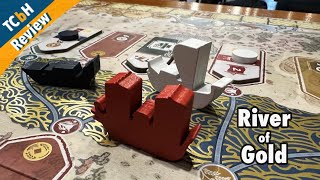
Production quality comes up in nearly every review. Foster the Meeple called the production awesome and named Office Dog Games a publisher to watch. The Broken Meeple singled out the gold embossing across the lid and board as giving the game its own unique look on the table, on top of a thin, example-heavy rulebook that gets new players into a first game quickly. Board Stupid ran through the same list, gold-inlaid board, sturdy card stock, a well-organized rulebook, and authentically Japanese artwork, before handing the production a perfect score.
Asymmetric Patrons and Multiple Paths to Score
The optional Patrons mini-expansion lets each of the four clans choose between two unique player powers, and reviewers who tried it found it added welcome texture without changing the core game. Board Stupid noted the patrons add a little asymmetry to the game without changing it very much, calling them a nice option rather than a requirement. Paula Deming's group discovered the player powers partway through their stream and immediately wanted to keep using them going forward. Scoring itself branches multiple ways, through completed customer deliveries, regional influence tracks, and public masteries, which The Broken Meeple credited with keeping the game replayable even though the underlying mechanisms are individually familiar.
Potential Drawbacks
Dice Luck and Denial-Only Interaction
Because every action is gated by a single die roll, a run of bad luck can genuinely narrow a player's options. Board Stupid pointed to a game where a string of low rolls limited them to customers and buildings in the same region turn after turn, calling it a little bit sticky even with Divine Favor available to soften it. The same review flagged that interaction stays limited to denial rather than direct conflict, which some players who want a more competitive table may find too gentle.
A Thin Theme, a Windy River, and Room to Grow
The Broken Meeple was the most direct about the game's soft spots: the Legend of the Five Rings theme, in their words, means nothing mechanically, and the winding river path split into curvy lines occasionally trips up players trying to count their movement correctly. The same review considered the variety between plays the game's one real blemish, since the pool of customer types and buildings stays largely the same from session to session, though it suggested an expansion could address that without raising the complexity much. The Cardboard Herald's host raised the missing solo mode directly with designer Keith Pigot, who confirmed a solo mode had been in development but was cut before release, leaving only a fan-made solo variant on BoardGameGeek in the meantime. Paula Deming's group also found a single session could run resource-poor when few resource-generating buildings came up, and felt the game could end before every planned delivery or objective was completed.
If You Enjoy River of Gold
Reviewers reached for a handful of specific comparisons. Paula Deming's group said the river itself acts a bit like Great Western Trail, looping players from the bottom of the track back to the top, and separately described the die-and-options structure as Castle of Burgundy-ish, naming Castle of Burgundy directly for how one roll opens up several possible moves. The Broken Meeple, burned out on some of the genre's older standbys, compared River of Gold's length and light complexity to Lords of Waterdeep and Pillars of the Earth, while explicitly recommending it as a fresher alternative to both. Board Stupid offered Iki as the natural next step up for players who like this game's medieval Japanese setting and want something with a bit more complexity from the same relaxed engine.
What Reviewers Are Saying
"Nothing in this game feels spiteful. It's a really pretty relaxed, nice flow, and I think that has quite a broad appeal to those people that like those sorts of games."
— Board Stupid
"The production is awesome. It's from Office Dog Games, who have been making some really great games. They are definitely a publisher to watch, I would say."
— Foster the Meeple
"The rules are dead simple. The rule book is nice and thin and easy to follow with good examples. You should have no trouble getting into this game, even with the player powers, it's not that complicated."
— The Broken Meeple