/pic6741520.jpg)
Imitating humans in constructing houses and large ships, tritons quickly became a trading folk, and their agricultural villages flourished on the riverbank of Ie.
Triton merchants are known for being able to provide extremely rare goods, such as dried starlight kelp seeds from Ie’s riverbed. Humans are willing to pay great sums for them, giving the triton merchants the incentive to seek them out, extract and provide to the market.
A group of tritons, which the governing order calls “Separatists”, dissatisfied with the commercial policy of their fellow citizens, began protesting, sabotaging the merchants’ trade of the sacred to them, kelp seed. Of course, there are those who seek to take advantage of the whole situation and, in secrecy, exploit both sides for their own benefit...
Riverbed Hunt is a light strategy deduction board game for 3 to 9 players.
Randomly take the role of a Merchant, Separatist, or the Profiteer.
This secret role will define your gameplay.
During your turn, perform one of your three available actions.
Dive to explore river tiles.
Swim to move around the river board.
Coop or Uncover to reveal river tiles.
In addition, you may play an ability card from your hand, to enhance your strategies.
Bring items to the surface until one of the win conditions is met.
Reveal enough Kelps and the Merchants succeed in growing their trading business with the humans.
Reveal enough Logs and the Separatists succeed in blocking this trade!
If enough Coins are revealed, the Profiteer managed to deceive everyone about his intentions, for his own profit!
—description from the publisher


Riverbed Hunt 🌊💎- How to play (with tips)

- three factions of Tritons competing to achieve their objectives and score treasures
- Hidden River
Mechanics (from transcript analysis)
- Action card system — Each player receives a set of three action cards, flip them to beige for all Stones, and choose a starting tile for their Triton meeples; players take turns selecting actions from four available on their cards.
- co-op and uncover actions — Co-op is a core action that lets players refresh, draw cards, and reveal tiles; uncover reveals a face-down tile within reach, with discard costs and tile flipping resolved in a fixed sequence.
- hidden role setup — The setup uses hidden Triton role cards (chief Merchant, separatist leader, profiteer) with other roles added to players based on the count of players, then one card dealt to each player and some dealt face down.
- Hidden Roles — The setup uses hidden Triton role cards (chief Merchant, separatist leader, profiteer) with other roles added to players based on the count of players, then one card dealt to each player and some dealt face down.
- hunt sequence and win conditions — Special hunt sequences (especially for the separatist leader and profiteer) involve flipping tiles with hunt icons and possibly continuing to hunt until a non-hunt tile appears, with a hunt penalty applied to the hunter’s team when the hunt ends.
- movement and river tiles — Movement (swim) costs steps with different costs for moving along the river and over land barriers; tiles are revealed by diving and can be manipulated via co-op and uncover actions.
- refresh and card management — Players may refresh (face-down to face-up) and/or use ability cards; at most one ability card can be played per turn, with some cards enhancing actions or disrupting other players’ resources.
- tile flipping and treasure scoring — Flipped tiles resolve icons (kelp, logs, coins) to advance resource tracks; treasures are scored as tiles are uncovered, influencing which team wins.
Video topics + discussion points
Quotes (from this video)
- This was a prototype copy of the game so the rules and components may not be final
- Co-op and uncover are the core actions of the game this is how you'll reveal tiles and score the treasures
References (from this video)
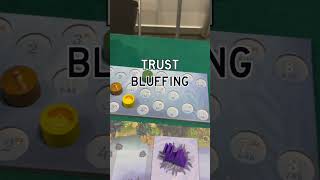
- Strong social deduction core with engaging bluffing and trust dynamics
- Tile reveal mechanic introduces meaningful risk-reward decisions
- Distinct hidden-role goals create varied player strategies
- Fresh indie publisher entry adds novelty and potential for unique design voice
- Emphasis on player interaction over heavy abstractions
- Publisher and designer details are not disclosed in the transcript
- Balance and depth may require extensive playtesting to feel polished
- Limited descriptive depth in the transcript may obscure full game complexity
- Potential accessibility concerns if the rules are dense or difficult to teach quickly
- Social deduction, bluffing, resource rivalry, and negotiation under hidden objectives.
- Riverbed setting with tiles scattered across a riverbed used to gather resources and compete for victory conditions.
- Ambiguous and player-driven; emphasis on interaction, misdirection, and timing.
Mechanics (from transcript analysis)
- bluffing and negotiation — Trust and deception drive decision-making and the timing of reveals.
- card-based actions (roll cards and ability cards) — Roll cards and ability cards grant special actions, adding an extra layer of strategic variability.
- Hidden Roles — Players have secret goals and must deduce others' roles to advance their own objective.
- hidden-role social deduction — Players have secret goals and must deduce others' roles to advance their own objective.
- Player interaction emphasis — The design centers on interaction, alliances, and shifting loyalties rather than pure engine-building.
- Positive Player Interaction — The design centers on interaction, alliances, and shifting loyalties rather than pure engine-building.
- Resource Management — Players move and peek at tiles scattered across the riverbed to collect needed resources.
- resource-centric scoring — Points are earned by successfully revealing tiles and meeting hidden objectives tied to resources.
- Simultaneous Reveal — When revealing tiles for points, a player must choose an opponent to perform the reveal, introducing trust and bluffing dynamics.
- tile discovery and resource management — Players move and peek at tiles scattered across the riverbed to collect needed resources.
- tile reveal with opponent selection — When revealing tiles for points, a player must choose an opponent to perform the reveal, introducing trust and bluffing dynamics.
Video topics + discussion points
Quotes (from this video)
- Riverbed Hunt is a social deduction strategy game where players must rely on their opponents to achieve their objectives.
- When it's time to reveal tiles for points you must choose an opponent to perform the reveal, creating trust and bluffing dynamics.
- Roll cards and ability cards introduce special actions and add excitement and surprises.
- Riverbed Hunt thrives on social deduction and the delicate balance of trusting the right person at the right time.
- Riverbed Hunt is a new game from a new and independent publisher.