




Rivet Wars: Eastern Front Deep Dive
What the Community Thinks About Rivet Wars: Eastern Front
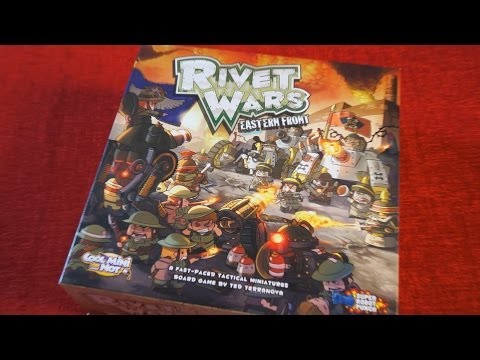
Reviewers tend to start with the physical product. The miniatures from Cool Mini or Not are described as gorgeous, and the praise extends to the sturdy boards, the beautiful tokens, and the dual-sided dashboards that keep each unit's stats within easy reach. John Carlo, Board to Death TV also pointed to the easy storage in the box and the playful nods to other geek culture in the rulebook as signs of a publisher paying attention to detail throughout.
The gameplay verdict is more divided. Reviewers see Rivet Wars as an approachable first step into miniature wargaming, but they temper that enthusiasm with concerns about faction balance and dice-driven randomness. The shared view is that the game is fun with a good group, yet it asks players to accept a fair amount of luck and a limited set of tools for shaping outcomes.
Core Mechanics That Define Rivet Wars: Eastern Front
Deployment Points, Rivets, and Objective Capture
Each round moves through a card phase, a deployment phase, a combat phase, a movement phase, and a wrap-up. During deployment, players spend deployment points and rivet points to place units and upgrades on the field. Deployment points cannot be saved from turn to turn, while rivet points are tracked on their own track and unlock certain units only after a set number of rounds. Objectives are captured by having models on them at the end of a turn, and the controlling faction keeps generating victory points until an enemy takes the marker. John Carlo, Board to Death TV walked through this sequence in detail. Ted Teranova, Board to Death TV described the game as turn-based, built around the deployment of units and counter units that respond to what the opponent is doing.
Dice Combat and the Targeting Grid Order
Combat is organized by grid. The active player activates all units in one grid, attacks into another grid within range, and cannot choose which unit takes the hit. Hits resolve in a fixed order that starts at the lower right corner of the target grid, then moves to its left, top right, and top left corners, a sequence shown on the tracking tile. Attackers roll dice matching their attack value against the defender's armor type, and each five or six is a hit. The result is then checked against the unit's health, so a unit is removed if its health is equal or lower and otherwise receives a wound marker. John Carlo, Board to Death TV noted that unit placement becomes the main tactical lever, since positioning units by armor and by which enemies can reach them determines who gets hit first.
The Rivet Wars: Eastern Front Experience
Immersive World-Building
Reviewers describe a World War I setting with steampunk touches that feels distinct from standard historical wargames. Ted Teranova summarized the look as a World War I, turn-of-the-century steampunk feel, with World War I influenced infantry alongside mono wheels, rocket cycles, artillery, and walking tanks. John Carlo, Board to Death TV credited the art in the rulebook and the flavor text with creating a unique world that immediately immerses players. A diorama by Rob Hawkins, shown at Gen Con, reinforced the same atmosphere on the table.
Approachable Intensity for Newcomers
The chibi art direction is a deliberate choice that makes the hobby less intimidating. Tom Vassel, The Dice Tower described the game as a chibi World War I game, and John Carlo, Board to Death TV noted that the style was designed on purpose to ease newcomers into the miniature genre. The rulebook is praised as a quick, well-explained read that gets players into the game fast, so the tactical tension arrives without a long learning curve.
What Makes Rivet Wars: Eastern Front Stand Out
Gorgeous Miniatures and Production Quality
The figures are the first thing reviewers mention. John Carlo praised Cool Mini or Not for making gorgeous miniatures whose style changes from game to game while keeping the same high production quality. Clear stands on the flying units let players see through them, which contributes to the dense feel of the battlefield. The quality is consistent across the box, from the miniatures to the tokens and reference boards.
Air Units Adding a Second Layer of Combat
The air units, added after a Kickstarter stretch goal, change how the battlefield works. In an interview with Ted Teranova, Watch It Played, the designer explained that air units sit on grid intersections rather than inside grids. A bomber attacks the four grids touching its intersection, and air range is measured in intersections while ground range is measured in grids. Anti-aircraft units can shoot upward, and fighters can take hero plugs that grant special abilities such as a barrel roll. The interview frames the result as a second layer of combat above the ground units, which lets planes pass over dense formations without disrupting them.
Potential Drawbacks
Faction Balance
John Carlo, Board to Death TV reported that the factions felt unbalanced in their games and hoped that future expansions would introduce new units to even things out.
Dice Randomness and Limited Manipulation
Dice remain central to outcomes. John Carlo framed the luck as the norm for miniature games, but felt it was harsher here because there are not enough in-game buffs to raise the chance of a critical hit when a player needs one. Action cards and secret mission cards add more randomness, since some are clearly stronger than others, and certain objectives can deliver easy victory points. The same reviewer suggested that seasoned miniature players may find the lack of game manipulation underwhelming, though the game appears to be aimed at a different audience.
If You Enjoy Rivet Wars: Eastern Front
Rivet Wars Reloaded is the most direct follow-up for players who want more of the same World War I miniatures combat. Tom Vassel, The Dice Tower had not yet played the newer edition when reviewing the original, but named it alongside the first game as part of the same line.
Players who want another entry point into miniature gaming should look at Wrath of Kings. In a Spitzer Ree, Board to Death TV segment filmed at Gen Con, Cool Mini or Not presented the game as a bridge from board games into miniature gaming, with rule sets that are quick and easy to understand. For a more chaotic option, the same segment showcased Chaos Ball, a four-player sports fantasy game with a draft system that is quick to learn. For a campaign-driven experience, Rodney Smith, Watch It Played described Arcadia Quest, which pits players against each other and against the game itself, with heroes who collect loot and upgrade between scenarios.
What Reviewers Are Saying
"The cute style makes it less intimidating for newcomers to the miniature genre and it's done so on purpose. Rivet Wars is a great gateway game for anyone wanting to try their hands at miniature wargaming."
— John Carlo, Board to Death TV
"This is a game that is a chibi World War I game. I don't know who was sitting around saying that would be fun, but you know what? It is fun. It's almost like a MOBA where your units keep coming and fighting back to get points."
— Tom Vassel, The Dice Tower
"I really wanted air units so bad I put the air range in there, not being sure we would have air units right away. I really wanted the game to work so that you wouldn't have the air units coming out later."
— Ted Teranova, Watch It Played