/pic2047441.jpg)
Robot Turtles is a board game for kids ages 3-8. Kids won't know it, but while they're playing, they're learning the fundamentals of programming.
Every player ("Turtle Master") takes a turtle and a matching deck of cards. Stack the cards face up on the table in piles, then build a maze for each player out of walls and a jewel. The youngest turtle master goes first, placing his first card down, then moving (or having his parent move) the turtle accordingly. As players progress, they build their program on the table; if they make a mistake, they can shout "Undo!" and debug it.
Before too long, kids figure out the secret of Robot Turtles: It lets the kids control the grown-ups! The little programmers put instruction cards down, driving the turtles through the maze, but the grown-up is the computer, executing commands on the board. At its heart, Robot Turtles is a game about bossing around adults, just like programming is about bossing around computers.

Robot Turtles Review!
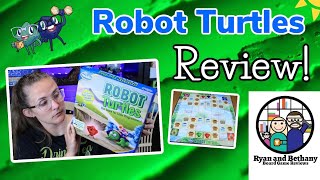
- Effective for teaching basic programming concepts to kids
- Cooperative play with adjustable difficulty and player leveling
- Engaging, with playful sounds and physical actions
- Flowers on cards help orientation and reduce confusion
- Scalable complexity through added rules and components
- Not the commenters' favorite family game
- Can feel dated compared to newer family games
- Requires active parental participation for instruction and pacing
- teaching basic programming concepts through card-based action sequencing
- family game night / classroom-styled setup featuring turtle tokens and a grid-based board
- cooperative, educational, light-hearted with parental facilitation
Mechanics (from transcript analysis)
- Bug / reset mechanic — Upsets require resetting or undoing moves to fix mistakes
- Card-driven actions — Players use action cards to control turtle movement (move forward, turn, etc.)
- Cooperative Game — Players work together to guide all turtles to their goals
- cooperative play — Players work together to guide all turtles to their goals
- Function cards — Grouping repeated actions into a function to simplify sequences
- Multi-Use Cards — Grouping repeated actions into a function to simplify sequences
- Neighbor Interaction — Pushing boxes and melting ice castles with lasers to clear paths
- Obstacle interaction — Pushing boxes and melting ice castles with lasers to clear paths
- Programming — Early play involves laying out all cards before executing them
- Score-and-Reset — Upsets require resetting or undoing moves to fix mistakes
- Sequencing ahead — Early play involves laying out all cards before executing them
- Tokens and goals — Race-like objective where turtles reach their gyms
- variable difficulty — Additional rules (lasers, permanent obstacles) to increase challenge
Video topics + discussion points
Quotes (from this video)
- there is no losing conditions in this game
- it's very important to be very serious about this whole thing
- the function frog sounds
- you can level it to the player
- flowers on the cards help orientation