

Rosetta: The Lost Language Deep Dive
What the Community Thinks About Rosetta: The Lost Language
Rosetta: The Lost Language is a 2020 party game from Story Machine Games, listed for 2 to 5 players, with a playing time of about 25 minutes and an age rating of 8 and up. Its light weight belies the demands it places on the table. Reviewers consistently frame it as a short game that asks players to think in unfamiliar ways, with the cooperative premise of experts decoding an author's invented script serving as the hook.
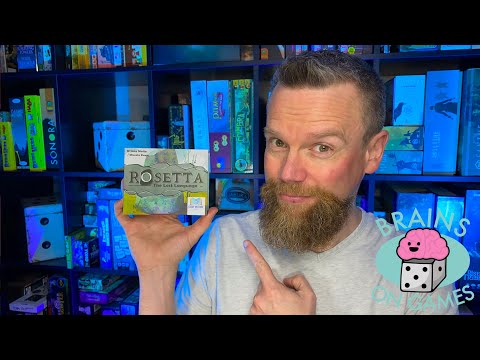
Brains On Games offers the most detailed take. The host, Dr. Brian McDonald, opens by calling it probably the game that requires more creativity than just about any game reviewed on the channel, and returns to that idea throughout the episode. McDonald praises the artwork on the location cards, describes the translation step as a genuine exercise in abstract thinking, and notes that the game becomes easier for both roles once a group has a few sessions behind it.
Getting Games approaches the game from a deduction angle. The host describes it as a fully cooperative game built around one player acting as the Rosetta Stone for the rest of the group, and reports having played it a couple of times before recording these thoughts. The coverage is more preview than verdict, which suggests the game left the host curious rather than settled.
The Dice Tower discusses Rosetta only briefly, in a news segment about a new edition from DVC Games. The hosts admit they are unsure whether they have played the original, and their remarks focus on the clue-giving structure rather than on how the game feels at the table. Their mention is useful mainly as evidence that the title is returning to shelves in a new production. Taken together, the coverage paints a picture of a clever, quick game whose appeal lies in its creative demands rather than in its component count or rules complexity.
Core Mechanics That Define Rosetta: The Lost Language
The Author's Symbolic Translation
Reviewers focus most closely on the author role. One player draws an inscription card and a location card, then writes a meaning on a wipe-off card that links the symbols to the artwork. Brains On Games stresses that the meaning cannot simply be a spelled-out letter or something already visible in the location picture. The translation has to be symbolic, which is exactly where the creativity and abstract thinking come in. McDonald describes working through a winter-scene location and a stack of fishing and kitchen imagery before settling on a word for the inscription, underscoring how open-ended that choice feels.
Expert Guesses, Hints, and Fragments
The expert side runs on a set of guess cards that the group can divide up or share, with a verbal guess available as well. Experts do not simply guess the meaning. They write a word on the card and the author must respond, either by drawing symbols that translate it or by crossing it out. Ability cards add structure. Experts can ask yes or no questions, or the author can offer an adjective that describes the meaning, and the Brains On Games host notes that choosing a good adjective is harder than it sounds. A later reveal of a fragment from the inscription gives the group a concrete foothold, and the episode shows how that single clue can suddenly make the whole design click. The turning point in the video comes when a player connects an oven symbol to a meal, then to a larger idea, and the group solves the inscription in just a few more guesses.
The Rosetta Experience
A Learning Curve That Pays Off
Brains On Games describes the early rounds as slow going. McDonald admits to taking a while to think through the first translation, and suggests the experience improves quickly with practice. That observation matters because Rosetta is short enough to replay several times in an evening. Sessions that run around fifteen minutes, as timed on Brains On Games, let groups build familiarity without committing to a long night, and the learning curve becomes part of the fun rather than a barrier.
Creativity Over Component Weight
The feel of Rosetta is defined by conversation rather than by a heavy rules load. The cards are wipe-off, the artwork is praised as strong, and the game lives in the back-and-forth between author and experts. Reviewers describe a table where the best moments come from unexpected connections, such as a navigation clue turning into a fishing picture or a pizza guess leading to a drawn oven. Those moments are where the game earns its reputation as a creativity exercise, and they are what makes it stand out in a light party game category.
What Makes Rosetta Stand Out
A Genuinely Original Creative Exercise
Brains On Games singles out the symbolic translation step as unlike anything else in the party game space, calling it among the most creativity-demanding designs the channel has covered. The requirement that an author's clue never simply spell out a word or copy the artwork forces a kind of lateral thinking that reviewers say is rare even among party games built around guessing.
Strong Artwork Doing Real Work
The location card artwork is not just decoration. Brains On Games praises it directly, and the design leans on it as the shared vocabulary the author and experts use to build and decode meaning. Reviewers treat the art quality as functional rather than cosmetic, since a richer picture gives the author more symbolic options to draw from.
Potential Drawbacks
A Slow First Session
Brains On Games is candid that the opening rounds can drag while new players get used to thinking symbolically rather than literally. McDonald's own admission to needing extra time on an early translation suggests the learning curve, while rewarding, is a real barrier for a first-time group expecting an easy filler game.
Success Depends on Reading Another Player's Logic
Because the author's symbolic choices are personal, success leans heavily on a group's ability to think the way a specific teammate thinks. Getting Games frames the game as a deduction exercise for exactly this reason, and groups that do not click on that wavelength may find the guessing frustrating rather than clever.
If You Enjoy Rosetta: The Lost Language
Rosetta suits groups that enjoy word games, drawing, and open-ended puzzles, especially families with older children or friends who like quick games that reward lateral thinking. Brains On Games notes that the game is accessible to players as young as eight, and its short runtime makes it a good filler or warm-up. Players who want a heavy strategy experience, or who dislike games where success depends on guessing another person's private logic, will likely find it frustrating. For everyone else, the reviews point to a compact, clever game that gets better with each session and rewards players willing to think outside the box.
What Reviewers Are Saying
"now this is a fully cooperative deduction style game where one player is essentially the Rosetta Stone that helps the other players in the game convert"
— Getting Games
"You're giving clues to guess a word, and I don't remember if I played this or not."
— The Dice Tower
"one thing that i found about this game is that it gets easier both for the author and for the experts to play once they've played it a couple of times"
— Brains On Games